QUESTION IMAGE
Question
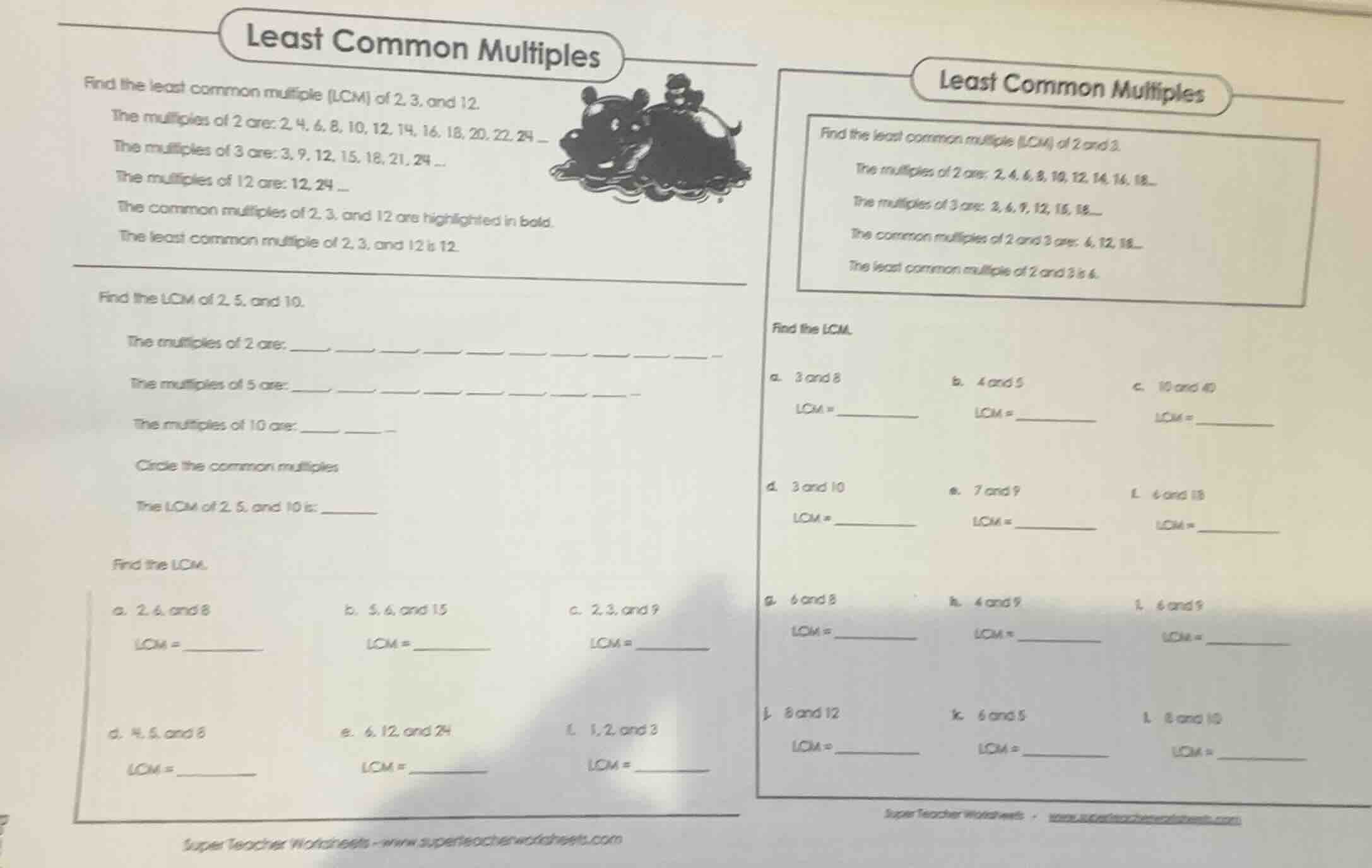
least common multiples
find the least common multiple (lcm) of 2, 3, and 12.
the multiples of 2 are: 2, 4, 6, 8, 10, 12, 14, 16, 18, 20, 22, 24...
the multiples of 3 are: 3, 6, 9, 12, 15, 18, 21, 24...
the multiples of 12 are: 12, 24...
the common multiples of 2, 3, and 12 are highlighted in bold.
the least common multiple of 2, 3, and 12 is 12.
find the lcm of 2, 5, and 10.
the multiples of 2 are: ______
the multiples of 5 are: ______
the multiples of 10 are: ______
circle the common multiples.
the lcm of 2, 5, and 10 is: ______
find the lcm.
a. 2, 6, and 8
lcm = ______
b. 5, 6, and 15
lcm = ______
c. 2, 3, and 9
lcm = ______
d. 4, 5, and 8
lcm = ______
e. 6, 12, and 24
lcm = ______
f. 1, 2, and 3
lcm = ______
least common multiples
find the least common multiple (lcm) of 2 and 3.
the multiples of 2 are: 2, 4, 6, 8, 10, 12, 14, 16, 18...
the multiples of 3 are: 3, 6, 9, 12, 15, 18...
the common multiples of 2 and 3 are: 6, 12, 18...
the least common multiple of 2 and 3 is 6.
find the lcm.
a. 3 and 8
lcm = ______
b. 4 and 5
lcm = ______
c. 10 and 40
lcm = ______
d. 3 and 10
lcm = ______
e. 7 and 9
lcm = ______
f. 6 and 18
lcm = ______
g. 6 and 8
lcm = ______
h. 4 and 9
lcm = ______
i. 6 and 9
lcm = ______
j. 8 and 12
lcm = ______
k. 6 and 5
lcm = ______
l. 8 and 10
lcm = ______
🆕 New Concept Discovered: Least Common Multiple (LCM)
The smallest positive integer shared as a multiple by two or more numbers.
---
Step 1: Find the LCM of 2, 5, and 10
Let's list the multiples of each number to find the smallest one they all share:
- Multiples of 2: \(2, 4, 6, 8, 10, 12, 14, 16, 18, 20, \dots\)
- Multiples of 5: \(5, 10, 15, 20, 25, \dots\)
- Multiples of 10: \(10, 20, 30, \dots\)
The smallest number that appears in all three lists is 10.
---
Step 2: Find the LCM (Left Page - Bottom Section)
We find the smallest common multiple for each group of three numbers:
- a. 2, 6, and 8
- Multiples of 2: \(2, 4, 6, 8, 10, 12, 14, 16, 18, 20, 22, 24, \dots\)
- Multiples of 6: \(6, 12, 18, 24, 30, \dots\)
- Multiples of 8: \(8, 16, 24, 32, \dots\)
- \(\text{LCM} = 24\)
- b. 5, 6, and 15
- Multiples of 5: \(5, 10, 15, 20, 25, 30, \dots\)
- Multiples of 6: \(6, 12, 18, 24, 30, \dots\)
- Multiples of 15: \(15, 30, 45, \dots\)
- \(\text{LCM} = 30\)
- c. 2, 3, and 9
- Multiples of 2: \(2, 4, 6, 8, 10, 12, 14, 16, 18, \dots\)
- Multiples of 3: \(3, 6, 9, 12, 15, 18, \dots\)
- Multiples of 9: \(9, 18, 27, \dots\)
- \(\text{LCM} = 18\)
- d. 4, 5, and 8
- Multiples of 4: \(4, 8, 12, 16, 20, 24, 28, 32, 36, 40, \dots\)
- Multiples of 5: \(5, 10, 15, 20, 25, 30, 35, 40, \dots\)
- Multiples of 8: \(8, 16, 24, 32, 40, \dots\)
- \(\text{LCM} = 40\)
- e. 6, 12, and 24
- Since 24 is a multiple of both 6 and 12, the smallest common multiple is 24.
- \(\text{LCM} = 24\)
- f. 1, 2, and 3
- Multiples of 1: \(1, 2, 3, 4, 5, 6, \dots\)
- Multiples of 2: \(2, 4, 6, \dots\)
- Multiples of 3: \(3, 6, \dots\)
- \(\text{LCM} = 6\)
---
Step 3: Find the LCM (Right Page)
We find the smallest common multiple for each pair of numbers:
- a. 3 and 8
- Multiples of 3: \(3, 6, 9, 12, 15, 18, 21, 24, \dots\)
- Multiples of 8: \(8, 16, 24, \dots\)
- \(\text{LCM} = 24\)
- b. 4 and 5
- Multiples of 4: \(4, 8, 12, 16, 20, \dots\)
- Multiples of 5: \(5, 10, 15, 20, \dots\)
- \(\text{LCM} = 20\)
- c. 10 and 40
- Since 40 is a multiple of 10, the smallest common multiple is 40.
- \(\text{LCM} = 40\)
- d. 3 and 10
- Multiples of 3: \(3, 6, \dots, 27, 30, \dots\)
- Multiples of 10: \(10, 20, 30, \dots\)
- \(\text{LCM} = 30\)
- e. 7 and 9
- Since 7 and 9 share no common factors, their LCM is their product: \(7 \times 9 = 63\).
- \(\text{LCM} = 63\)
- f. 6 and 18
- Since 18 is a multiple of 6, the smallest common multiple is 18.
- \(\text{LCM} = 18\)
- g. 6 and 8
- Multiples of 6: \(6, 12, 18, 24, \dots\)
- Multiples of 8: \(8, 16, 24, \dots\)
- \(\text{LCM} = 24\)
- h. 4 and 9
- Multiples of 4: \(4, 8, 12, 16, 20, 24, 28, 32, 36, \dots\)
- Multiples of 9: \(9, 18, 27, 36, \dots\)
- \(\text{LCM} = 36\)
- i. 6 and 9
- Multiples of 6: \(6, 12, 18, 24, \dots\)
- Multiples of 9: \(9, 18, 27, \dots\)
- \(\text{LCM} = 18\)
- j. 8 and 12
- Multiples of 8: \(8, 16, 24, 32, \dots\)
- Multiples of 12: \(12, 24, 36, \dots\)
- \(\text{LCM} = 24\)
- k. 6 and 5
- Multiples of 6: \(6, 12, 18, 24, 30, \dots\)
- Multiples of 5: \(5, 10, 15, 20, 25, 30, \dots\)
- \(\text{LCM} = 30\)
- l. 8 and 10
- Multiples of 8:…

Snap & solve any problem in the app
Get step-by-step solutions on Sovi AI
Photo-based solutions with guided steps
Explore more problems and detailed explanations
Left Page:
- Find the LCM of 2, 5, and 10:
- Multiples of 2: 2, 4, 6, 8, 10, 12, 14, 16, 18, 20
- Multiples of 5: 5, 10, 15, 20
- Multiples of 10: 10, 20
- The LCM of 2, 5, and 10 is: 10
- Find the LCM (Bottom Section):
- a. LCM = 24
- b. LCM = 30
- c. LCM = 18
- d. LCM = 40
- e. LCM = 24
- f. LCM = 6
Right Page:
- a. LCM = 24
- b. LCM = 20
- c. LCM = 40
- d. LCM = 30
- e. LCM = 63
- f. LCM = 18
- g. LCM = 24
- h. LCM = 36
- i. LCM = 18
- j. LCM = 24
- k. LCM = 30
- l. LCM = 40