QUESTION IMAGE
Question
learning activity 2.2: consequences of breaking a rule in the education (school attendance) regulations
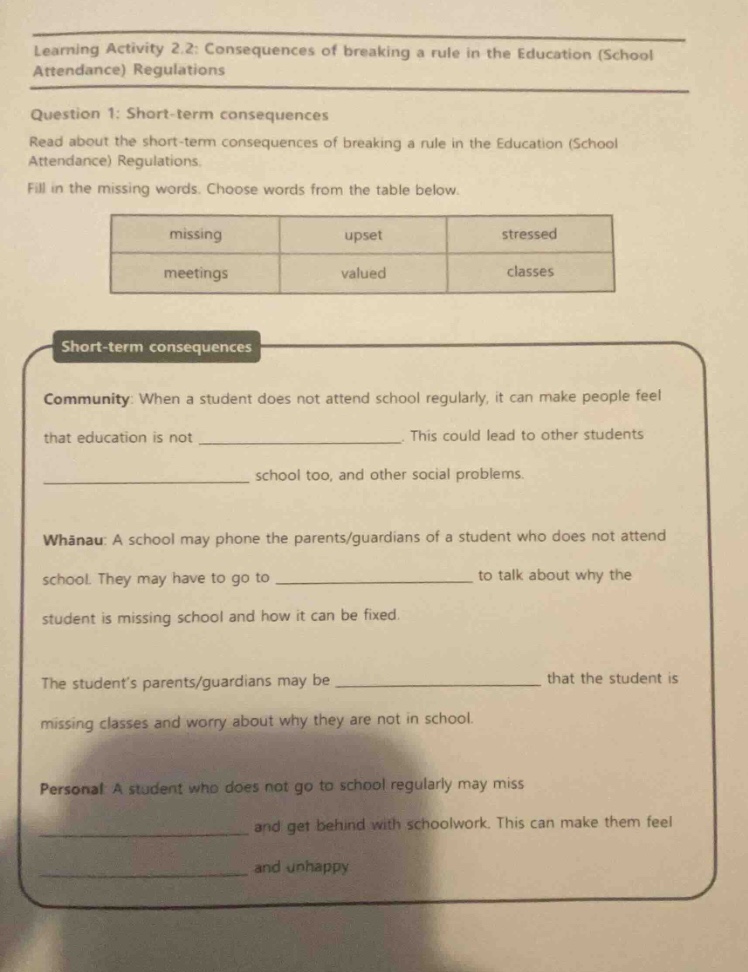
question 1: short-term consequences
read about the short-term consequences of breaking a rule in the education (school attendance) regulations.
fill in the missing words. choose words from the table below.
| missing | upset | stressed |
| meetings | valued | classes |
short-term consequences
community: when a student does not attend school regularly, it can make people feel that education is not _____. this could lead to other students _____ school too, and other social problems.
whānau: a school may phone the parents/guardians of a student who does not attend school. they may have to go to _______ to talk about why the student is missing school and how it can be fixed.
the students parents/guardians may be _______ that the student is missing classes and worry about why they are not in school.
personal: a student who does not go to school regularly may miss _____ and get behind with schoolwork. this can make them feel _____ and unhappy.
Analyze the context for Community
The first paragraph discusses how irregular school attendance affects the community.
- "...it can make people feel that education is not [blank]." Looking at the word bank (missing, upset, stressed, meetings, valued, classes), "valued" fits grammatically and semantically.
- "This could lead to other students [blank] school too..." The verb form "missing" fits perfectly here to describe the action of not attending.
Analyze the context for Whānau
The second paragraph discusses the impact on the family (Whānau).
- "They may have to go to [blank] to talk about why..." Parents go to "meetings" at school to discuss attendance issues.
- "The student's parents/guardians may be [blank] that the student is missing..." The emotion that fits parents worrying is "upset".
Analyze the context for Personal
The third paragraph discusses the personal impact on the student.
- "A student who does not go to school regularly may miss [blank] and get behind..." Students attend "classes", so missing them causes them to get behind.
- "This can make them feel [blank] and unhappy." The remaining emotional state from the word bank is "stressed".

Snap & solve any problem in the app
Get step-by-step solutions on Sovi AI
Photo-based solutions with guided steps
Explore more problems and detailed explanations
Community: When a student does not attend school regularly, it can make people feel that education is not <blank>valued</blank>. This could lead to other students <blank>missing</blank> school too, and other social problems.
Whānau: A school may phone the parents/guardians of a student who does not attend school. They may have to go to <blank>meetings</blank> to talk about why the student is missing school and how it can be fixed.
The student's parents/guardians may be <blank>upset</blank> that the student is missing classes and worry about why they are not in school.
Personal: A student who does not go to school regularly may miss <blank>classes</blank> and get behind with schoolwork. This can make them feel <blank>stressed</blank> and unhappy.