Sovi.AI - AI Math Tutor

Scan to solve math questions

QUESTION IMAGE

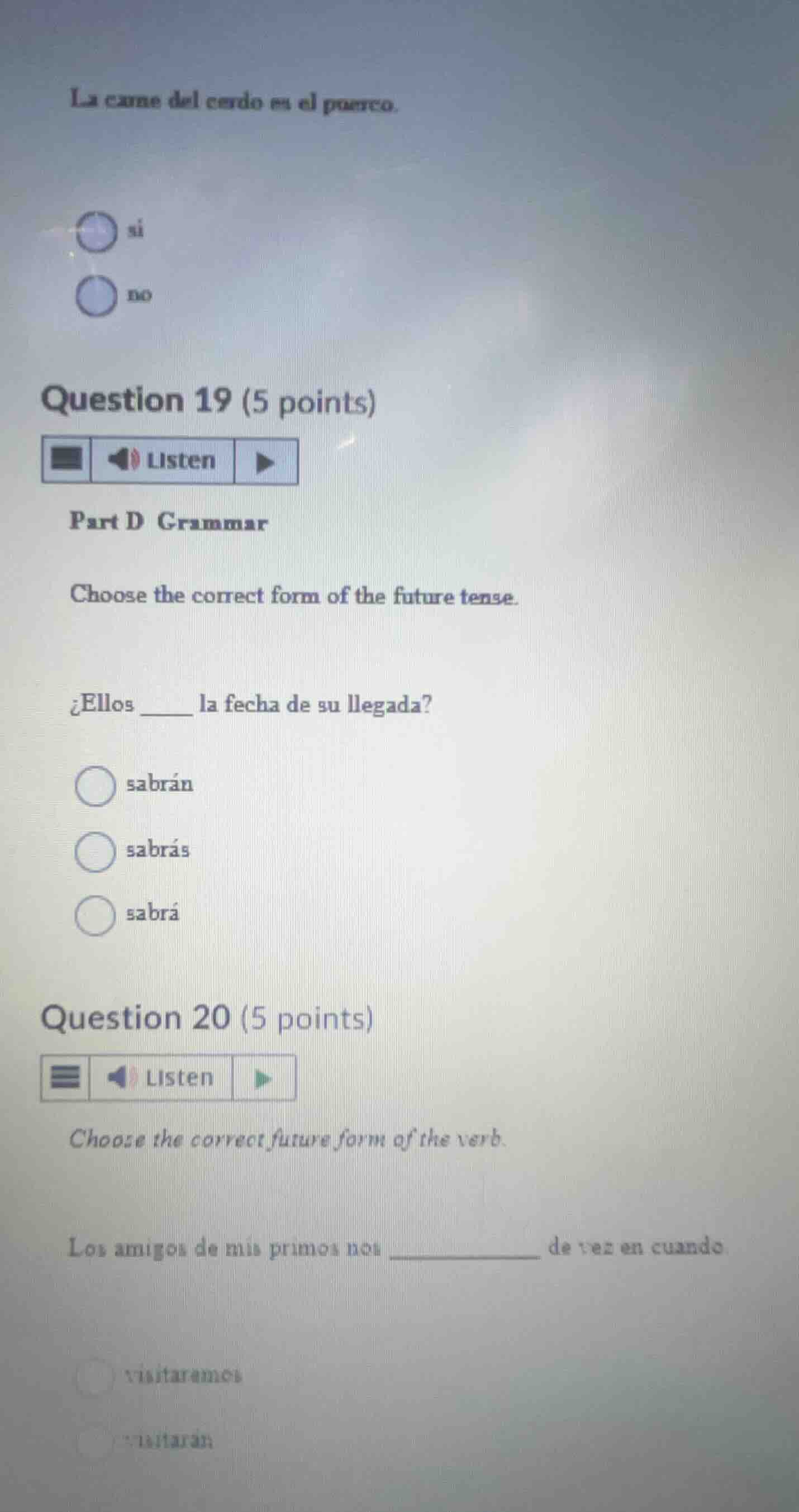
la carne del cerdo es el puerco. si no question 19 (5 points) part d gr…

Question

la carne del cerdo es el puerco.

si
no

question 19 (5 points)
part d grammar
choose the correct form of the future tense.

¿ellos ___ la fecha de su llegada?

sabrán
sabrás
sabrá

question 20 (5 points)
choose the correct future form of the verb.

los amigos de mis primos nos ___ de vez en cuando.

visitaramos
visitarán

Explanation:

Response

<pre_analysis>
{
"quality": "clear",
"question_count": 3,
"skills_matched": [
"direct_cot",
"multiple_choice_formatter",
"explain_then_answer",
"quick"
],
"needs_drawing": false,
"concepts_used": [],
"new_concepts": [
"Spanish Future Tense",
"Spanish Verb Conjugation"
],
"current_concepts": [
"Spanish Vocabulary",
"Spanish Future Tense",
"Spanish Verb Conjugation"
]
}
</pre_analysis>

<reasoning>

Analyze the true/false statement

The statement is "La carne del cerdo es el puerco" (The meat of the pig is pork). In Spanish, "cerdo" refers to the animal (pig), and its meat is indeed called "puerco" (or "carne de cerdo"). Therefore, the statement is true ("sí").

Conjugate saber for Question 19

The subject is "Ellos" (they). The verb is "saber" (to know information). The future tense stem for "saber" is irregular: "sabr-". The ending for "ellos" in the future tense is "-án". Combining them gives "sabrán".

Conjugate visitar for Question 20

The subject is "Los amigos de mis primos" (The friends of my cousins), which corresponds to the third-person plural pronoun "ellos" (they). The verb is "visitar" (to visit). The future tense ending for "-ar" verbs with "ellos" is "-arán". Combining the infinitive "visitar" with "-án" gives "visitarán".
</reasoning>

<answer>

Question 1

<mcq-correct>sí</mcq-correct>
<mcq-option>no</mcq-option>

Question 19

<mcq-correct>sabrán</mcq-correct>
<mcq-option>sabrás</mcq-option>
<mcq-option>sabrá</mcq-option>

Question 20

<mcq-option>visitaremos</mcq-option>
<mcq-correct>visitarán</mcq-correct>
</answer>

<post_analysis>
{
"subject": "Others",
"question_type": "Multiple Choice",
"knowledge_point": [
"Others",
"Spanish",
"Spanish Future Tense"
]
}
</post_analysis>

Answer:

<pre_analysis>
{
"quality": "clear",
"question_count": 3,
"skills_matched": [
"direct_cot",
"multiple_choice_formatter",
"explain_then_answer",
"quick"
],
"needs_drawing": false,
"concepts_used": [],
"new_concepts": [
"Spanish Future Tense",
"Spanish Verb Conjugation"
],
"current_concepts": [
"Spanish Vocabulary",
"Spanish Future Tense",
"Spanish Verb Conjugation"
]
}
</pre_analysis>

<reasoning>

Analyze the true/false statement

The statement is "La carne del cerdo es el puerco" (The meat of the pig is pork). In Spanish, "cerdo" refers to the animal (pig), and its meat is indeed called "puerco" (or "carne de cerdo"). Therefore, the statement is true ("sí").

Conjugate saber for Question 19

The subject is "Ellos" (they). The verb is "saber" (to know information). The future tense stem for "saber" is irregular: "sabr-". The ending for "ellos" in the future tense is "-án". Combining them gives "sabrán".

Conjugate visitar for Question 20

The subject is "Los amigos de mis primos" (The friends of my cousins), which corresponds to the third-person plural pronoun "ellos" (they). The verb is "visitar" (to visit). The future tense ending for "-ar" verbs with "ellos" is "-arán". Combining the infinitive "visitar" with "-án" gives "visitarán".
</reasoning>

<answer>

Question 1

<mcq-correct>sí</mcq-correct>
<mcq-option>no</mcq-option>

Question 19

<mcq-correct>sabrán</mcq-correct>
<mcq-option>sabrás</mcq-option>
<mcq-option>sabrá</mcq-option>

Question 20

<mcq-option>visitaremos</mcq-option>
<mcq-correct>visitarán</mcq-correct>
</answer>

<post_analysis>
{
"subject": "Others",
"question_type": "Multiple Choice",
"knowledge_point": [
"Others",
"Spanish",
"Spanish Future Tense"
]
}
</post_analysis>