Sovi.AI - AI Math Tutor

Scan to solve math questions

QUESTION IMAGE

kevin is participating in a group discussion about teens and technology…

Question

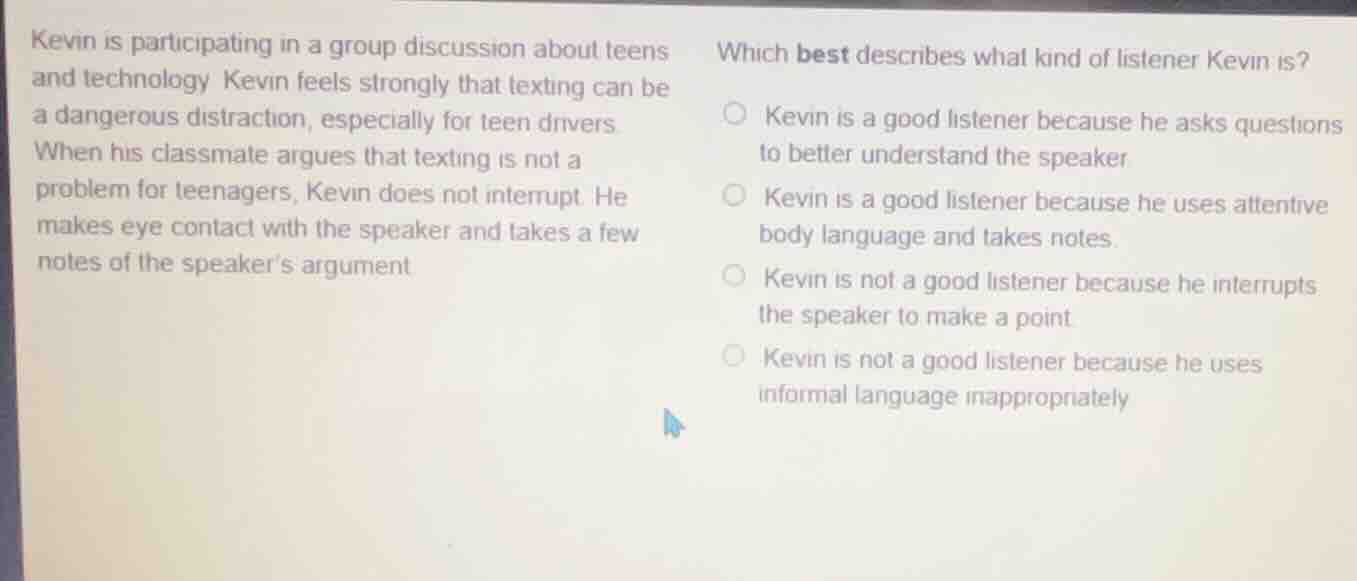
kevin is participating in a group discussion about teens and technology. kevin feels strongly that texting can be a dangerous distraction, especially for teen drivers. when his classmate argues that texting is not a problem for teenagers, kevin does not interrupt. he makes eye contact with the speaker and takes a few notes of the speakers argument.

which best describes what kind of listener kevin is?

kevin is a good listener because he asks questions to better understand the speaker.
kevin is a good listener because he uses attentive body language and takes notes.
kevin is not a good listener because he interrupts the speaker to make a point.
kevin is not a good listener because he uses informal language inappropriately.

Explanation:

Response

<pre_analysis>
{
"quality": "clear",
"question_count": 1,
"skills_matched": [
"direct_cot",
"multiple_choice_formatter",
"explain_then_answer",
"tutor"
],
"needs_drawing": false,
"concepts_used": [
"Active Listening",
"Discussion Etiquette"
],
"new_concepts": [],
"current_concepts": [
"Active Listening",
"Discussion Etiquette",
"Group Discussion"
]
}
</pre_analysis>

<reasoning>

Analyze Kevin's actions in the scenario

The text states that Kevin is participating in a group discussion. When a classmate argues a point that contradicts Kevin's strong beliefs, Kevin:

  1. Does not interrupt the speaker.
  2. Makes eye contact with the speaker.
  3. Takes a few notes of the speaker's argument.

These actions demonstrate respectful Discussion Etiquette and positive nonverbal engagement.

Evaluate the characteristics of active listening

Using the Active Listening concept, we know that key components of being a good listener include:

  • Maintaining eye contact to show engagement.
  • Taking notes to capture the speaker's points.
  • Refraining from interrupting, even when disagreeing.

Kevin's behaviors directly align with these positive traits.

Assess the given multiple-choice options

  • Option 1: "Kevin is a good listener because he asks questions to better understand the speaker." -> Incorrect, as the text does not mention him asking questions.
  • Option 2: "Kevin is a good listener because he uses attentive body language and takes notes." -> Correct, as eye contact is attentive body language, and he explicitly takes notes.
  • Option 3: "Kevin is not a good listener because he interrupts..." -> Incorrect, the text states he does not interrupt.
  • Option 4: "Kevin is not a good listener because he uses informal language..." -> Incorrect, there is no mention of him using inappropriate informal language.

</reasoning>

<answer>
<mcq-option>(A) Kevin is a good listener because he asks questions to better understand the speaker.</mcq-option>
<mcq-correct>(B) Kevin is a good listener because he uses attentive body language and takes notes.</mcq-correct>
<mcq-option>(C) Kevin is not a good listener because he interrupts the speaker to make a point.</mcq-option>
<mcq-option>(D) Kevin is not a good listener because he uses informal language inappropriately.</mcq-option>
</answer>

<post_analysis>
{
"subject": "Others",
"question_type": "Multiple Choice",
"knowledge_point": [
"Others",
"Communication Skills",
"Active Listening"
]
}
</post_analysis>

Answer:

<pre_analysis>
{
"quality": "clear",
"question_count": 1,
"skills_matched": [
"direct_cot",
"multiple_choice_formatter",
"explain_then_answer",
"tutor"
],
"needs_drawing": false,
"concepts_used": [
"Active Listening",
"Discussion Etiquette"
],
"new_concepts": [],
"current_concepts": [
"Active Listening",
"Discussion Etiquette",
"Group Discussion"
]
}
</pre_analysis>

<reasoning>

Analyze Kevin's actions in the scenario

The text states that Kevin is participating in a group discussion. When a classmate argues a point that contradicts Kevin's strong beliefs, Kevin:

  1. Does not interrupt the speaker.
  2. Makes eye contact with the speaker.
  3. Takes a few notes of the speaker's argument.

These actions demonstrate respectful Discussion Etiquette and positive nonverbal engagement.

Evaluate the characteristics of active listening

Using the Active Listening concept, we know that key components of being a good listener include:

  • Maintaining eye contact to show engagement.
  • Taking notes to capture the speaker's points.
  • Refraining from interrupting, even when disagreeing.

Kevin's behaviors directly align with these positive traits.

Assess the given multiple-choice options

  • Option 1: "Kevin is a good listener because he asks questions to better understand the speaker." -> Incorrect, as the text does not mention him asking questions.
  • Option 2: "Kevin is a good listener because he uses attentive body language and takes notes." -> Correct, as eye contact is attentive body language, and he explicitly takes notes.
  • Option 3: "Kevin is not a good listener because he interrupts..." -> Incorrect, the text states he does not interrupt.
  • Option 4: "Kevin is not a good listener because he uses informal language..." -> Incorrect, there is no mention of him using inappropriate informal language.

</reasoning>

<answer>
<mcq-option>(A) Kevin is a good listener because he asks questions to better understand the speaker.</mcq-option>
<mcq-correct>(B) Kevin is a good listener because he uses attentive body language and takes notes.</mcq-correct>
<mcq-option>(C) Kevin is not a good listener because he interrupts the speaker to make a point.</mcq-option>
<mcq-option>(D) Kevin is not a good listener because he uses informal language inappropriately.</mcq-option>
</answer>

<post_analysis>
{
"subject": "Others",
"question_type": "Multiple Choice",
"knowledge_point": [
"Others",
"Communication Skills",
"Active Listening"
]
}
</post_analysis>