QUESTION IMAGE
Question
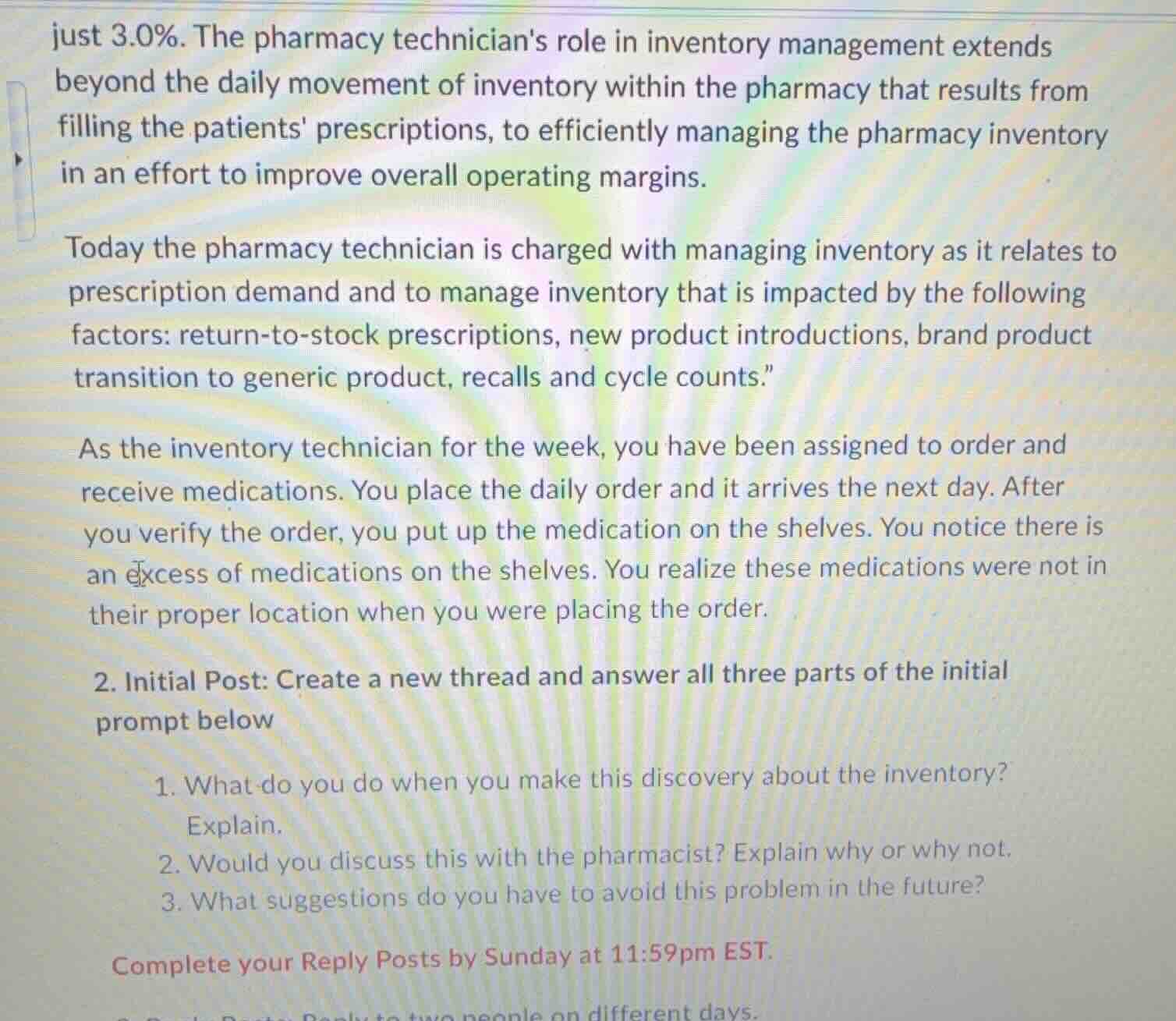
just 3.0%. the pharmacy technicians role in inventory management extends beyond the daily movement of inventory within the pharmacy that results from filling the patients prescriptions, to efficiently managing the pharmacy inventory in an effort to improve overall operating margins.
today the pharmacy technician is charged with managing inventory as it relates to prescription demand and to manage inventory that is impacted by the following factors: return-to-stock prescriptions, new product introductions, brand product transition to generic product, recalls and cycle counts.\
as the inventory technician for the week, you have been assigned to order and receive medications. you place the daily order and it arrives the next day. after you verify the order, you put up the medication on the shelves. you notice there is an excess of medications on the shelves. you realize these medications were not in their proper location when you were placing the order.
- initial post: create a new thread and answer all three parts of the initial prompt below
- what do you do when you make this discovery about the inventory? explain.
- would you discuss this with the pharmacist? explain why or why not.
- what suggestions do you have to avoid this problem in the future?
Identify inventory issues
Upon discovering that medications were misplaced on the shelves, leading to an unnecessary over-order, the immediate priority is to correct the physical inventory and assess the financial/operational impact. This directly relates to Pharmacy Inventory Management. First, locate all misplaced stock and return them to their designated, correct shelf locations. Second, perform a physical count to determine the exact quantity of excess stock. Third, check the expiration dates and apply Stock Rotation principles (placing shorter-dated stock in front) to ensure the excess is used first. Finally, evaluate if the excess stock can be returned to the distributor under the pharmacy's return policy to avoid tying up capital.
Determine communication protocol
Discussing this discovery with the pharmacist-in-charge is essential. In a pharmacy setting, the pharmacist is ultimately responsible for the operational budget, inventory costs, and overall workflow efficiency. Informing the pharmacist ensures transparency regarding why there is a sudden surplus of inventory and allows them to approve any potential inventory returns to the wholesaler. It also helps the pharmacist understand potential workflow bottlenecks or training needs among the staff.
Formulate preventive measures
To prevent misplaced inventory and subsequent over-ordering in the future, several systematic strategies should be implemented:
- Shelf Organization: Ensure clear, highly visible shelf labels, utilizing "tall-man lettering" for look-alike/sound-alike (LASA) medications.
- Pre-Order Verification: Before placing any daily order, perform a quick physical shelf scan (or "shelf-read") of the specific areas to verify that the system's inventory count matches the physical stock.
- Staff Training: Conduct regular training sessions for all technicians on the importance of putting away stock in its exact designated location immediately upon receipt.
- Cycle Counts: Implement regular, scheduled cycle counts for high-volume or high-cost medications to catch placement errors early.

Snap & solve any problem in the app
Get step-by-step solutions on Sovi AI
Photo-based solutions with guided steps
Explore more problems and detailed explanations
Question 1
When discovering that misplaced medications led to an over-order, you should take the following steps:
- Relocate Stock: Immediately move the misplaced medications back to their correct, designated shelf locations.
- Assess and Rotate: Count the total inventory now on hand. Apply Stock Rotation by placing the earliest-expiring bottles at the front of the shelf so they are dispensed first.
- Evaluate Returns: Check if the excess unopened medication can be returned to the prime vendor/wholesaler for credit, minimizing unnecessary holding costs and optimizing Pharmacy Inventory Management.
Question 2
Yes, you should absolutely discuss this with the pharmacist.
- Why: The pharmacist is responsible for the pharmacy's operational budget and overall inventory metrics. Informing them explains the temporary surplus of stock, allows them to authorize any wholesale returns, and helps identify if there is a systemic training issue or workflow bottleneck among the staff putting away daily orders.
Question 3
To avoid this problem in the future, implement these suggestions:
- Pre-Order Shelf Checks: Perform a quick physical shelf-read of the specific medication slots before finalizing the daily order to verify that the on-hand stock matches the computer inventory.
- Enhanced Labeling: Use clear, color-coded shelf labels and "tall-man lettering" for look-alike/sound-alike medications to minimize placement errors.
- Staff Training and Audits: Train all staff on strict placement protocols and establish routine cycle counts to catch misplaced items before ordering cycles occur.