Sovi.AI - AI Math Tutor

Scan to solve math questions

QUESTION IMAGE

jim and jennifer have excellent credit, and they purchased property wit…

Question

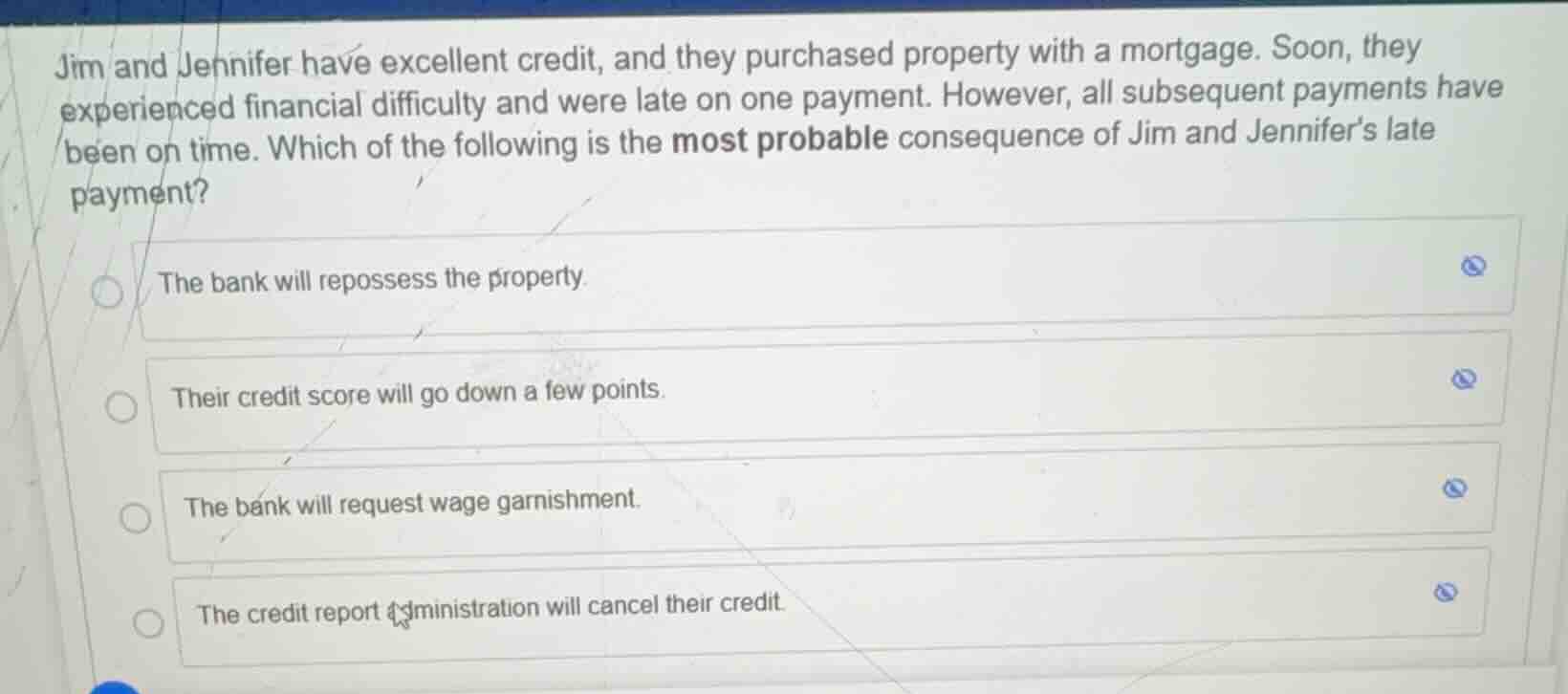
jim and jennifer have excellent credit, and they purchased property with a mortgage. soon, they experienced financial difficulty and were late on one payment. however, all subsequent payments have been on time. which of the following is the most probable consequence of jim and jennifers late payment?

  • the bank will repossess the property.
  • their credit score will go down a few points.
  • the bank will request wage garnishment.
  • the credit report administration will cancel their credit.

Explanation:

Response

<pre_analysis>
{
"quality": "clear",
"question_count": 1,
"skills_matched": [
"direct_cot",
"multiple_choice_formatter",
"explain_then_answer",
"tutor"
],
"needs_drawing": false,
"concepts_used": [],
"new_concepts": [
"Credit Score Factors",
"Mortgage Consequences"
],
"current_concepts": [
"Credit Score Factors",
"Mortgage Consequences",
"Personal Finance"
]
}
</pre_analysis>

<reasoning>

Analyze the scenario details

The scenario describes Jim and Jennifer, who have excellent credit. They made one late payment on their mortgage due to temporary financial difficulty, but all subsequent payments have been on time. We need to evaluate the most probable consequence of this single late payment.

Evaluate option A

Repossession (foreclosure) of a property is an extreme measure. Banks typically only initiate foreclosure after multiple consecutive missed payments (usually 90 days or more delinquent), not after a single late payment that was subsequently resolved.

Evaluate option B

Payment history is the largest component of a credit score. A single late payment (especially if reported to credit bureaus after being 30 days late) will negatively impact their credit score, causing it to drop. Since they have excellent credit and all other payments are on time, the drop is a direct, standard consequence.

Evaluate option C

Wage garnishment is a legal procedure where a court orders an employer to withhold earnings for the payment of a debt. This only occurs after a lawsuit and judgment, which does not happen over a single late mortgage payment.

Evaluate option D

There is no entity called the "credit report administration" that cancels credit. Credit bureaus only report credit history; they do not grant or cancel credit lines.
</reasoning>

<answer>
<mcq-option>The bank will repossess the property.</mcq-option>
<mcq-correct>Their credit score will go down a few points.</mcq-correct>
<mcq-option>The bank will request wage garnishment.</mcq-option>
<mcq-option>The credit report administration will cancel their credit.</mcq-option>
</answer>

<post_analysis>
{
"subject": "Business",
"question_type": "Multiple Choice",
"knowledge_point": [
"Business",
"Finance",
"Personal Finance"
]
}
</post_analysis>

Answer:

<pre_analysis>
{
"quality": "clear",
"question_count": 1,
"skills_matched": [
"direct_cot",
"multiple_choice_formatter",
"explain_then_answer",
"tutor"
],
"needs_drawing": false,
"concepts_used": [],
"new_concepts": [
"Credit Score Factors",
"Mortgage Consequences"
],
"current_concepts": [
"Credit Score Factors",
"Mortgage Consequences",
"Personal Finance"
]
}
</pre_analysis>

<reasoning>

Analyze the scenario details

The scenario describes Jim and Jennifer, who have excellent credit. They made one late payment on their mortgage due to temporary financial difficulty, but all subsequent payments have been on time. We need to evaluate the most probable consequence of this single late payment.

Evaluate option A

Repossession (foreclosure) of a property is an extreme measure. Banks typically only initiate foreclosure after multiple consecutive missed payments (usually 90 days or more delinquent), not after a single late payment that was subsequently resolved.

Evaluate option B

Payment history is the largest component of a credit score. A single late payment (especially if reported to credit bureaus after being 30 days late) will negatively impact their credit score, causing it to drop. Since they have excellent credit and all other payments are on time, the drop is a direct, standard consequence.

Evaluate option C

Wage garnishment is a legal procedure where a court orders an employer to withhold earnings for the payment of a debt. This only occurs after a lawsuit and judgment, which does not happen over a single late mortgage payment.

Evaluate option D

There is no entity called the "credit report administration" that cancels credit. Credit bureaus only report credit history; they do not grant or cancel credit lines.
</reasoning>

<answer>
<mcq-option>The bank will repossess the property.</mcq-option>
<mcq-correct>Their credit score will go down a few points.</mcq-correct>
<mcq-option>The bank will request wage garnishment.</mcq-option>
<mcq-option>The credit report administration will cancel their credit.</mcq-option>
</answer>

<post_analysis>
{
"subject": "Business",
"question_type": "Multiple Choice",
"knowledge_point": [
"Business",
"Finance",
"Personal Finance"
]
}
</post_analysis>