QUESTION IMAGE
Question
jennifer has estimated the volume of this cylinder to be \\(1500\text{ cm}^3\\).
a) show the workings used to calculate this estimate.
b) will the real volume be larger or smaller than \\(1500\text{ cm}^3\\)? write an explanation.
⚡ Using what you learned: volume of prisms, pyramids, cylinders, cones, spheres · Estimation and Rounding in Computation
Step 1: Identify the dimensions and formula
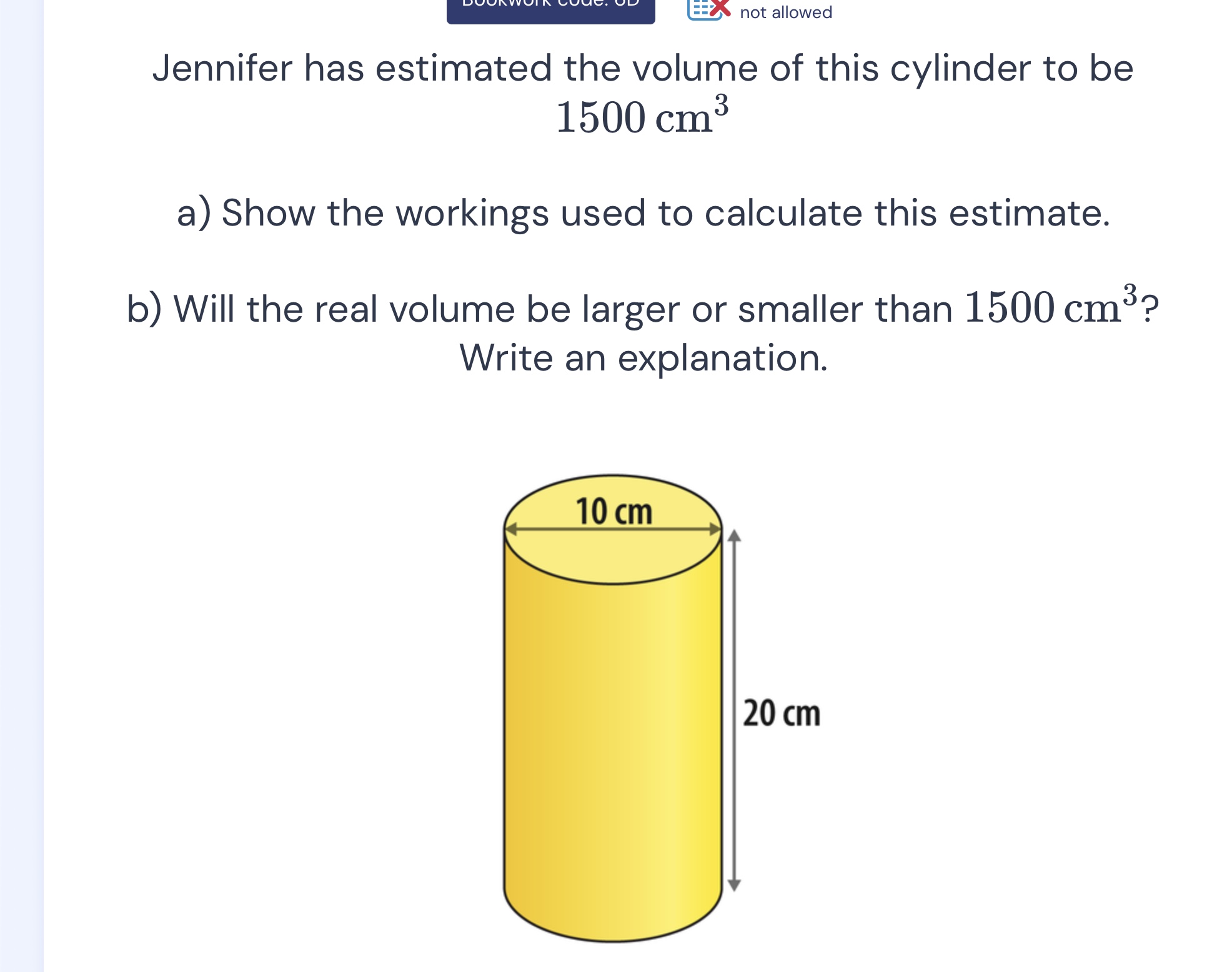
The cylinder has:
- Diameter \( d = 10\text{ cm} \), which means the radius is:
- Height \( h = 20\text{ cm} \)
The formula for the volume of a cylinder is:
Step 2: Show the workings for the estimate
To estimate the volume without a calculator, we round the value of \(\pi \approx 3.14159...\) to \( 3 \):
Step 3: Determine if the real volume is larger or smaller
The real value of \(\pi\) is approximately \( 3.14 \), which is larger than the estimated value of \( 3 \).
Since we underestimated the value of \(\pi\) in our calculation:
The real volume will be larger than the estimated volume of \( 1500\text{ cm}^3 \).

Snap & solve any problem in the app
Get step-by-step solutions on Sovi AI
Photo-based solutions with guided steps
Explore more problems and detailed explanations
a)
b)
The real volume will be larger because \(\pi\) was rounded down to \(3\) for the estimate. Since the actual value of \(\pi\) (\(\approx 3.14\)) is larger than \(3\), the actual volume will be larger than \(1500\text{ cm}^3\).