QUESTION IMAGE
Question
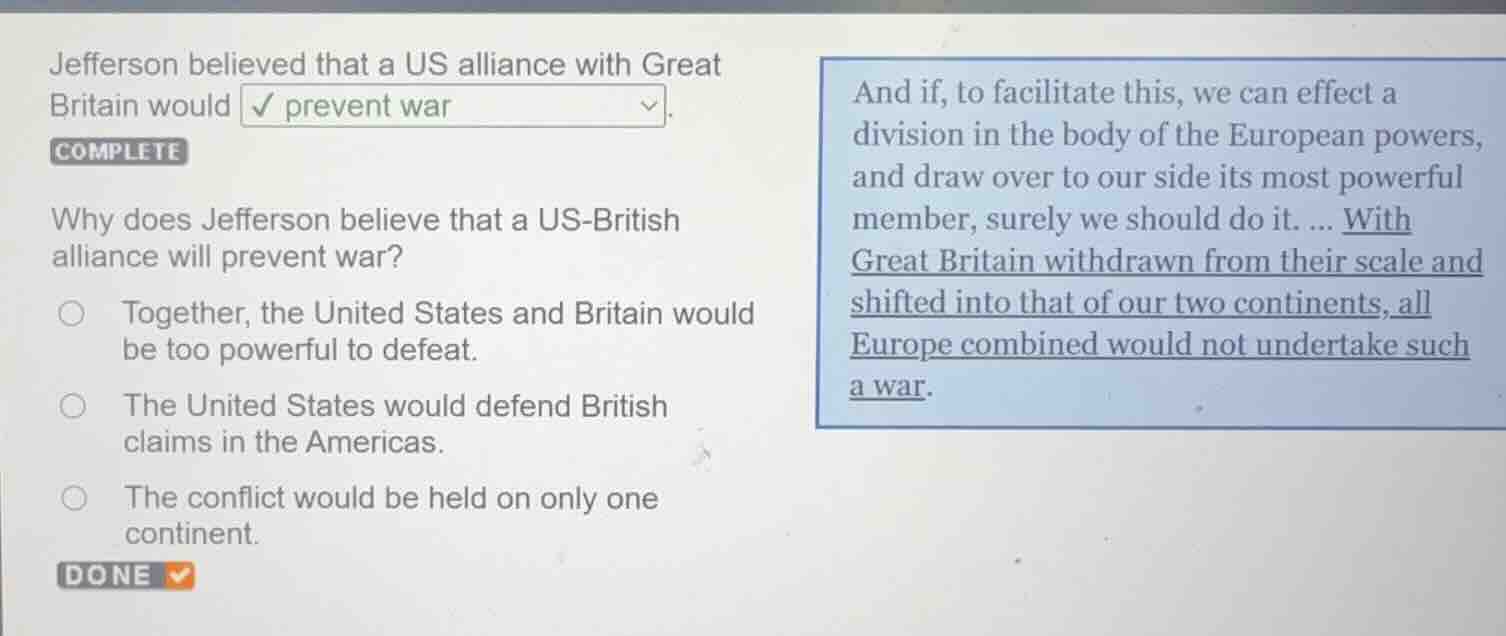
jefferson believed that a us alliance with great britain would prevent war.
why does jefferson believe that a us-british alliance will prevent war?
together, the united states and britain would be too powerful to defeat.
the united states would defend british claims in the americas.
the conflict would be held on only one continent.
and if, to facilitate this, we can effect a division in the body of the european powers, and draw over to our side its most powerful member, surely we should do it. ... with great britain withdrawn from their scale and shifted into that of our two continents, all europe combined would not undertake such a war.
<pre_analysis>
{
"quality": "clear",
"question_count": 1,
"skills_matched": [
"direct_cot",
"multiple_choice_formatter",
"explain_then_answer",
"tutor"
],
"needs_drawing": false,
"concepts_used": [
"Jeffersonian Foreign Policy",
"Textual Evidence Analysis"
],
"new_concepts": [],
"current_concepts": [
"Jeffersonian Foreign Policy",
"Textual Evidence Analysis",
"Monroe Doctrine Context"
]
}
</pre_analysis>
<reasoning>
Analyze the provided text
The provided historical excerpt states: "And if, to facilitate this, we can effect a division in the body of the European powers, and draw over to our side its most powerful member, surely we should do it. ... With Great Britain withdrawn from their scale and shifted into that of our two continents, all Europe combined would not undertake such a war." This passage highlights the strategic value of drawing Britain (the "most powerful member" of the European powers) to the American side.
Evaluate the options using textual evidence
Using Textual Evidence Analysis, we can evaluate the multiple-choice options:
- Option 1: "Together, the United States and Britain would be too powerful to defeat." This matches the text's assertion that if Britain is shifted to the American side, "all Europe combined would not undertake such a war" because the combined power would deter any conflict.
- Option 2: "The United States would defend British claims in the Americas." The text does not mention defending British claims.
- Option 3: "The conflict would be held on only one continent." The text refers to shifting Britain "into that of our two continents" to prevent war altogether, not limiting its geographic scope.
Connect to historical context
Under Jeffersonian Foreign Policy, Thomas Jefferson recognized that aligning with Great Britain—the dominant naval power of the era—would create a powerful deterrent against aggressive actions by other European empires (such as France or Spain) in the Western Hemisphere. This strategic alignment is what Jefferson believed would prevent future wars.
</reasoning>
<answer>
<mcq-correct>(A) Together, the United States and Britain would be too powerful to defeat.</mcq-correct>
<mcq-option>(B) The United States would defend British claims in the Americas.</mcq-option>
<mcq-option>(C) The conflict would be held on only one continent.</mcq-option>
</answer>
<post_analysis>
{
"subject": "Social Science",
"question_type": "Multiple Choice",
"knowledge_point": [
"Social Science",
"History",
"Jeffersonian Foreign Policy"
]
}
</post_analysis>
Snap & solve any problem in the app
Get step-by-step solutions on Sovi AI
Photo-based solutions with guided steps
Explore more problems and detailed explanations
<pre_analysis>
{
"quality": "clear",
"question_count": 1,
"skills_matched": [
"direct_cot",
"multiple_choice_formatter",
"explain_then_answer",
"tutor"
],
"needs_drawing": false,
"concepts_used": [
"Jeffersonian Foreign Policy",
"Textual Evidence Analysis"
],
"new_concepts": [],
"current_concepts": [
"Jeffersonian Foreign Policy",
"Textual Evidence Analysis",
"Monroe Doctrine Context"
]
}
</pre_analysis>
<reasoning>
Analyze the provided text
The provided historical excerpt states: "And if, to facilitate this, we can effect a division in the body of the European powers, and draw over to our side its most powerful member, surely we should do it. ... With Great Britain withdrawn from their scale and shifted into that of our two continents, all Europe combined would not undertake such a war." This passage highlights the strategic value of drawing Britain (the "most powerful member" of the European powers) to the American side.
Evaluate the options using textual evidence
Using Textual Evidence Analysis, we can evaluate the multiple-choice options:
- Option 1: "Together, the United States and Britain would be too powerful to defeat." This matches the text's assertion that if Britain is shifted to the American side, "all Europe combined would not undertake such a war" because the combined power would deter any conflict.
- Option 2: "The United States would defend British claims in the Americas." The text does not mention defending British claims.
- Option 3: "The conflict would be held on only one continent." The text refers to shifting Britain "into that of our two continents" to prevent war altogether, not limiting its geographic scope.
Connect to historical context
Under Jeffersonian Foreign Policy, Thomas Jefferson recognized that aligning with Great Britain—the dominant naval power of the era—would create a powerful deterrent against aggressive actions by other European empires (such as France or Spain) in the Western Hemisphere. This strategic alignment is what Jefferson believed would prevent future wars.
</reasoning>
<answer>
<mcq-correct>(A) Together, the United States and Britain would be too powerful to defeat.</mcq-correct>
<mcq-option>(B) The United States would defend British claims in the Americas.</mcq-option>
<mcq-option>(C) The conflict would be held on only one continent.</mcq-option>
</answer>
<post_analysis>
{
"subject": "Social Science",
"question_type": "Multiple Choice",
"knowledge_point": [
"Social Science",
"History",
"Jeffersonian Foreign Policy"
]
}
</post_analysis>