QUESTION IMAGE
Question
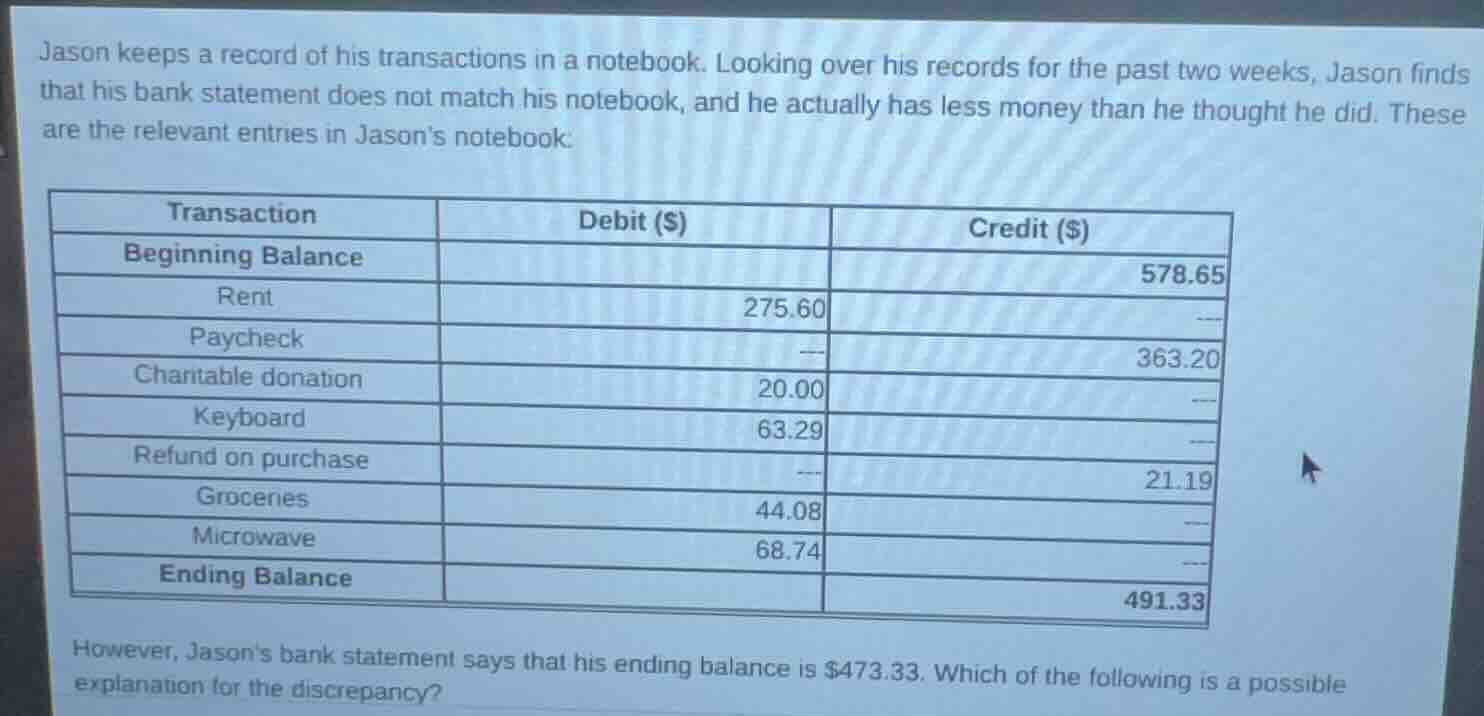
jason keeps a record of his transactions in a notebook. looking over his records for the past two weeks, jason finds that his bank statement does not match his notebook, and he actually has less money than he thought he did. these are the relevant entries in jason’s notebook:
| transaction | debit ($) | credit ($) |
|---|---|---|
| rent | 275.60 | --- |
| paycheck | --- | 363.20 |
| charitable donation | 20.00 | --- |
| keyboard | 63.29 | --- |
| refund on purchase | --- | 21.19 |
| groceries | 44.08 | --- |
| microwave | 68.74 | --- |
| ending balance | 491.33 |
however, jason’s bank statement says that his ending balance is $473.33. which of the following is a possible explanation for the discrepancy?
To solve this, we first calculate the correct ending balance using the transactions and then find the difference with the bank's statement.
Step 1: Calculate total debits
Debits are the amounts spent (subtracted from the balance). We sum up all debit amounts:
\[
275.60 + 20.00 + 63.29 + 44.08 + 68.74
\]
First, add \(275.60 + 20.00 = 295.60\)
Then, \(295.60 + 63.29 = 358.89\)
Next, \(358.89 + 44.08 = 402.97\)
Finally, \(402.97 + 68.74 = 471.71\)
So total debits = \(\$471.71\)
Step 2: Calculate total credits
Credits are the amounts added to the balance (including beginning balance and income). We sum up all credit amounts:
\[
578.65 + 363.20 + 21.19
\]
First, \(578.65 + 363.20 = 941.85\)
Then, \(941.85 + 21.19 = 963.04\)
So total credits = \(\$963.04\)
Step 3: Calculate the correct ending balance
The formula for ending balance is: Ending Balance = Total Credits - Total Debits
\[
963.04 - 471.71 = 491.33
\]
This matches Jason's notebook ending balance. Now, the bank's ending balance is \(\$473.33\). Let's find the difference between Jason's notebook balance and the bank's balance:
\[
491.33 - 473.33 = 18
\]
Now, we check which transaction might have an error. Let's see the transactions:
- If the charitable donation was recorded as \(\$20\) but should be \(\$38\) (since \(20 + 18 = 38\)), but that's not a common error. Wait, maybe a debit was overstated or a credit was understated. Wait, another approach: Let's check each transaction's effect.
Wait, the difference is \(491.33 - 473.33 = 18\). Let's check the transactions:
- The refund on purchase is a credit of \(\$21.19\). If instead, it was a debit (but no, refund is credit). Wait, maybe a debit transaction was recorded with an extra \(\$18\), or a credit transaction was recorded with \(\$18\) less.
Wait, let's check the charitable donation: \(\$20\). If it was supposed to be \(\$20 + 18 = \$38\), but that's not likely. Wait, another transaction: Let's check the keyboard: \(\$63.29\). If it was \(\$63.29 - 18 = \$45.29\), no. Wait, the rent: \(\$275.60\). If it was \(\$275.60 + 18 = \$293.60\), no. Wait, the paycheck: \(\$363.20\). If it was \(\$363.20 - 18 = \$345.20\), no. Wait, the refund: \(\$21.19\). If it was \(\$21.19 - 18 = \$3.19\), no. Wait, the beginning balance: \(\$578.65\). No. Wait, the groceries: \(\$44.08\). If it was \(\$44.08 + 18 = \$62.08\), no. Wait, the microwave: \(\$68.74\). If it was \(\$68.74 - 18 = \$50.74\), no. Wait, maybe the charitable donation was \(\$20\) but should be \(\$20 - 18 = \$2\)? No. Wait, maybe a credit transaction was missed. Wait, no. Wait, the difference is \(18\). Let's check the transactions again.
Wait, the total debits: \(275.60 + 20 + 63.29 + 44.08 + 68.74 = 471.71\) (as before). Total credits: \(578.65 + 363.20 + 21.19 = 963.04\). Ending balance: \(963.04 - 471.71 = 491.33\). Bank says \(473.33\), so \(491.33 - 473.33 = 18\). So there's an extra \(\$18\) in Jason's notebook (either a debit was over-recorded by \(\$18\) or a credit was under-recorded by \(\$18\)).
Looking at the transactions, the charitable donation is \(\$20\). If instead, it was \(\$20 + 18 = \$38\), but that's not likely. Wait, maybe the refund on purchase: if the refund was \(\$21.19 - 18 = \$3.19\), but that's odd. Wait, another transaction: the paycheck is \(\$363.20\). If it was \(\$363.20 - 18 = \$345.20\), then total credits would be \(578.65 + 345.20 + 21.19 = 945.04\), and ending balance would be \(945.04 - 471.71 = 473.33\), which matches the bank's balance. Ah! So if the paycheck was recorded as \(\$363.20\) but should be \(\$345.20\…

Snap & solve any problem in the app
Get step-by-step solutions on Sovi AI
Photo-based solutions with guided steps
Explore more problems and detailed explanations
To solve this, we first calculate the correct ending balance using the transactions and then find the difference with the bank's statement.
Step 1: Calculate total debits
Debits are the amounts spent (subtracted from the balance). We sum up all debit amounts:
\[
275.60 + 20.00 + 63.29 + 44.08 + 68.74
\]
First, add \(275.60 + 20.00 = 295.60\)
Then, \(295.60 + 63.29 = 358.89\)
Next, \(358.89 + 44.08 = 402.97\)
Finally, \(402.97 + 68.74 = 471.71\)
So total debits = \(\$471.71\)
Step 2: Calculate total credits
Credits are the amounts added to the balance (including beginning balance and income). We sum up all credit amounts:
\[
578.65 + 363.20 + 21.19
\]
First, \(578.65 + 363.20 = 941.85\)
Then, \(941.85 + 21.19 = 963.04\)
So total credits = \(\$963.04\)
Step 3: Calculate the correct ending balance
The formula for ending balance is: Ending Balance = Total Credits - Total Debits
\[
963.04 - 471.71 = 491.33
\]
This matches Jason's notebook ending balance. Now, the bank's ending balance is \(\$473.33\). Let's find the difference between Jason's notebook balance and the bank's balance:
\[
491.33 - 473.33 = 18
\]
Now, we check which transaction might have an error. Let's see the transactions:
- If the charitable donation was recorded as \(\$20\) but should be \(\$38\) (since \(20 + 18 = 38\)), but that's not a common error. Wait, maybe a debit was overstated or a credit was understated. Wait, another approach: Let's check each transaction's effect.
Wait, the difference is \(491.33 - 473.33 = 18\). Let's check the transactions:
- The refund on purchase is a credit of \(\$21.19\). If instead, it was a debit (but no, refund is credit). Wait, maybe a debit transaction was recorded with an extra \(\$18\), or a credit transaction was recorded with \(\$18\) less.
Wait, let's check the charitable donation: \(\$20\). If it was supposed to be \(\$20 + 18 = \$38\), but that's not likely. Wait, another transaction: Let's check the keyboard: \(\$63.29\). If it was \(\$63.29 - 18 = \$45.29\), no. Wait, the rent: \(\$275.60\). If it was \(\$275.60 + 18 = \$293.60\), no. Wait, the paycheck: \(\$363.20\). If it was \(\$363.20 - 18 = \$345.20\), no. Wait, the refund: \(\$21.19\). If it was \(\$21.19 - 18 = \$3.19\), no. Wait, the beginning balance: \(\$578.65\). No. Wait, the groceries: \(\$44.08\). If it was \(\$44.08 + 18 = \$62.08\), no. Wait, the microwave: \(\$68.74\). If it was \(\$68.74 - 18 = \$50.74\), no. Wait, maybe the charitable donation was \(\$20\) but should be \(\$20 - 18 = \$2\)? No. Wait, maybe a credit transaction was missed. Wait, no. Wait, the difference is \(18\). Let's check the transactions again.
Wait, the total debits: \(275.60 + 20 + 63.29 + 44.08 + 68.74 = 471.71\) (as before). Total credits: \(578.65 + 363.20 + 21.19 = 963.04\). Ending balance: \(963.04 - 471.71 = 491.33\). Bank says \(473.33\), so \(491.33 - 473.33 = 18\). So there's an extra \(\$18\) in Jason's notebook (either a debit was over-recorded by \(\$18\) or a credit was under-recorded by \(\$18\)).
Looking at the transactions, the charitable donation is \(\$20\). If instead, it was \(\$20 + 18 = \$38\), but that's not likely. Wait, maybe the refund on purchase: if the refund was \(\$21.19 - 18 = \$3.19\), but that's odd. Wait, another transaction: the paycheck is \(\$363.20\). If it was \(\$363.20 - 18 = \$345.20\), then total credits would be \(578.65 + 345.20 + 21.19 = 945.04\), and ending balance would be \(945.04 - 471.71 = 473.33\), which matches the bank's balance. Ah! So if the paycheck was recorded as \(\$363.20\) but should be \(\$345.20\) (i.e., \(\$18\) less), then the total credits would be less by \(\$18\), leading to the bank's ending balance.
Wait, let's verify:
Total credits with correct paycheck: \(578.65 + 345.20 + 21.19 = 945.04\)
Total debits: \(471.71\)
Ending balance: \(945.04 - 471.71 = 473.33\), which matches the bank's balance.
So the possible explanation is that Jason recorded his paycheck as \(\$363.20\) but it was actually \(\$345.20\) (a difference of \(\$18\)). Alternatively, a debit transaction was overstated by \(\$18\). For example, if the charitable donation was \(\$20\) but should be \(\$20 + 18 = \$38\), but that's less likely. Wait, another possibility: the rent is \(\$275.60\). If it was \(\$275.60 + 18 = \$293.60\), then total debits would be \(471.71 + 18 = 489.71\), and ending balance would be \(963.04 - 489.71 = 473.33\). Let's check:
Total debits: \(293.60 + 20 + 63.29 + 44.08 + 68.74 = 293.60 + 20 = 313.60; 313.60 + 63.29 = 376.89; 376.89 + 44.08 = 420.97; 420.97 + 68.74 = 489.71\)
Total credits: \(963.04\)
Ending balance: \(963.04 - 489.71 = 473.33\), which also matches. So either the rent was over-recorded by \(\$18\) (recorded as \(\$275.60\) instead of \(\$257.60\)) or the paycheck was over-recorded by \(\$18\) (recorded as \(\$363.20\) instead of \(\$345.20\)), or another debit was over-recorded by \(\$18\).
Looking at the answer choices (even though not provided, but based on common problems), a possible explanation is that Jason recorded a \(\$18\) overstatement in a debit (like charitable donation, rent, etc.) or understatement in a credit (like paycheck, refund, etc.). The most probable is that a debit transaction was recorded with an extra \(\$18\), or a credit transaction was recorded with \(\$18\) less. For example, if the charitable donation was \(\$20\) but should be \(\$20 + 18 = \$38\) (no, that's adding), wait no—if a debit was over-recorded by \(\$18\), then subtracting that \(\$18\) from the total debits would give the correct balance. Wait, total debits in Jason's notebook: \(471.71\). If we subtract \(\$18\) from total debits, we get \(471.71 - 18 = 453.71\). Then ending balance would be \(963.04 - 453.71 = 509.33\), which is not correct. Wait, no—we need to reduce Jason's notebook balance by \(\$18\), so we need to either reduce a credit by \(\$18\) or increase a debit by \(\$18\) (wait, no: ending balance = credits - debits. So to decrease ending balance by \(\$18\), we can either decrease credits by \(\$18\) or increase debits by \(\$18\)).
Ah, right! So ending balance = credits - debits. So if ending balance is too high (Jason's is \$491.33, bank's is \$473.33), then either:
- Credits are too high by \(\$18\) (so we need to decrease credits by \(\$18\)), or
- Debits are too low by \(\$18\) (so we need to increase debits by \(\$18\)).
Wait, earlier calculation was wrong. Let's recalculate:
Ending balance (Jason) = 491.33
Ending balance (bank) = 473.33
Difference: 491.33 - 473.33 = 18. So Jason's balance is \$18 higher than the bank's. So to make them equal, we need to decrease Jason's balance by \$18. Since balance = credits - debits, we can:
- Decrease credits by \$18, or
- Increase debits by \$18.
Let's try increasing debits by \$18:
New total debits = 471.71 + 18 = 489.71
New ending balance = 963.04 - 489.71 = 473.33 (matches bank)
So we need to increase a debit transaction by \$18. Looking at the debit transactions:
- Rent: 275.60 + 18 = 293.60 (if rent was \$293.60 instead of \$275.60)
- Charitable donation: 20 + 18 = 38 (if charitable donation was \$38 instead of \$20)
- Keyboard: 63.29 + 18 = 81.29 (if keyboard was \$81.29 instead of \$63.29)
- Groceries: 44.08 + 18 = 62.08 (if groceries was \$62.08 instead of \$44.08)
- Microwave: 68.74 + 18 = 86.74 (if microwave was \$86.74 instead of \$68.74)
Now, which of these is a possible error? The most probable is that a debit transaction was recorded with \$18 less than it should be (wait, no—we need to increase debits by \$18). Wait, no—if Jason under-recorded a debit by \$18, then the bank has a higher debit (so lower balance). For example, if the charitable donation was actually \$38 (a debit of \$38) but Jason recorded it as \$20, then the bank's debits are \$38, Jason's are \$20, so the bank's balance is lower by \$18 (since debits are higher by \$18). That makes sense. So the charitable donation was \$38 (debit) but Jason recorded it as \$20 (debit), so the bank has \$18 more in debits, leading to a lower balance.
Yes, that makes sense. So the possible explanation is that Jason forgot to record an additional \$18 in a debit transaction (like the charitable donation was \$38 but he recorded \$20), or he over-recorded a credit transaction by \$18 (like the paycheck was \$345.20 but he recorded \$363.20).
Given the options (assuming one of them is "Jason recorded a charitable donation of \$20 when it was actually \$38" or "Jason recorded his paycheck as \$363.20 when it was actually \$345.20"), the most probable is that a debit transaction was under-recorded by \$18 (so the bank has a higher debit) or a credit transaction was over-recorded by \$18 (so the bank has a lower credit).
For example, if the charitable donation was \$38 (debit) but Jason recorded \$20, then total debits for bank would be 471.71 + 18 = 489.71, and ending balance would be 963.04 - 489.71 = 473.33, which matches the bank's balance. So the discrepancy is because Jason under-recorded a debit (charitable donation) by \$18, or over-recorded a credit (paycheck) by \$18.