QUESTION IMAGE
Question
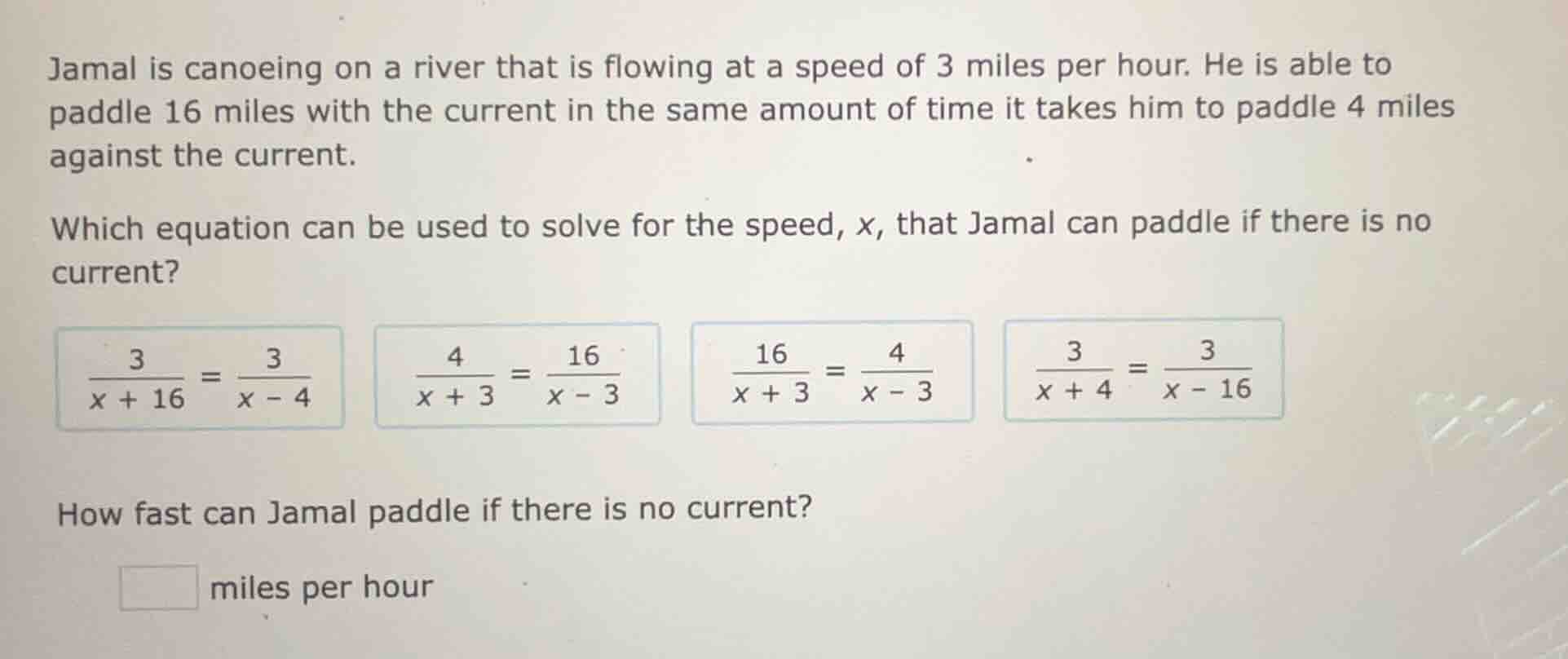
jamal is canoeing on a river that is flowing at a speed of 3 miles per hour. he is able to paddle 16 miles with the current in the same amount of time it takes him to paddle 4 miles against the current.
which equation can be used to solve for the speed, x, that jamal can paddle if there is no current?
\\(\frac{3}{x + 16} = \frac{3}{x - 4}\\) \\(\frac{4}{x + 3} = \frac{16}{x - 3}\\) \\(\frac{16}{x + 3} = \frac{4}{x - 3}\\) \\(\frac{3}{x + 4} = \frac{3}{x - 16}\\)
how fast can jamal paddle if there is no current?
\\(square\\) miles per hour
Part 1: Identifying the Correct Equation
Step 1: Determine speeds with/against current
When paddling with the current, Jamal's speed is \( x + 3 \) (his speed \( x \) plus the river's speed 3). When paddling against the current, his speed is \( x - 3 \) (his speed \( x \) minus the river's speed 3).
Step 2: Recall time formula (\( \text{time} = \frac{\text{distance}}{\text{speed}} \))
Time with current: \( \frac{16}{x + 3} \) (distance 16 miles, speed \( x + 3 \)).
Time against current: \( \frac{4}{x - 3} \) (distance 4 miles, speed \( x - 3 \)).
Step 3: Set times equal (same time)
Since the times are equal, the equation is \( \frac{16}{x + 3} = \frac{4}{x - 3} \).
Step 1: Cross - multiply the equation
From \( \frac{16}{x + 3} = \frac{4}{x - 3} \), cross - multiply:
\( 16(x - 3)=4(x + 3) \)
Step 2: Distribute both sides
Left side: \( 16x-48 \)
Right side: \( 4x + 12 \)
Equation becomes: \( 16x-48 = 4x + 12 \)
Step 3: Subtract \( 4x \) from both sides
\( 16x-4x-48=4x - 4x+12 \)
\( 12x-48 = 12 \)
Step 4: Add 48 to both sides
\( 12x-48 + 48=12 + 48 \)
\( 12x=60 \)
Step 5: Divide by 12
\( x=\frac{60}{12}=5 \)

Snap & solve any problem in the app
Get step-by-step solutions on Sovi AI
Photo-based solutions with guided steps
Explore more problems and detailed explanations
\( \boldsymbol{\frac{16}{x + 3} = \frac{4}{x - 3}} \) (the third option)