QUESTION IMAGE
Question
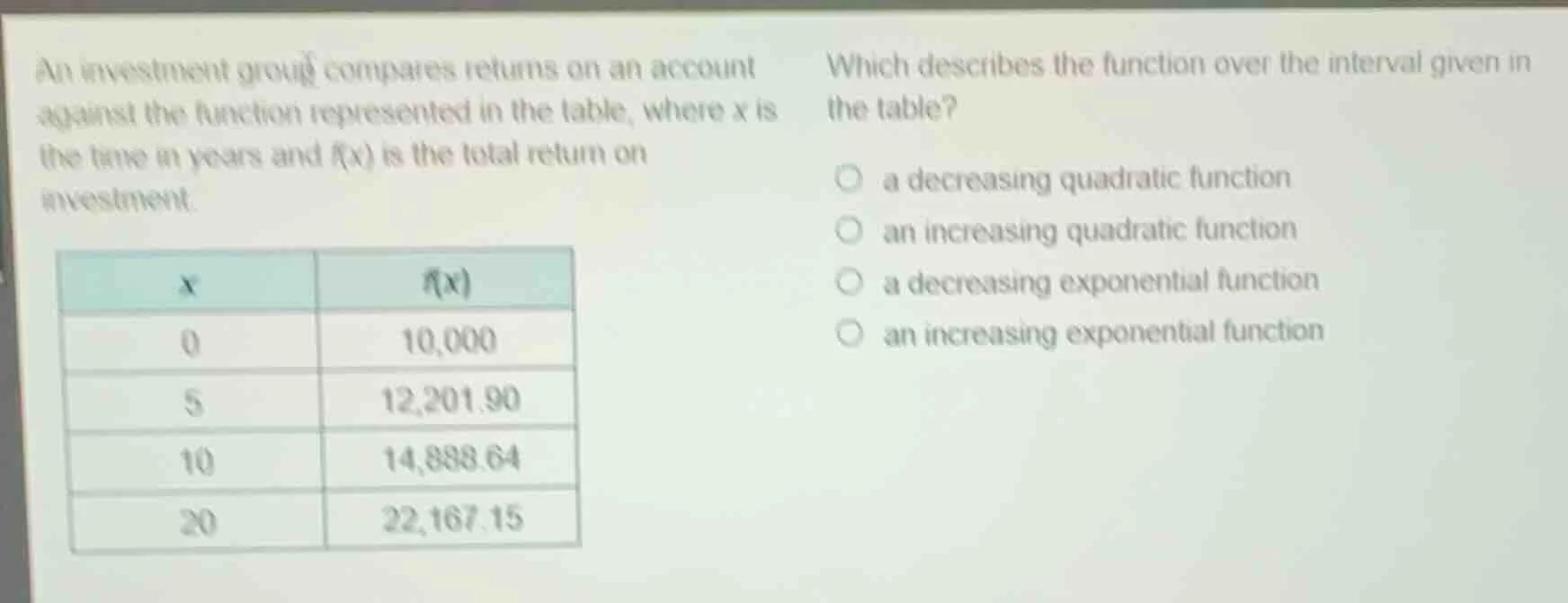
an investment group compares returns on an account against the function represented in the table, where x is the time in years and f(x) is the total return on investment.
| x | f(x) |
|---|---|
| 5 | 12,201.90 |
| 10 | 14,888.64 |
| 20 | 22,167.15 |
which describes the function over the interval given in the table?
- a decreasing quadratic function
- an increasing quadratic function
- a decreasing exponential function
- an increasing exponential function
Step1: Analyze if it's increasing or decreasing
As \( x \) (time in years) increases from 0 to 5 to 10 to 20, \( f(x) \) (total return) increases from 10,000 to 12,201.90 to 14,888.64 to 22,167.15. So the function is increasing, eliminating the decreasing options (a decreasing quadratic function, a decreasing exponential function).
Step2: Distinguish between quadratic and exponential
For a quadratic function \( f(x)=ax^{2}+bx + c \), the rate of change (difference in \( f(x) \)) should follow a linear pattern (since the second difference is constant for quadratic). Let's check the differences:
- From \( x = 0 \) to \( x = 5 \): \( 12201.90 - 10000=2201.90 \)
- From \( x = 5 \) to \( x = 10 \): \( 14888.64 - 12201.90 = 2686.74 \)
- From \( x = 10 \) to \( x = 20 \): \( 22167.15 - 14888.64=7278.51 \)
The differences are not linear (they are increasing at an increasing rate). For an exponential function \( f(x)=a\cdot b^{x} \), the ratio of consecutive \( f(x) \) values should be approximately constant. Let's check the ratios:
- From \( x = 0 \) to \( x = 5 \): \( \frac{12201.90}{10000}=1.22019 \)
- From \( x = 5 \) to \( x = 10 \): \( \frac{14888.64}{12201.90}\approx1.22 \) (since \( 12201.90\times1.22\approx14886.32 \), close to 14888.64)
- From \( x = 10 \) to \( x = 20 \): \( \frac{22167.15}{14888.64}\approx1.488 \), and \( 1.22^{2}\approx1.4884 \), which is very close. So the ratio is approximately constant (base \( b\approx1.22 \)), indicating exponential growth.

Snap & solve any problem in the app
Get step-by-step solutions on Sovi AI
Photo-based solutions with guided steps
Explore more problems and detailed explanations
an increasing exponential function