QUESTION IMAGE
Question
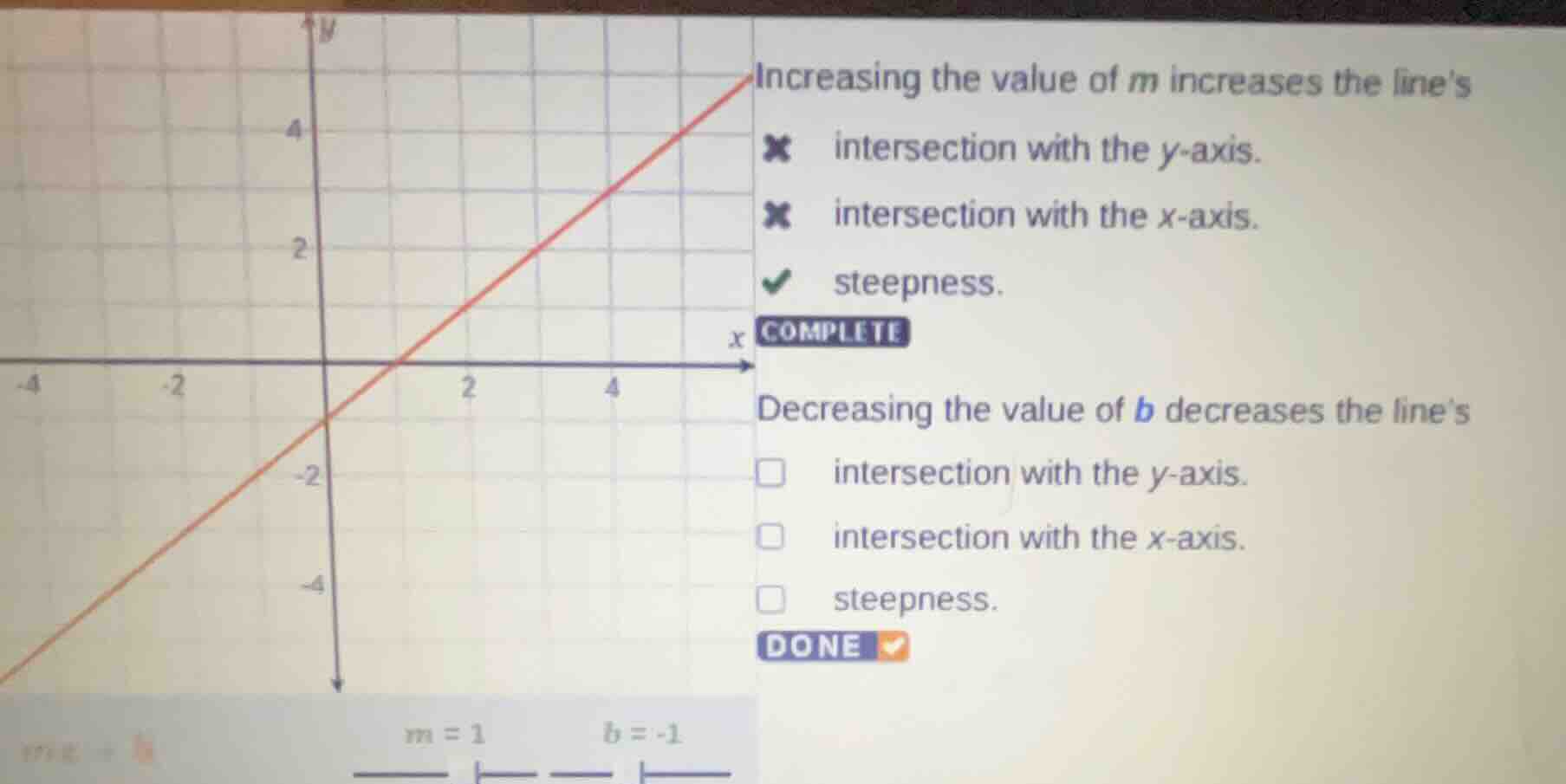
increasing the value of m increases the lines
intersection with the y - axis.
intersection with the x - axis.
steepness.
complete
decreasing the value of b decreases the lines
intersection with the y - axis.
intersection with the x - axis.
steepness.
done
m = 1 b = - 1
The equation of a line is \( y = mx + b \), where \( m \) is the slope (affecting steepness) and \( b \) is the y - intercept (the point where the line crosses the y - axis).
- For the effect of \( b \): The y - intercept is the value of \( y \) when \( x = 0 \), so it's the point \( (0,b) \) on the y - axis. If we decrease \( b \), the point \( (0,b) \) moves down the y - axis, so the line's intersection with the y - axis decreases.
- The x - intercept is found by setting \( y = 0 \), so \( 0=mx + b\Rightarrow x=-\frac{b}{m} \). Decreasing \( b \) (if \( m>0 \)) will increase the x - intercept (move it to the right), not decrease it.
- The steepness of the line is determined by the slope \( m \), not the y - intercept \( b \), so decreasing \( b \) does not affect the steepness.

Snap & solve any problem in the app
Get step-by-step solutions on Sovi AI
Photo-based solutions with guided steps
Explore more problems and detailed explanations
The correct option is: \(\square\) intersection with the \( y \)-axis. (We should check the box next to "intersection with the \( y \)-axis" as decreasing \( b \) decreases the line's intersection with the \( y \)-axis.)