QUESTION IMAGE
Question
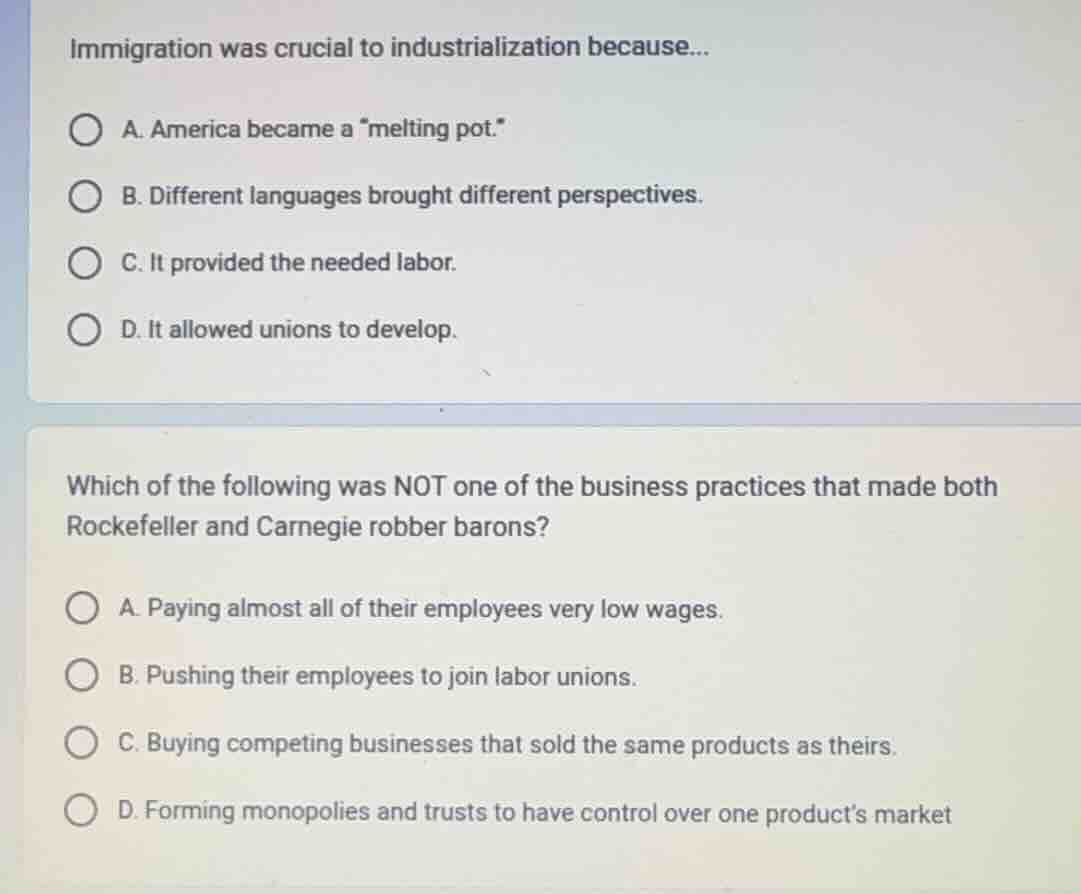
immigration was crucial to industrialization because...
a. america became a \melting pot.\
b. different languages brought different perspectives.
c. it provided the needed labor.
d. it allowed unions to develop.
which of the following was not one of the business practices that made both rockefeller and carnegie robber barons?
a. paying almost all of their employees very low wages.
b. pushing their employees to join labor unions.
c. buying competing businesses that sold the same products as theirs.
d. forming monopolies and trusts to have control over one products market
Analyze the role of immigration in industrialization
The first question asks why immigration was crucial to industrialization. During the late 19th and early 20th centuries, American industries expanded rapidly. This massive growth required an enormous workforce to operate factories, build railroads, and work in mines. Immigrants provided the vast, cheap labor pool necessary to sustain this industrial expansion. While cultural concepts like the "melting pot" emerged, they were social outcomes rather than the direct economic reason immigration was crucial to the process of industrialization itself.
Evaluate the options for the first question
- Option A: The "melting pot" concept describes cultural assimilation, not the economic driver of industrial growth.
- Option B: Diverse perspectives did not directly fuel the physical operations of heavy industry.
- Option C: Providing the needed labor directly explains why industrialization was physically and economically possible.
- Option D: Industrialists generally opposed unions, and immigration did not occur to help unions develop.
Analyze the business practices of Rockefeller and Carnegie
The second question asks which practice was NOT one of the business methods that characterized John D. Rockefeller and Andrew Carnegie as "robber barons." Robber barons were powerful 19th-century industrialists known for exploitative practices to eliminate competition and maximize wealth. They paid low wages, bought out competitors (horizontal integration), and formed monopolies or trusts to control markets.
Evaluate the options for the second question
- Option A: Both industrialists paid very low wages to maximize profits, which is a characteristic robber baron practice.
- Option B: Both Rockefeller and Carnegie actively fought against labor unions (for example, Carnegie's involvement in the Homestead Strike). They did not push employees to join unions.
- Option C: Buying competing businesses (horizontal integration) was a core strategy used by both to dominate their industries.
- Option D: Forming monopolies and trusts (like Standard Oil) was their primary method of market control.

Snap & solve any problem in the app
Get step-by-step solutions on Sovi AI
Photo-based solutions with guided steps
Explore more problems and detailed explanations
Question 1
- (A) America became a "melting pot."
- (B) Different languages brought different perspectives.
- (C) It provided the needed labor. (Correct answer)
- (D) It allowed unions to develop.
Question 2
- (A) Paying almost all of their employees very low wages.
- (B) Pushing their employees to join labor unions. (Correct answer)
- (C) Buying competing businesses that sold the same products as theirs.
- (D) Forming monopolies and trusts to have control over one product's market