QUESTION IMAGE
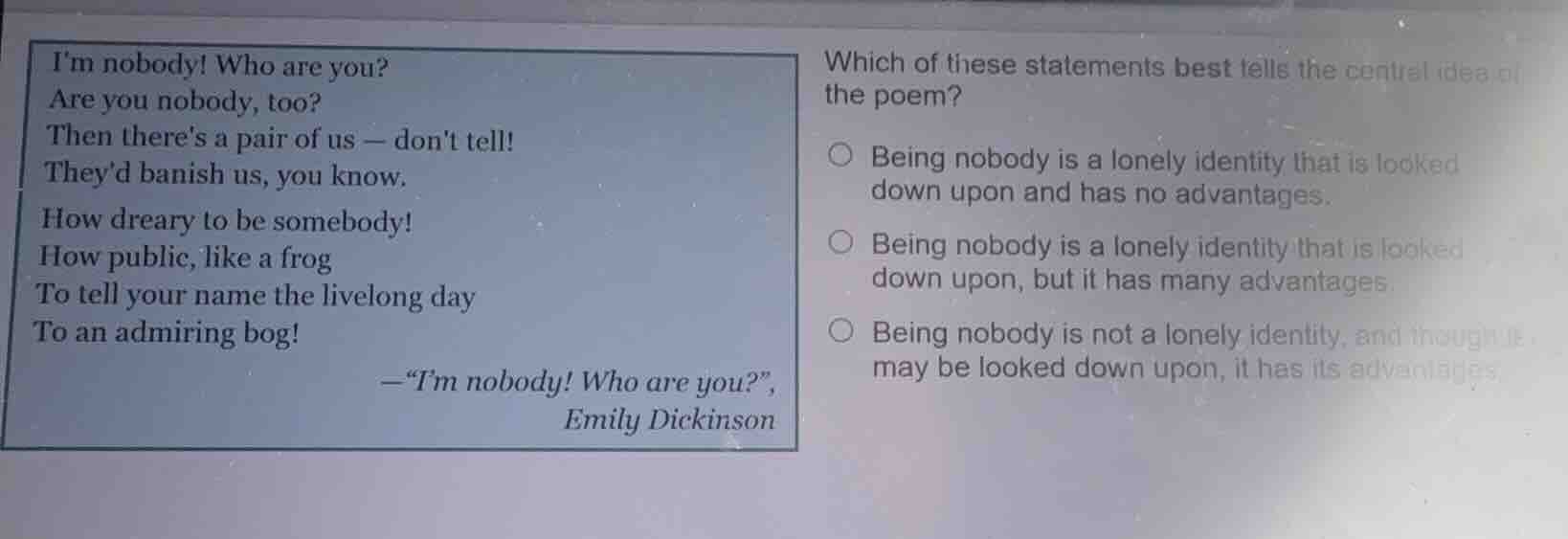
Question
im nobody! who are you?
are you nobody, too?
then theres a pair of us - dont tell!
theyd banish us, you know.
how dreary to be somebody!
how public, like a frog
to tell your name the livelong day
to an admiring bog!
-\im nobody! who are you?\, emily dickinson
which of these statements best tells the central idea of the poem?
being nobody is a lonely identity that is looked down upon and has no advantages.
being nobody is a lonely identity that is looked down upon, but it has many advantages.
being nobody is not a lonely identity, and though it may be looked down upon, it has its advantages.
Analyze the poem's depiction of being "nobody"
The speaker welcomes another "nobody" ("Then there's a pair of us — don't tell!") and expresses that being "somebody" is dreary and overly public ("How dreary to be somebody! / How public, like a frog"). This shows that being a "nobody" is not a lonely state, but rather a shared, private connection that has distinct advantages over being a public "somebody."
Evaluate the given options
- Option 1 states being nobody is a lonely identity with no advantages. This contradicts the speaker's joy in finding a partner and their preference for privacy.
- Option 2 states being nobody is a lonely identity but has advantages. This still incorrectly labels it as "lonely."
- Option 3 states being nobody is not a lonely identity, and though it may be looked down upon (implied by "They'd banish us"), it has its advantages (privacy, quiet, and genuine connection).

Snap & solve any problem in the app
Get step-by-step solutions on Sovi AI
Photo-based solutions with guided steps
Explore more problems and detailed explanations
- Being nobody is a lonely identity that is looked down upon and has no advantages.
- Being nobody is a lonely identity that is looked down upon, but it has many advantages.
- Being nobody is not a lonely identity, and though it may be looked down upon, it has its advantages. (Correct answer)