QUESTION IMAGE
Question
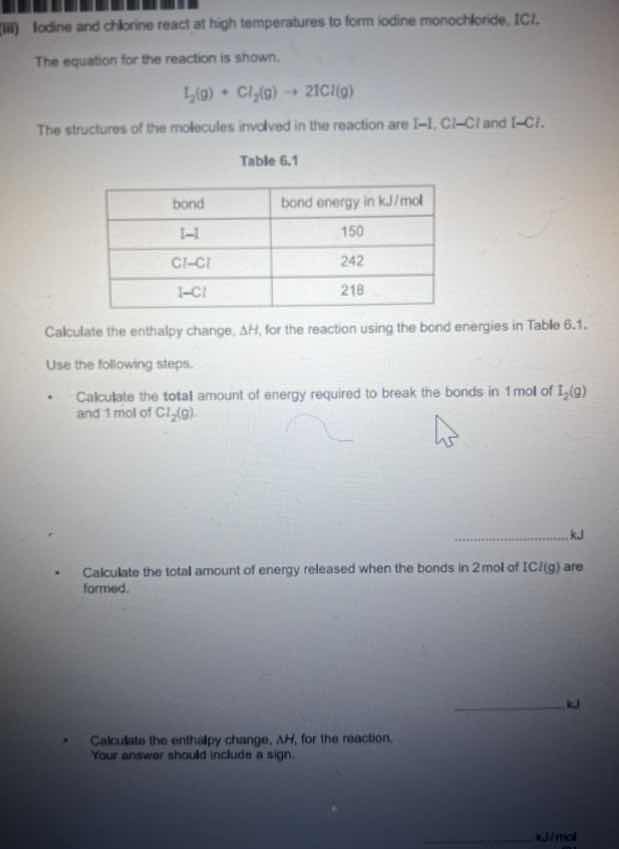
(iii) iodine and chlorine react at high temperatures to form iodine monochloride, \\(\text{icl}\\).
the equation for the reaction is shown.
\\\text{i}_2(\text{g}) + \text{cl}_2(\text{g}) \
ightarrow 2\text{icl}(\text{g})\\
the structures of the molecules involved in the reaction are \\(\text{i}-\text{i}\\), \\(\text{cl}-\text{cl}\\) and \\(\text{i}-\text{cl}\\).
table 6.1
| bond | bond energy in kj/mol |
|---|---|
| \\(\text{cl}-\text{cl}\\) | 242 |
| \\(\text{i}-\text{cl}\\) | 218 |
calculate the enthalpy change, \\(\delta h\\), for the reaction using the bond energies in table 6.1.
use the following steps.
- calculate the total amount of energy required to break the bonds in 1 mol of \\(\text{i}_2(\text{g})\\) and 1 mol of \\(\text{cl}_2(\text{g})\\).
.................................................. kj
- calculate the total amount of energy released when the bonds in 2 mol of \\(\text{icl}(\text{g})\\) are formed.
.................................................. kj
- calculate the enthalpy change, \\(\delta h\\), for the reaction.
your answer should include a sign.
.................................................. kj/mol
Calculate energy required to break reactant bonds
Calculate energy released when product bonds form
Calculate the overall enthalpy change

Snap & solve any problem in the app
Get step-by-step solutions on Sovi AI
Photo-based solutions with guided steps
Explore more problems and detailed explanations
Question 1
Calculate the total amount of energy required to break the bonds in \(1\text{ mol}\) of \(\text{I}_2\text{(g)}\) and \(1\text{ mol}\) of \(\text{Cl}_2\text{(g)}\).
<blank>392</blank> \(\text{kJ}\)
Question 2
Calculate the total amount of energy released when the bonds in \(2\text{ mol}\) of \(\text{ICl(g)}\) are formed.
<blank>436</blank> \(\text{kJ}\)
Question 3
Calculate the enthalpy change, \(\Delta H\), for the reaction. Your answer should include a sign.
<blank>-44</blank> \(\text{kJ/mol}\)