QUESTION IMAGE
Question
ii. patterns of urbanization
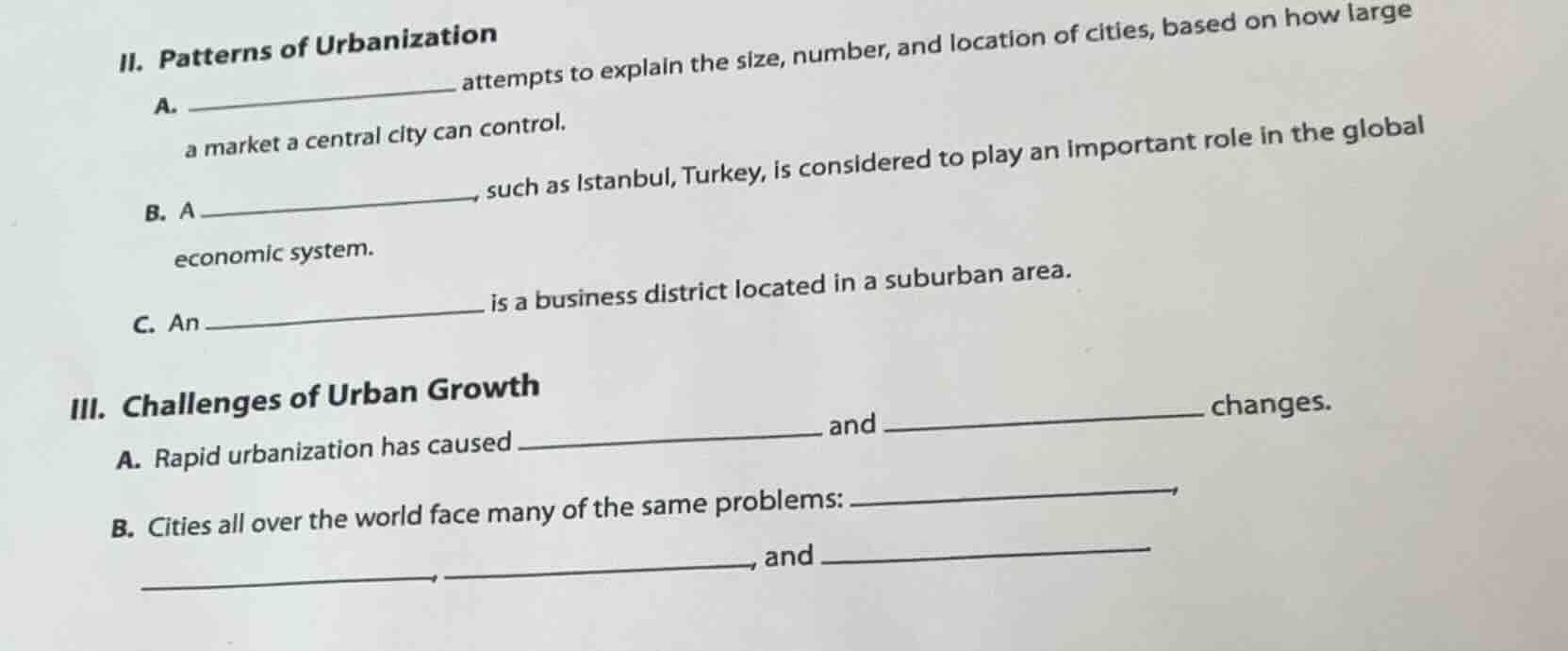
a. ____________________ attempts to explain the size, number, and location of cities, based on how large a market a central city can control.
b. a ____________________, such as istanbul, turkey, is considered to play an important role in the global economic system.
c. an ____________________ is a business district located in a suburban area.
iii. challenges of urban growth
a. rapid urbanization has caused __________________ and __________________ changes.
b. cities all over the world face many of the same problems: __________________, ________________, and __________________.
Identify Central Place Theory
The first statement describes a theory explaining the size, number, and location of human settlements. It focuses on the market area or hinterland a central city controls. This is the definition of Central Place Theory, developed by Walter Christaller. We apply Urban Geography to identify this spatial model.
Identify Global City
The second statement describes a city that plays an important role in the global economic system, using Istanbul, Turkey as an example. This refers to a global city (or world city), which acts as a primary node in the global economic network.
Identify Edge City
The third statement describes a business district located in a suburban area. This is the definition of an edge city, which is a concentration of business, shopping, and entertainment outside a traditional downtown or central business district.
Analyze Challenges of Urban Growth
For section III, we look at common geographic curriculum frameworks (such as AP Human Geography) regarding urbanization challenges:
- Statement A: Rapid urbanization causes dramatic social and environmental (or economic) changes.
- Statement B: Cities worldwide face shared challenges. Common major issues resulting from rapid urban growth include housing (or slums/shantytowns), pollution (or environmental degradation), infrastructure strain, and poverty (or unemployment).

Snap & solve any problem in the app
Get step-by-step solutions on Sovi AI
Photo-based solutions with guided steps
Explore more problems and detailed explanations
II. Patterns of Urbanization
A. <blank>Central place theory</blank> attempts to explain the size, number, and location of cities, based on how large a market a central city can control.
B. A <blank>global city (or world city)</blank>, such as Istanbul, Turkey, is considered to play an important role in the global economic system.
C. An <blank>edge city</blank> is a business district located in a suburban area.
III. Challenges of Urban Growth
A. Rapid urbanization has caused <blank>social</blank> and <blank>environmental</blank> changes.
B. Cities all over the world face many of the same problems: <blank>poverty</blank>, <blank>pollution</blank>, <blank>inadequate housing</blank>, and <blank>traffic congestion</blank>.