QUESTION IMAGE
Question
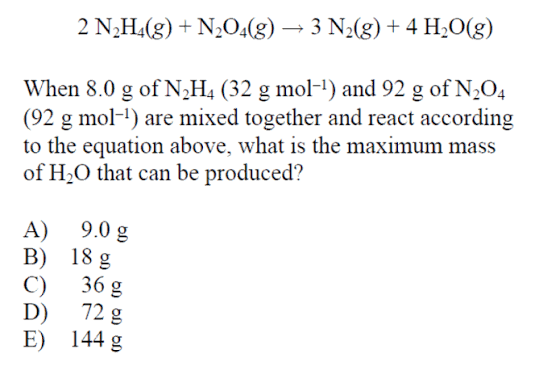
\\2 \text{ n}_2\text{h}_4(g) + \text{n}_2\text{o}_4(g) \
ightarrow 3 \text{ n}_2(g) + 4 \text{ h}_2\text{o}(g)\\
when \\(8.0\text{ g}\\) of \\(\text{n}_2\text{h}_4\\) (\\(32\text{ g mol}^{-1}\\)) and \\(92\text{ g}\\) of \\(\text{n}_2\text{o}_4\\) (\\(92\text{ g mol}^{-1}\\)) are mixed together and react according to the equation above, what is the maximum mass of \\(\text{h}_2\text{o}\\) that can be produced?
a) \\(9.0\text{ g}\\)
b) \\(18\text{ g}\\)
c) \\(36\text{ g}\\)
d) \\(72\text{ g}\\)
e) \\(144\text{ g}\\)
🆕 New Concept Discovered: Limiting Reactant Stoichiometry
Finding which ingredient runs out first
Step 1: Calculate moles of each reactant
To find out how much product can be made, we first need to convert the given masses of our starting materials into moles. Moles tell us the actual number of molecules we are working with.
For hydrazine (\(\text{N}_2\text{H}_4\)):
For dinitrogen tetroxide (\(\text{N}_2\text{O}_4\)):
Step 2: Identify the limiting reactant
The balanced chemical equation is:
This tells us we need \(2\) moles of \(\text{N}_2\text{H}_4\) for every \(1\) mole of \(\text{N}_2\text{O}_4\).
Let's determine how many moles of \(\text{N}_2\text{O}_4\) are needed to completely react with our \(0.25\text{ mol}\) of \(\text{N}_2\text{H}_4\):
Since we have \(1.0\text{ mol}\) of \(\text{N}_2\text{O}_4\) available, which is much more than the \(0.125\text{ mol}\) required, \(\text{N}_2\text{O}_4\) is in excess.
Therefore, \(\text{N}_2\text{H}_4\) is the limiting reactant and will determine the maximum amount of product we can make.
Step 3: Calculate the maximum moles of \(\text{H}_2\text{O}\) produced
Using the mole ratio between the limiting reactant (\(\text{N}_2\text{H}_4\)) and the desired product (\(\text{H}_2\text{O}\)) from the balanced equation:
Now, calculate the moles of \(\text{H}_2\text{O}\):
Step 4: Convert moles of \(\text{H}_2\text{O}\) to mass
The molar mass of water (\(\text{H}_2\text{O}\)) is:
Now, calculate the mass:

Snap & solve any problem in the app
Get step-by-step solutions on Sovi AI
Photo-based solutions with guided steps
Explore more problems and detailed explanations
A) 9.0 g