QUESTION IMAGE
Question
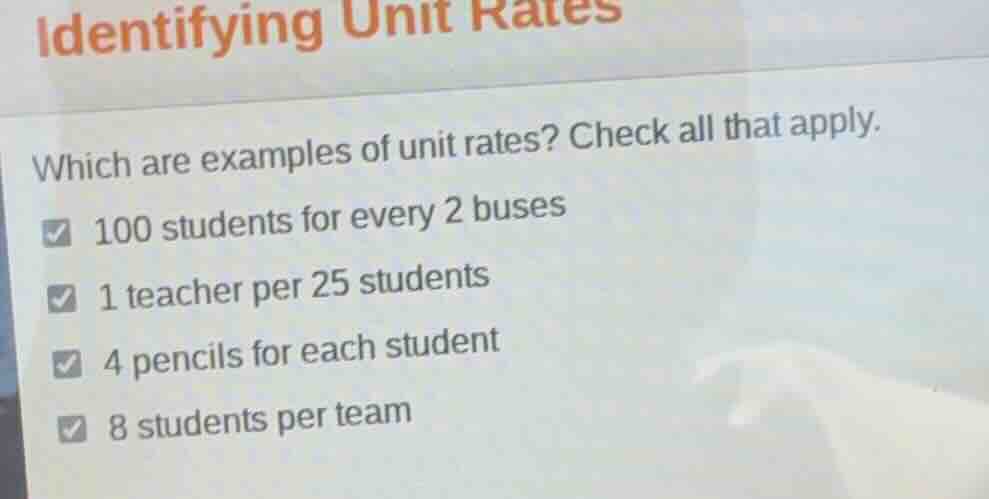
identifying unit rates
which are examples of unit rates? check all that apply.
100 students for every 2 buses
1 teacher per 25 students
4 pencils for each student
8 students per team
🆕 New Concept Discovered: Unit Rates
Comparing quantities where the second quantity is exactly 1.
Step 1: Understand what a unit rate is
A rate is a comparison of two different quantities with different units. A unit rate is a specific type of rate where the second quantity (the denominator) is exactly \(1\) unit.
We often use words like "per", "each", or "for every" to show this relationship. To be a unit rate, the quantity following these words must represent a single unit (exactly \(1\)).
Step 2: Analyze each option
- 100 students for every 2 buses
- This compares \(100\) students to \(2\) buses.
- Since the second quantity is \(2\) (not \(1\)), this is a regular rate, not a unit rate.
- 1 teacher per 25 students
- This compares \(1\) teacher to \(25\) students.
- Since the second quantity is \(25\) (not \(1\)), this is not a unit rate. (Even though the first number is \(1\), a unit rate must have a \(1\) as the second quantity, representing "per single unit").
- 4 pencils for each student
- This compares \(4\) pencils to \(1\) student ("each student" means \(1\) student).
- Since the second quantity is exactly \(1\), this is a unit rate.
- 8 students per team
- This compares \(8\) students to \(1\) team ("per team" means per \(1\) team).
- Since the second quantity is exactly \(1\), this is a unit rate.

Snap & solve any problem in the app
Get step-by-step solutions on Sovi AI
Photo-based solutions with guided steps
Explore more problems and detailed explanations
The examples of unit rates are:
- 4 pencils for each student
- 8 students per team