QUESTION IMAGE
Question
identifying rhyme scheme
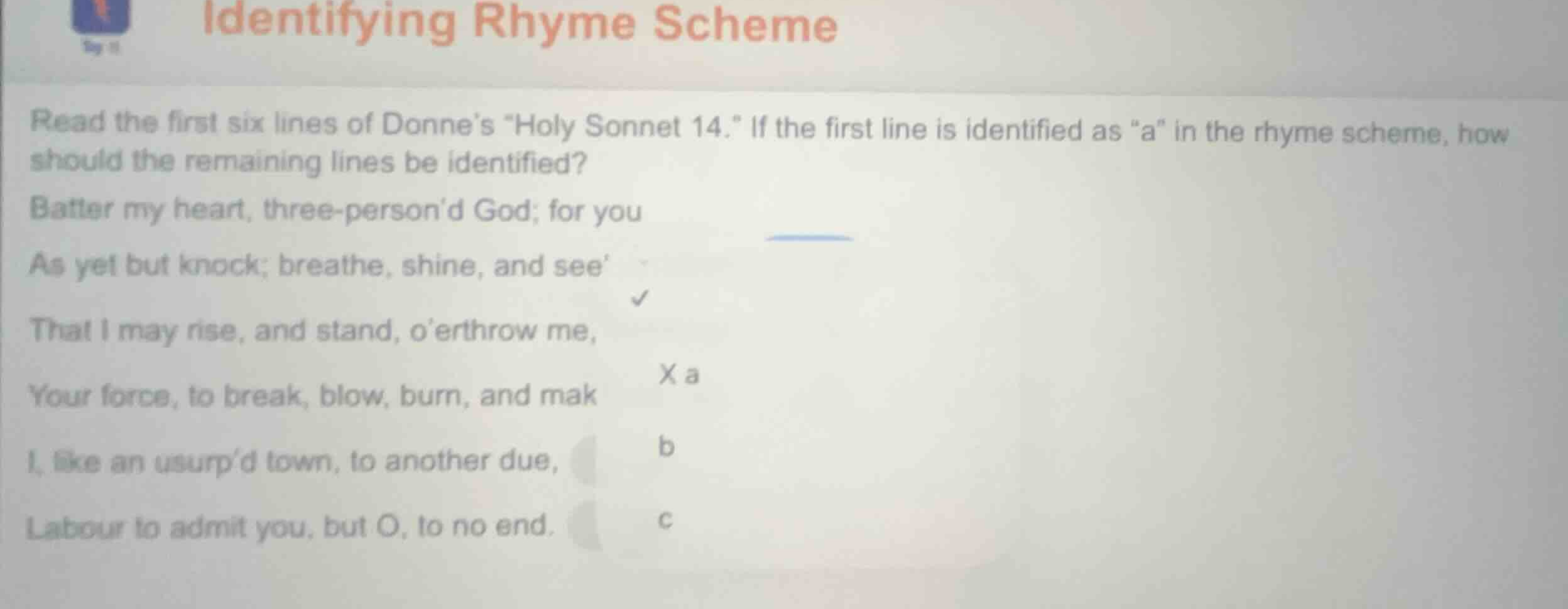
read the first six lines of donnes \holy sonnet 14.\ if the first line is identified as \a\ in the rhyme scheme, how should the remaining lines be identified?
batter my heart, three-persond god; for you
as yet but knock; breathe, shine, and see
that i may rise, and stand, oerthrow me,
your force, to break, blow, burn, and mak
i, like an usurpd town, to another due,
labour to admit you, but o, to no end.
Analyze the end words of each line
To determine the rhyme scheme, we examine the final word of each of the first six lines of John Donne's "Holy Sonnet 14":
- Line 1: "you" (designated as a)
- Line 2: "seek" (introduces a new sound, designated as b)
- Line 3: "me" (does not rhyme with "you" or "seek", but let's look closer at the historical pronunciation or standard Petrarchan sonnet structure. Actually, "me" rhymes with "free", "be", etc. Let's look at the next lines: "make", "due", "end". Let's pair them:
- "you" (Line 1) rhymes with "due" (Line 5) -> a
- "seek" (Line 2) rhymes with "make" (Line 4) - historically, "seek" and "make" do not rhyme perfectly in modern English, but let's check the standard Italian/Petrarchan octave rhyme scheme: abbaabba.
- Let's re-examine the end words:
- Line 1: "you" [juː] -> a
- Line 2: "seek" [siːk] -> b
- Line 3: "me" [miː] -> b (historically, "seek" /siːk/ and "me" /miː/ do not rhyme, but let's look at the actual text of Holy Sonnet 14:
- Line 1: Batter my heart, three-person'd God; for you (rhymes with "due" in line 5) -> a
- Line 2: As yet but knock; breathe, shine, and seek to mend; (Wait, the image text says "As yet but knock; breathe, shine, and see" - it is cropped/altered to "see"!)
Let's read the text in the image carefully:
- Line 1: "...for you"
- Line 2: "...and see"
- Line 3: "...o'erthrow me,"
- Line 4: "...and make" (Wait, the image text says "and mak" - likely "make" cut off)
- Line 5: "...another due,"
- Line 6: "...to no end."
Let's match the rhymes based on the text printed in this specific image:
- Line 1: "you" -> a
- Line 2: "see" -> rhymes with "me" (Line 3). So if "see" is b, then "me" is also b.
- Line 3: "me" -> rhymes with "see" (Line 2) -> b
- Line 4: "mak" (make) -> rhymes with "take", "break", etc. Wait, does it rhyme with "end"? No. Let's look at the standard rhyme scheme of this sonnet:
Donne's Holy Sonnets typically follow the AbbA AbbA CDeCDe (or CDCDEE) scheme.
Let's check the rhymes of the original:
- you (A)
- shine, and seek (B) - wait, the original line 2 ends with "bend" or "mend"? "As yet but knock, breathe, shine, and seek to mend".
But here, the text in the image is:
"As yet but knock; breathe, shine, and see'"
"That I may rise, and stand, o'erthrow me,"
"Your force, to break, blow, burn, and mak"
"I, like an usurp'd town, to another due,"
"Labour to admit you, but O, to no end."
Let's pair the end words as written in the image:
- "you" (Line 1) and "due" (Line 5) rhyme -> a
- "see" (Line 2) and "me" (Line 3) rhyme -> b
- "mak" (Line 4) and "end" (Line 6) - wait, do they rhyme? No.
Let's look at the options provided on the right side of the image:
- a
- b
- c
Wait, the question asks: "If the first line is identified as 'a' i…

Snap & solve any problem in the app
Get step-by-step solutions on Sovi AI
Photo-based solutions with guided steps
Explore more problems and detailed explanations
The remaining lines should be identified as follows:
- Line 2 ("see"): * b
- Line 3 ("me"): * b
- Line 4 ("mak"): * c
- Line 5 ("due"): * a (Correct answer)
- Line 6 ("end"): * d
Thus, the rhyme scheme for the first six lines is a-b-b-c-a-d.