QUESTION IMAGE
Question
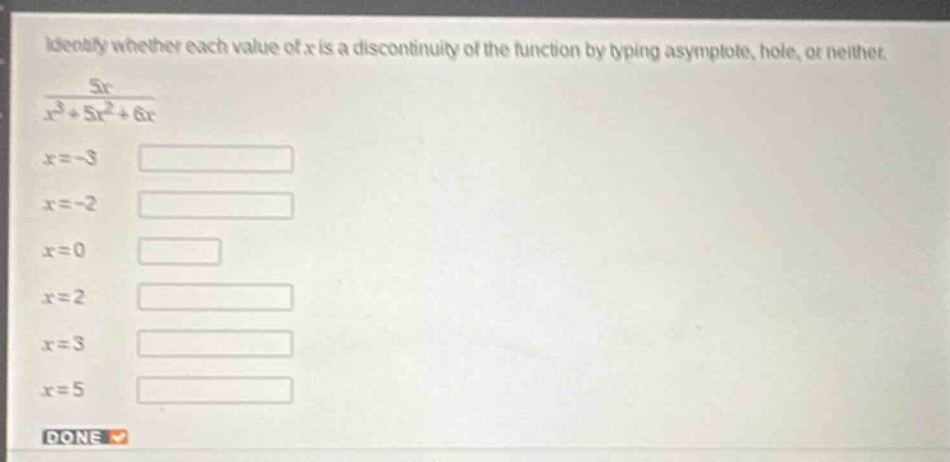
identify whether each value of \\(x\\) is a discontinuity of the function by typing asymptote, hole, or neither.
\\\frac{5x}{x^3+5x^2+6x}\\
\\(x = -3\\)
\\(x = -2\\)
\\(x = 0\\)
\\(x = 2\\)
\\(x = 3\\)
\\(x = 5\\)
⚡ Using what you learned: Types of Discontinuity (removable, jump, infinite)
Step 1: Factor the denominator
Factor the denominator of the function \( f(x) = \frac{5x}{x^3 + 5x^2 + 6x} \):
$$
x^3 + 5x^2 + 6x = x(x^2 + 5x + 6) = x(x + 2)(x + 3)
$$
The function can be written as:
$$
f(x) = \frac{5x}{x(x + 2)(x + 3)}
$$
Step 2: Identify discontinuities and their types
The function is undefined where the denominator is zero: \( x = 0 \), \( x = -2 \), and \( x = -3 \).
- For \( x = 0 \): The factor \( x \) is common to both the numerator and the denominator. It can be canceled out (removable discontinuity), which represents a hole.
- For \( x = -2 \): The factor \( x + 2 \) remains in the denominator after simplification, causing the function to approach infinity (non-removable infinite discontinuity), which represents an asymptote.
- For \( x = -3 \): The factor \( x + 3 \) remains in the denominator after simplification, which represents an asymptote.
- For \( x = 2 \), \( x = 3 \), and \( x = 5 \): The denominator is not zero at these values, so there is no discontinuity (neither).

Snap & solve any problem in the app
Get step-by-step solutions on Sovi AI
Photo-based solutions with guided steps
Explore more problems and detailed explanations
- \( x = -3 \): asymptote
- \( x = -2 \): asymptote
- \( x = 0 \): hole
- \( x = 2 \): neither
- \( x = 3 \): neither
- \( x = 5 \): neither