QUESTION IMAGE
Question
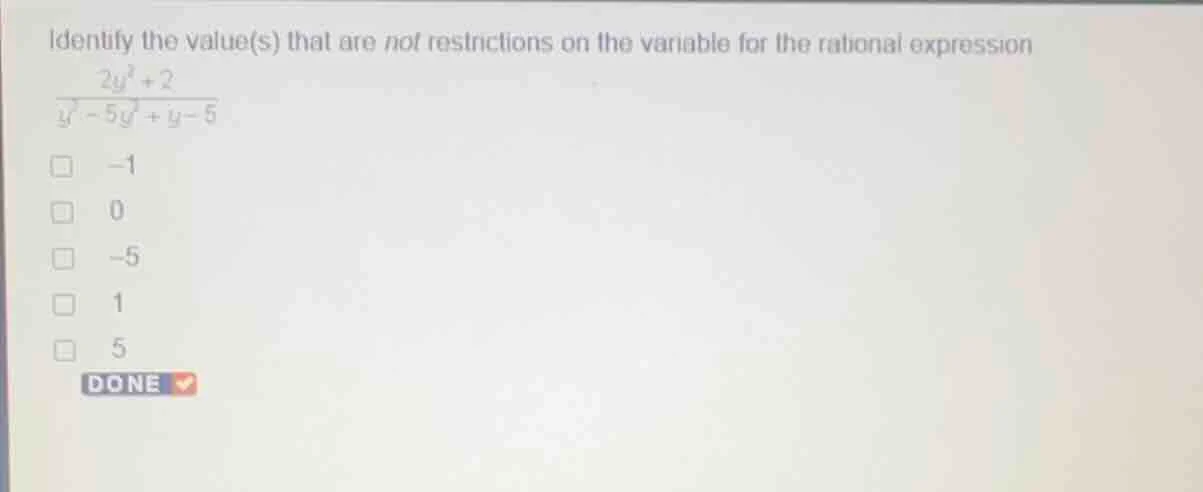
identify the value(s) that are not restrictions on the variable for the rational expression \\(\frac{2y^2 + 2}{y^3 - 5y^2 + y - 5}\\) \
\\(\square\\) \\(-1\\) \
\\(\square\\) \\(0\\) \
\\(\square\\) \\(-5\\) \
\\(\square\\) \\(1\\) \
\\(\square\\) \\(5\\) \
done
Step1: Factor the denominator
Factor \(y^3 - 5y^2 + y - 5\) by grouping. Group the first two terms and the last two terms:
\((y^3 - 5y^2)+(y - 5)=y^2(y - 5)+1(y - 5)=(y^2 + 1)(y - 5)\)
Step2: Find the restrictions
For a rational expression, the denominator cannot be zero. So we set each factor equal to zero and solve for \(y\):
- For \(y^2+1 = 0\), \(y^2=-1\), which has no real solutions.
- For \(y - 5=0\), we get \(y = 5\). So the only real restriction is \(y = 5\).
Now we check the given values:
- For \(y=-1\): Substitute into the denominator \(((-1)^2 + 1)((-1)-5)=(1 + 1)(-6)=2\times(-6)=-12
eq0\), so \(-1\) is not a restriction.
- For \(y = 0\): Substitute into the denominator \((0^2 + 1)(0 - 5)=(0 + 1)(-5)=-5
eq0\), so \(0\) is not a restriction.
- For \(y=-5\): Substitute into the denominator \(((-5)^2 + 1)((-5)-5)=(25 + 1)(-10)=26\times(-10)=-260
eq0\), so \(-5\) is not a restriction.
- For \(y = 1\): Substitute into the denominator \((1^2 + 1)(1 - 5)=(1 + 1)(-4)=2\times(-4)=-8
eq0\), so \(1\) is not a restriction.
- For \(y = 5\): As we found earlier, the denominator is zero, so \(5\) is a restriction.

Snap & solve any problem in the app
Get step-by-step solutions on Sovi AI
Photo-based solutions with guided steps
Explore more problems and detailed explanations
-1, 0, -5, 1 (These values do not make the denominator zero, so they are not restrictions. The value 5 is a restriction as it makes the denominator zero.)