QUESTION IMAGE
Question
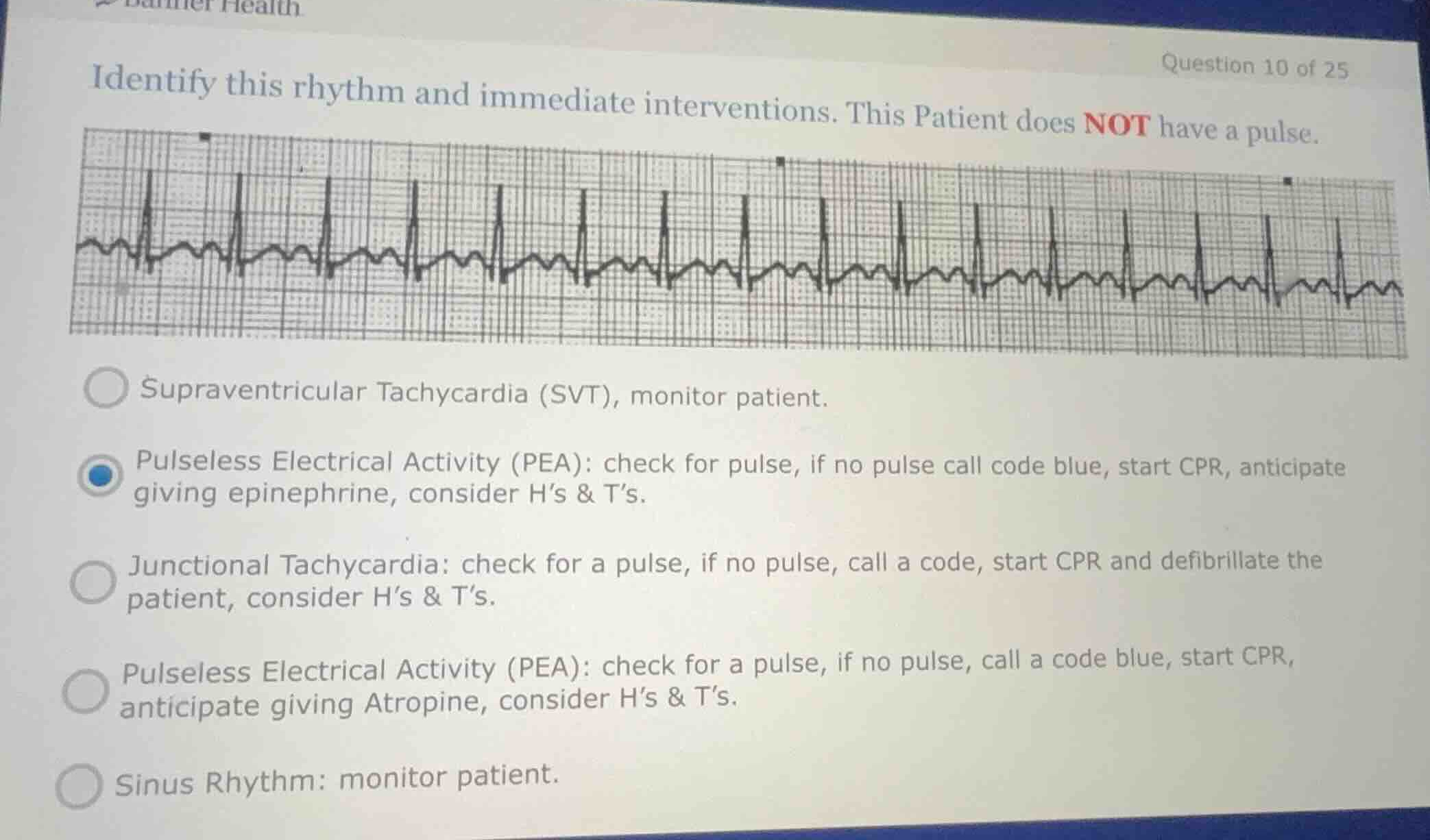
identify this rhythm and immediate interventions. this patient does not have a pulse.
supraventricular tachycardia (svt), monitor patient.
pulseless electrical activity (pea): check for pulse, if no pulse call code blue, start cpr, anticipate giving epinephrine, consider hs & ts.
junctional tachycardia: check for a pulse, if no pulse, call a code, start cpr and defibrillate the patient, consider hs & ts.
pulseless electrical activity (pea): check for pulse, if no pulse, call a code blue, start cpr, anticipate giving atropine, consider hs & ts.
sinus rhythm: monitor patient.
Analyze the ECG rhythm and clinical presentation
The ECG strip shows an organized rhythm with regular QRS complexes and visible P waves, resembling a sinus rhythm or supraventricular rhythm. However, the clinical prompt explicitly states: "This Patient does NOT have a pulse."
Determine the clinical diagnosis
An organized electrical rhythm on an ECG in the absence of a palpable pulse is the definition of Pulseless Electrical Activity (PEA).
Identify the correct intervention protocol
The management of PEA cardiac arrest involves:
- Initiating high-quality CPR.
- Calling a code blue.
- Administering Epinephrine (not Atropine, which is no longer in the standard cardiac arrest algorithm).
- Identifying and treating reversible causes (H's and T's).

Snap & solve any problem in the app
Get step-by-step solutions on Sovi AI
Photo-based solutions with guided steps
Explore more problems and detailed explanations
- Supraventricular Tachycardia (SVT), monitor patient.
- Pulseless Electrical Activity (PEA): check for pulse, if no pulse call code blue, start CPR, anticipate giving epinephrine, consider H's & T's. (Correct answer)
- Junctional Tachycardia: check for a pulse, if no pulse, call a code, start CPR and defibrillate the patient, consider H's & T's.
- Pulseless Electrical Activity (PEA): check for a pulse, if no pulse, call a code blue, start CPR, anticipate giving Atropine, consider H's & T's.
- Sinus Rhythm: monitor patient.