QUESTION IMAGE
Question
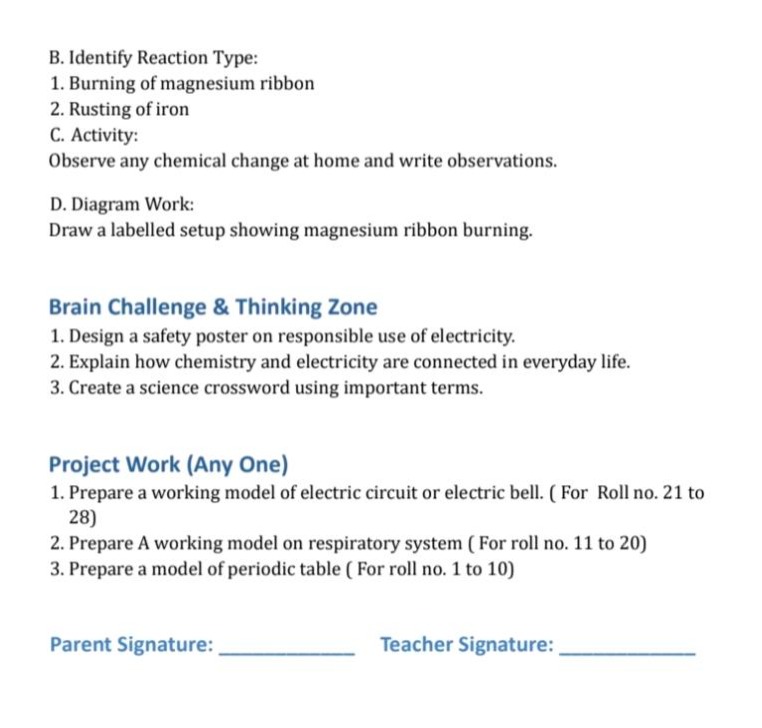
b. identify reaction type:
- burning of magnesium ribbon
- rusting of iron
c. activity:
observe any chemical change at home and write observations.
d. diagram work:
draw a labelled setup showing magnesium ribbon burning.
brain challenge & thinking zone
- design a safety poster on responsible use of electricity.
- explain how chemistry and electricity are connected in everyday life.
- create a science crossword using important terms.
project work (any one)
- prepare a working model of electric circuit or electric bell. ( for roll no. 21 to 28)
- prepare a working model on respiratory system ( for roll no. 11 to 20)
- prepare a model of periodic table ( for roll no. 1 to 10)
parent signature: ____ teacher signature: ____
🆕 New Concept Discovered: Chemical Reaction Types
How substances change into entirely new substances
Step 1: Identify Reaction Types (Section B)
To identify the reaction types, we look at what happens to the substances chemically:
- Burning of magnesium ribbon: When magnesium burns in the presence of oxygen, it combines with oxygen to form magnesium oxide.
Because two reactants combine to form a single product, this is a Combination Reaction (specifically, a Combustion/Oxidation Reaction).
- Rusting of iron: Iron reacts slowly with oxygen and moisture (water) in the air to form hydrated iron(III) oxide (rust).
This is also a Combination Reaction (specifically, a slow Oxidation Reaction).
---
Step 2: Describe a Home Chemical Change Activity (Section C)
A simple, safe chemical change you can observe at home is the reaction between baking soda and vinegar.
- Observation: When you mix a spoonful of baking soda (sodium bicarbonate) with a splash of vinegar (acetic acid) in a cup, it immediately begins to fizz and bubble vigorously, releasing carbon dioxide gas. The cup also feels slightly colder (an endothermic reaction).
---
Step 3: Describe the Diagram Setup for Burning Magnesium (Section D)
To draw a labeled setup showing a magnesium ribbon burning, include the following components:
- Pair of tongs: Holding one end of the magnesium ribbon.
- Magnesium ribbon: Burning with a dazzling, brilliant white flame.
- Bunsen burner (or spirit lamp): Providing the flame to ignite the ribbon.
- Watch glass (or petri dish): Placed underneath to collect the white powder product, which is Magnesium Oxide (\(\text{MgO}\)).
- Safety Note: Wear safety goggles to protect your eyes from the bright UV light.
---
Step 4: Answer Brain Challenge & Thinking Zone (Questions 1 & 2)
- Safety Poster Ideas on Responsible Use of Electricity:
- Headline: "Stay Safe, Stay Connected!"
- Rule 1: Never touch electrical switches or appliances with wet hands (water conducts electricity).
- Rule 2: Do not overload electrical sockets with too many plugs.
- Rule 3: Keep electrical cords away from water sources and heat.
- Rule 4: Never pull a plug out by tugging on its cord; pull the plug itself.
- Connection Between Chemistry and Electricity:
- Batteries: The devices we use to power our phones, laptops, and toys rely on chemical reactions inside them to generate electrical energy (electrochemistry).
- Power Generation: Burning fossil fuels (a chemical combustion reaction) is used to generate steam that spins turbines to produce electricity.
---

Snap & solve any problem in the app
Get step-by-step solutions on Sovi AI
Photo-based solutions with guided steps
Explore more problems and detailed explanations
B. Identify Reaction Type:
- Burning of magnesium ribbon: Combination Reaction (Oxidation / Combustion)
- Rusting of iron: Combination Reaction (Oxidation / Corrosion)
C. Activity (Home Observation):
- Chemical Change: Mixing baking soda and vinegar.
- Observation: Vigorous bubbling and fizzing due to the rapid release of carbon dioxide gas (\(\text{CO}_2\)).
D. Diagram Work:
To draw the setup, sketch a hand holding a pair of tongs which grips a magnesium ribbon over a burner flame. Show a brilliant white light radiating from the burning tip, with white ash (magnesium oxide) falling into a watch glass placed below.
Brain Challenge & Thinking Zone:
- Safety Poster Rules:
- Do not touch switches with wet hands.
- Do not overload sockets.
- Pull the plug, not the cord.
- Chemistry & Electricity Connection: Batteries convert stored chemical energy into electrical energy to power everyday portable devices.