QUESTION IMAGE
Question
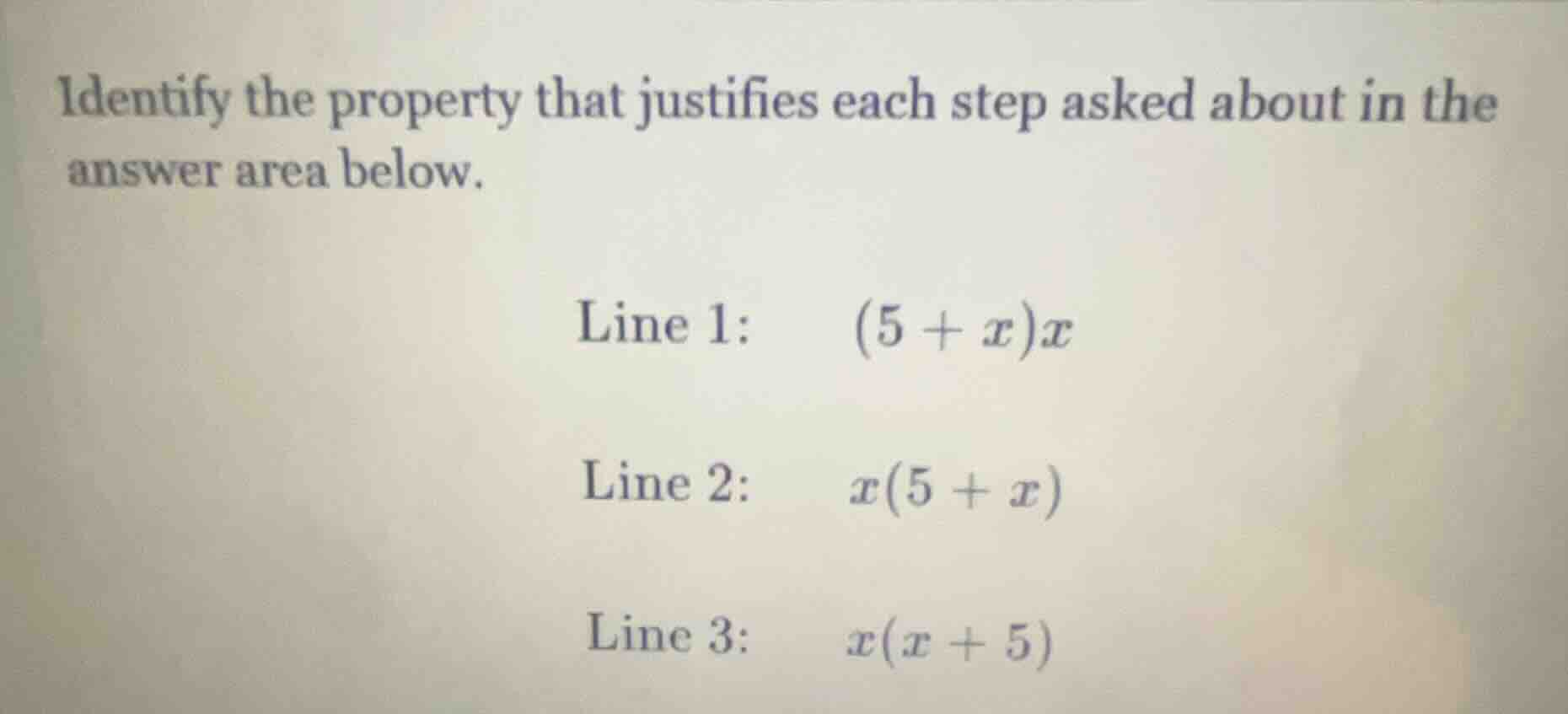
identify the property that justifies each step asked about in the answer area below. line 1: (5 + x)x line 2: x(5 + x) line 3: x(x + 5)
For Line 1 to Line 2:
Step1: Recall multiplication property
The multiplication property that allows changing the order of factors is the commutative property of multiplication, which states that for any real numbers \(a\) and \(b\), \(ab = ba\).
Here, \(a=(5 + x)\) and \(b = x\), so \((5 + x)x=x(5 + x)\) by the commutative property of multiplication.
Step2: For Line 2 to Line 3
The addition property that allows changing the order of addends is the commutative property of addition, which states that for any real numbers \(a\) and \(b\), \(a + b=b + a\).
Here, inside the parentheses, \(5 + x=x + 5\) by the commutative property of addition, so \(x(5 + x)=x(x + 5)\) by substituting \(5 + x\) with \(x + 5\) (using the commutative property of addition on the addends inside the parentheses).

Snap & solve any problem in the app
Get step-by-step solutions on Sovi AI
Photo-based solutions with guided steps
Explore more problems and detailed explanations
- From Line 1 to Line 2: Commutative Property of Multiplication (since we re - ordered the factors \((5 + x)\) and \(x\) in the multiplication \((5 + x)x\) to get \(x(5 + x)\)).
- From Line 2 to Line 3: Commutative Property of Addition (since we re - ordered the addends \(5\) and \(x\) in the sum \(5 + x\) to get \(x + 5\) inside the parentheses of \(x(5 + x)\) to form \(x(x + 5)\)).