QUESTION IMAGE
Question
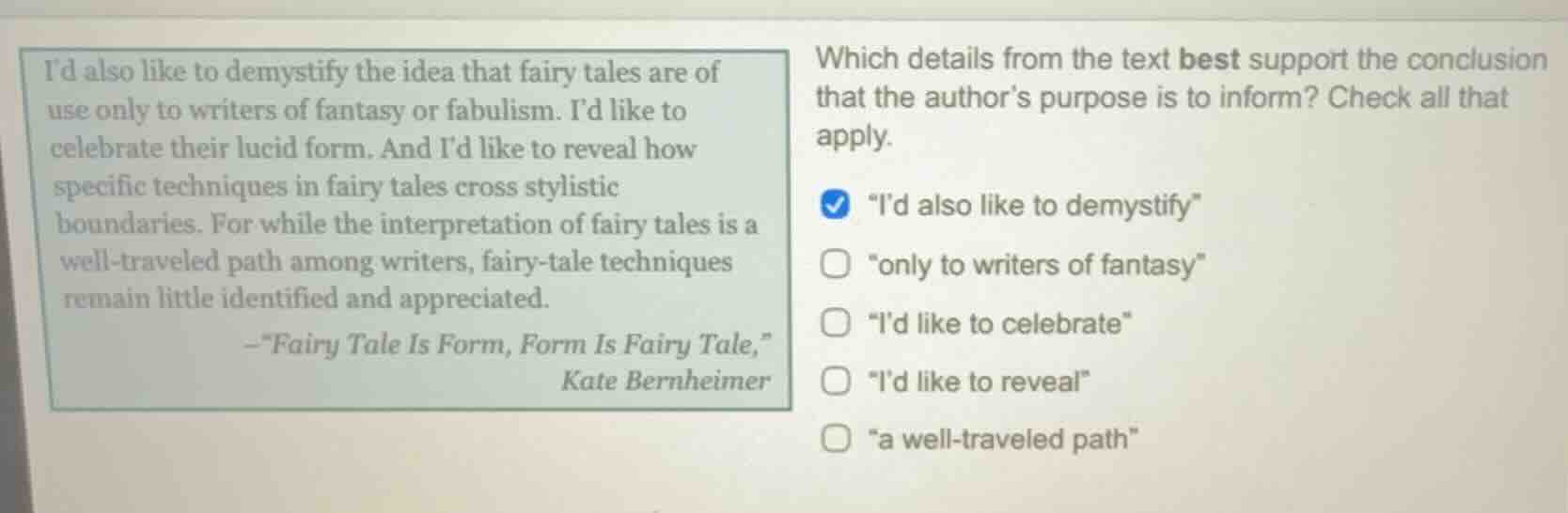
id also like to demystify the idea that fairy tales are of use only to writers of fantasy or fabulism. id like to celebrate their lucid form. and id like to reveal how specific techniques in fairy tales cross stylistic boundaries. for while the interpretation of fairy tales is a well-traveled path among writers, fairy-tale techniques remain little identified and appreciated.
-\fairy tale is form, form is fairy tale,\
kate bernheimer
which details from the text best support the conclusion that the authors purpose is to inform? check all that apply.
\id also like to demystify\
\only to writers of fantasy\
\id like to celebrate\
\id like to reveal\
\a well-traveled path\
Analyze the author's purpose
The question asks which details from the text best support the conclusion that the author's purpose is to inform. An informative purpose aims to clarify, explain, or make something known to the reader.
Evaluate the text and choices
Using the Authors Purpose Analysis knowledge point:
- "demystify" means to make a difficult subject clearer or easier to understand, which directly aligns with an informative purpose.
- "reveal" means to make previously unknown information known, which also directly supports an informative purpose.
- "celebrate" aligns more with an expressive, appreciative, or persuasive purpose rather than strictly informative.
- "only to writers of fantasy" and "a well-traveled path" are contextual details rather than active verbs indicating an intent to inform.
Therefore, the phrases "I'd also like to demystify" and "I'd like to reveal" are the best evidence of an informative purpose.

Snap & solve any problem in the app
Get step-by-step solutions on Sovi AI
Photo-based solutions with guided steps
Explore more problems and detailed explanations
- "I'd also like to demystify" (Correct answer)
- "only to writers of fantasy"
- "I'd like to celebrate"
- "I'd like to reveal" (Correct answer)
- "a well-traveled path"