Sovi.AI - AI Math Tutor

Scan to solve math questions

QUESTION IMAGE

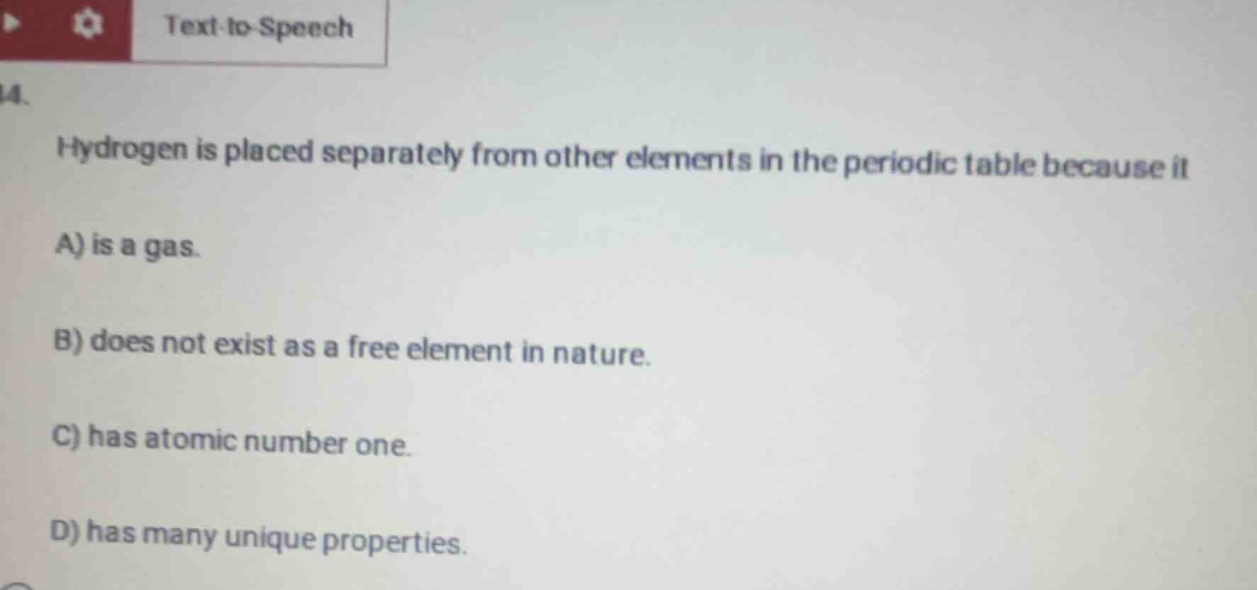
hydrogen is placed separately from other elements in the periodic table…

Question

hydrogen is placed separately from other elements in the periodic table because it

a) is a gas.

b) does not exist as a free element in nature.

c) has atomic number one.

d) has many unique properties.

Explanation:

Response

<pre_analysis>
{
"quality": "clear",
"question_count": 1,
"skills_matched": [
"direct_cot",
"multiple_choice_formatter",
"explain_then_answer",
"quick"
],
"needs_drawing": false,
"concepts_used": [],
"new_concepts": [
"Hydrogen Properties",
"Periodic Table Organization"
],
"current_concepts": [
"Hydrogen Properties",
"Periodic Table Organization"
]
}
</pre_analysis>

<reasoning>

Analyze the placement of hydrogen in the periodic table

Hydrogen is a nonmetal with one valence electron, meaning it can behave like alkali metals (losing an electron) or halogens (gaining an electron), giving it unique chemical and physical properties that do not fit perfectly into any single group.

Evaluate the given options

  • A is incorrect because other gases (like noble gases, oxygen, nitrogen, fluorine, chlorine) are placed within standard groups.
  • B is incorrect because many other elements (like sodium or fluorine) do not exist freely in nature but are placed in standard groups.
  • C is incorrect because helium has atomic number two and is placed in Group 18, and atomic number alone does not require separate placement.
  • D is correct because hydrogen's unique properties prevent it from fitting neatly into any single chemical family.

</reasoning>

<answer>
<mcq-option>(A) is a gas.</mcq-option>
<mcq-option>(B) does not exist as a free element in nature.</mcq-option>
<mcq-option>(C) has atomic number one.</mcq-option>
<mcq-correct>(D) has many unique properties.</mcq-correct>
</answer>

<post_analysis>
{
"subject": "Natural Science",
"question_type": "Multiple Choice",
"knowledge_point": [
"Natural Science",
"Chemistry",
"Periodic Table Organization"
]
}
</post_analysis>

Answer:

<pre_analysis>
{
"quality": "clear",
"question_count": 1,
"skills_matched": [
"direct_cot",
"multiple_choice_formatter",
"explain_then_answer",
"quick"
],
"needs_drawing": false,
"concepts_used": [],
"new_concepts": [
"Hydrogen Properties",
"Periodic Table Organization"
],
"current_concepts": [
"Hydrogen Properties",
"Periodic Table Organization"
]
}
</pre_analysis>

<reasoning>

Analyze the placement of hydrogen in the periodic table

Hydrogen is a nonmetal with one valence electron, meaning it can behave like alkali metals (losing an electron) or halogens (gaining an electron), giving it unique chemical and physical properties that do not fit perfectly into any single group.

Evaluate the given options

  • A is incorrect because other gases (like noble gases, oxygen, nitrogen, fluorine, chlorine) are placed within standard groups.
  • B is incorrect because many other elements (like sodium or fluorine) do not exist freely in nature but are placed in standard groups.
  • C is incorrect because helium has atomic number two and is placed in Group 18, and atomic number alone does not require separate placement.
  • D is correct because hydrogen's unique properties prevent it from fitting neatly into any single chemical family.

</reasoning>

<answer>
<mcq-option>(A) is a gas.</mcq-option>
<mcq-option>(B) does not exist as a free element in nature.</mcq-option>
<mcq-option>(C) has atomic number one.</mcq-option>
<mcq-correct>(D) has many unique properties.</mcq-correct>
</answer>

<post_analysis>
{
"subject": "Natural Science",
"question_type": "Multiple Choice",
"knowledge_point": [
"Natural Science",
"Chemistry",
"Periodic Table Organization"
]
}
</post_analysis>