QUESTION IMAGE
Question
the human experience
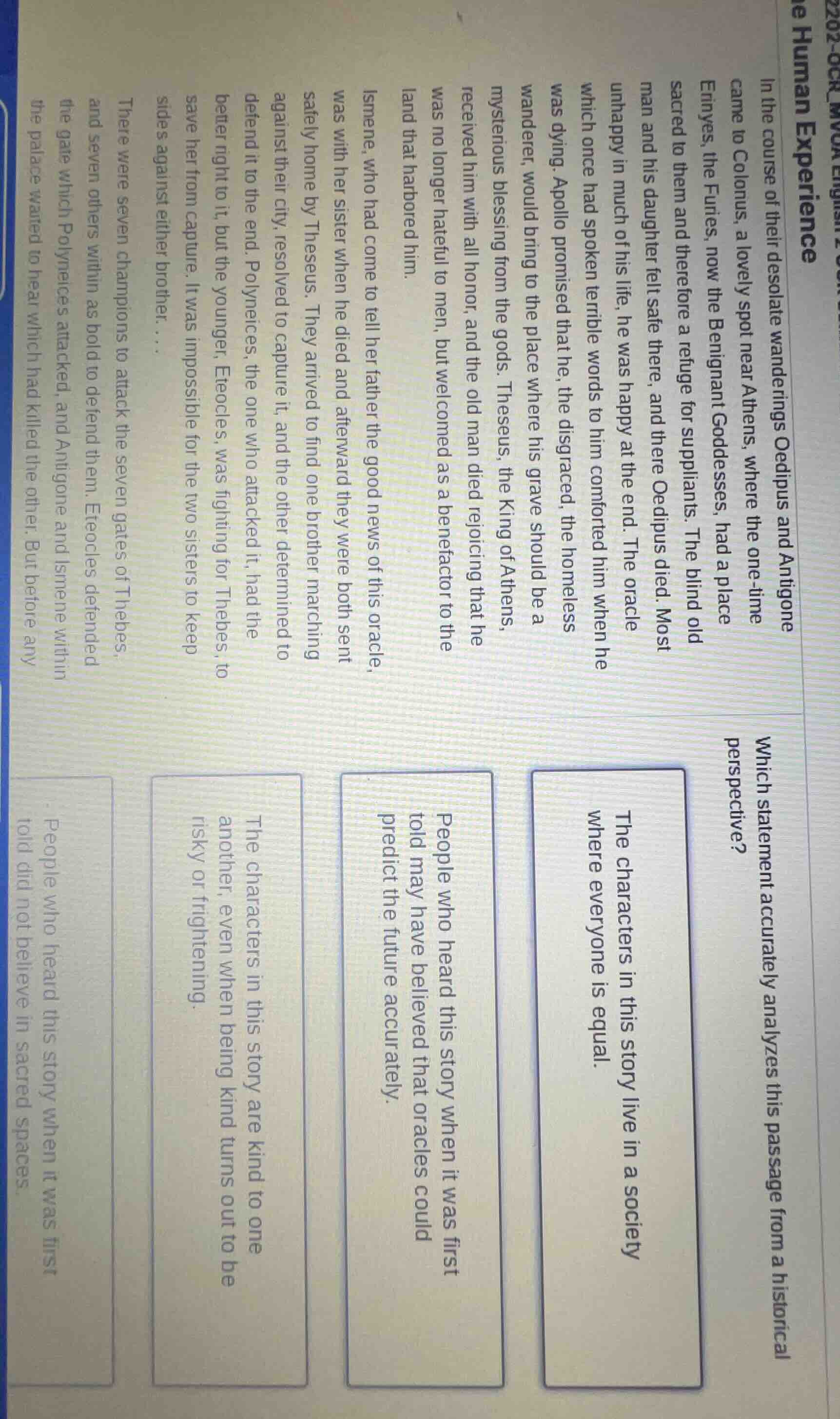
in the course of their desolate wanderings oedipus and antigone
came to colonus, a lovely spot near athens, where the one - time
erinyes, the furies, now the benignant goddesses, had a place
sacred to them and therefore a refuge for suppliants. the blind old
man and his daughter felt safe there, and there oedipus died. most
unhappy in much of his life, he was happy at the end. the oracle
which once had spoken terrible words to him comforted him when he
was dying. apollo promised that he, the disgraced, the homeless
wanderer, would bring to the place where his grave should be a
mysterious blessing from the gods. theseus, the king of athens,
received him with all honor, and the old man died rejoicing that he
was no longer hateful to men, but welcomed as a benefactor to the
land that harbored him.
ismene, who had come to tell her father the good news of this oracle,
was with her sister when he died and afterward they were both sent
safely home by theseus. they arrived to find one brother marching
against their city, resolved to capture it, and the other determined to
defend it to the end. polyneices, the one who attacked it, had the
better right to it, but the younger, eteocles, was fighting for thebes, to
save her from capture. it was impossible for the two sisters to keep
sides against either brother.
there were seven champions to attack the seven gates of thebes,
and seven others within as bold to defend them. eteocles defended
the gate which polyneices attacked, and antigone and ismene within
the palace waited to hear which had killed the other. but before any
which statement accurately analyzes this passage from a historical
perspective?
the characters in this story live in a society
where everyone is equal.
people who heard this story when it was first
told may have believed that oracles could
predict the future accurately.
the characters in this story are kind to one
another, even when being kind turns out to be
risky or frightening.
people who heard this story when it was first
told did not believe in sacred spaces.
To determine the accurate statement from a historical perspective, we analyze each option:
- Option 1: The passage doesn't suggest the story's setting has an equal - society. Oedipus is a blind old man, and there are power dynamics (e.g., fighting over Thebes' gates), so this is incorrect.
- Option 2: In ancient Greek society, oracles were highly regarded, and people believed they could predict the future accurately. The passage mentions Apollo's oracle comforting Oedipus, which aligns with this belief, so this is accurate.
- Option 3: The passage focuses on the story's events, not the characters' behavior in terms of being kind then risky. This is not relevant to a historical perspective on the passage.
- Option 4: The passage includes sacred spaces (e.g., Colonus with a place sacred to deities) and oracles, which were part of ancient Greek belief. So the idea that people didn't believe in sacred spaces is incorrect.

Snap & solve any problem in the app
Get step-by-step solutions on Sovi AI
Photo-based solutions with guided steps
Explore more problems and detailed explanations
B. People who heard this story when it was first told may have believed that oracles could predict the future accurately.