QUESTION IMAGE
Question
Question was provided via image upload.
Analyze the sample response
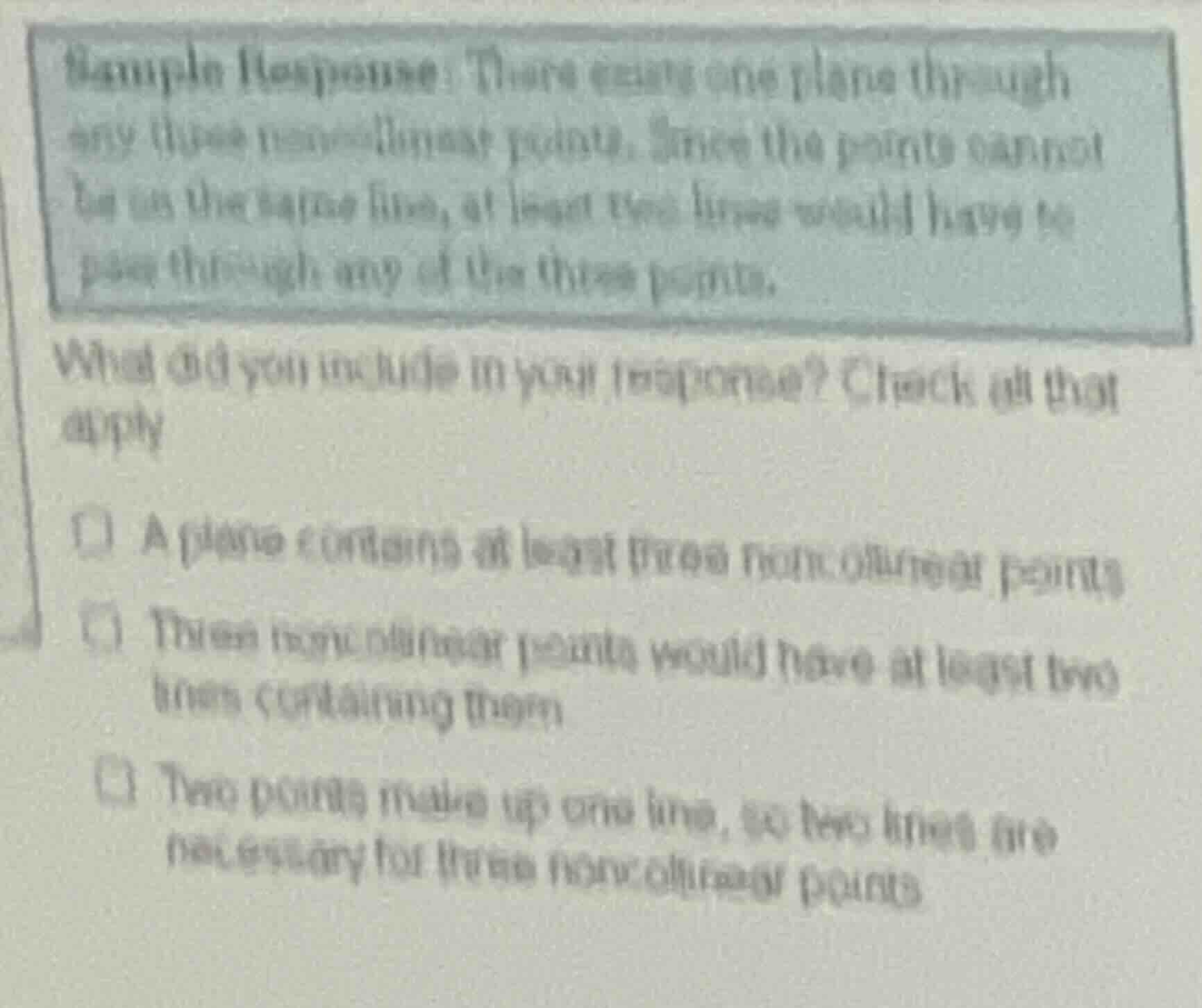
The sample response states: "There exists one plane through any three noncollinear points. Since the points cannot be on the same line, at least two lines would have to pass through any of the three points."
Evaluate the first option
The first option is: "A plane contains at least three noncollinear points".
The sample response explicitly mentions: "There exists one plane through any three noncollinear points." This directly corresponds to the idea that a plane is determined by or contains three noncollinear points. Thus, this concept is included.
Evaluate the second option
The second option is: "Three noncollinear points would have to have at least two lines containing them".
The sample response explicitly states: "Since the points cannot be on the same line, at least two lines would have to pass through any of the three points." This matches the second option.
Evaluate the third option
The third option is: "Two points make up one line, so two lines are necessary for three noncollinear points".
The sample response explains that because the three points are noncollinear (cannot be on the same line), at least two lines are needed to connect them. Since any two points determine a unique line, three noncollinear points cannot all lie on a single line, requiring multiple lines. This reasoning is fully aligned with the sample response.

Snap & solve any problem in the app
Get step-by-step solutions on Sovi AI
Photo-based solutions with guided steps
Explore more problems and detailed explanations
- A plane contains at least three noncollinear points (Correct answer)
- Three noncollinear points would have to have at least two lines containing them (Correct answer)
- Two points make up one line, so two lines are necessary for three noncollinear points (Correct answer)