QUESTION IMAGE
Question
Question was provided via image upload.
Analyze Cytochrome C ubiquity
Using the Cytochrome C Analysis and Evolutionary Evidence knowledge points:
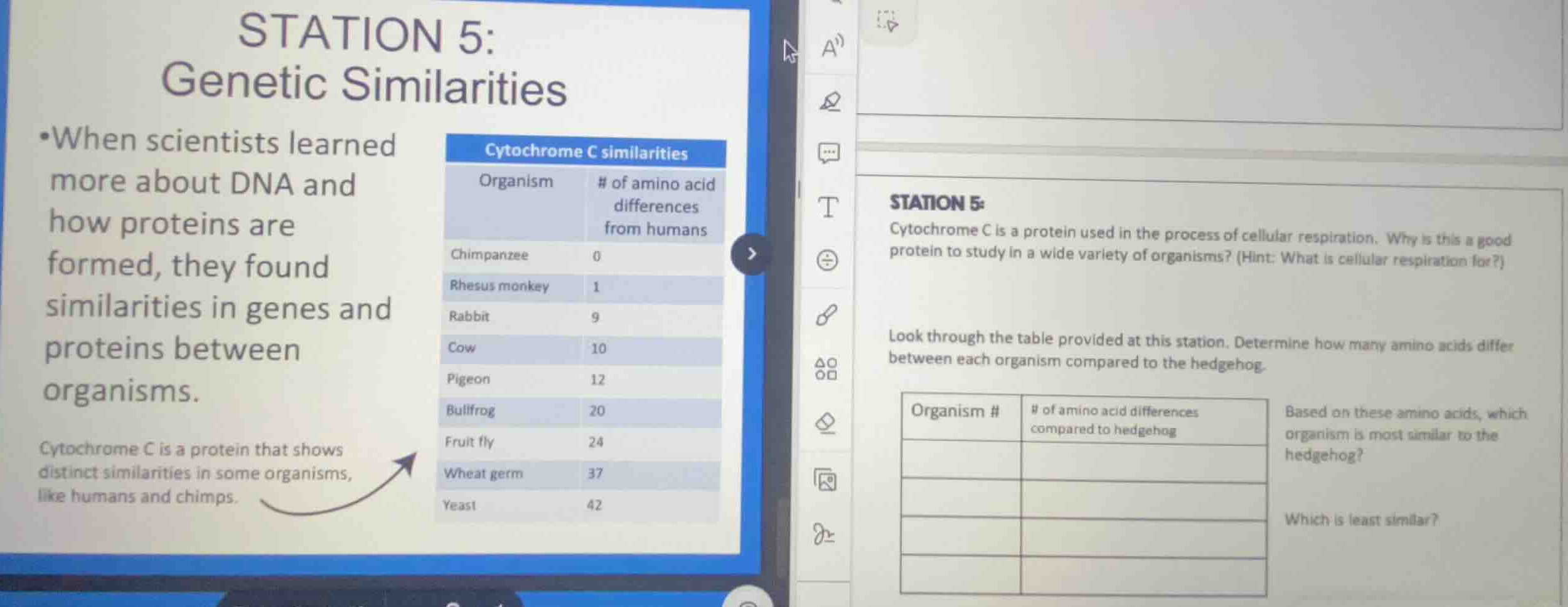
Cytochrome C is essential for cellular respiration, a universal process for generating ATP in aerobic organisms. Because cellular respiration is fundamental to life, Cytochrome C is highly conserved across diverse taxonomic domains, making it an ideal molecular marker to study evolutionary relationships.
Identify missing data constraints
The worksheet asks to determine amino acid differences compared to the "hedgehog." However, the provided reference table on the left ("Cytochrome C similarities") lists differences relative to "humans," and does not contain data for a hedgehog. Without the hedgehog's specific sequence or its differences relative to humans, direct numerical comparison is mathematically underdetermined.
Infer relative similarities
Using the Evolutionary Evidence knowledge point:
Even without the explicit hedgehog data table, we can answer the conceptual questions. Organisms with the fewest amino acid differences in Cytochrome C are most closely related. Among the listed organisms, the Chimpanzee (0 differences from humans) and Rhesus monkey (1 difference) are mammals, which are evolutionarily closest to another mammal like a hedgehog. Yeast (42 differences) and Wheat germ (37 differences) are the most distantly related.

Snap & solve any problem in the app
Get step-by-step solutions on Sovi AI
Photo-based solutions with guided steps
Explore more problems and detailed explanations
Question 1
Cytochrome C is an essential protein in the electron transport chain of cellular respiration. Because cellular respiration is a fundamental process required by almost all living organisms to produce energy (ATP), this protein is highly conserved across a wide variety of species, making it excellent for tracing deep evolutionary relationships.
Question 2
The provided reference table lists amino acid differences compared to humans, but does not contain the data for a hedgehog. To complete this table, the specific amino acid difference data for the hedgehog is required.
Question 3
Based on evolutionary classification, the organism most similar to the hedgehog (which is a mammal) would be the other mammals in the list with the fewest differences, such as the Chimpanzee or Rhesus monkey.
Question 4
The organism least similar to the hedgehog would be Yeast (or Wheat germ), as they are non-animal organisms with the highest number of amino acid differences in Cytochrome C.