QUESTION IMAGE
Question
Question was provided via image upload.
Analyze the tables and limit behavior
The problem asks us to determine the behavior of a function \(f(x)\) as \(x\) approaches zero from both the positive and negative directions using numerical tables.
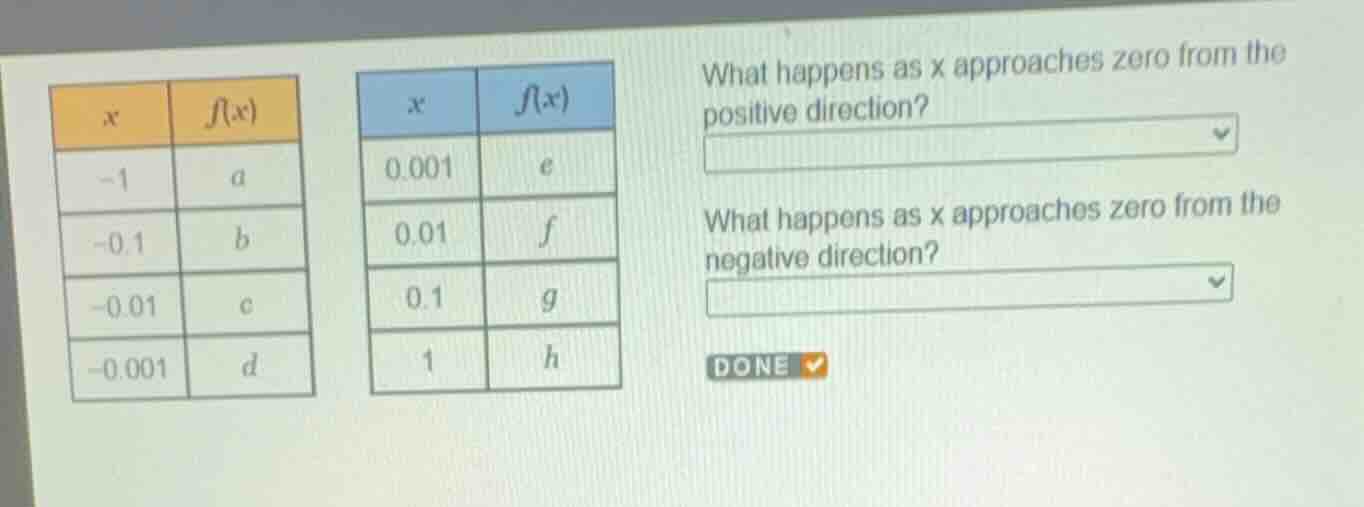
The first table lists negative values of \(x\) that get closer to zero:
- \(x = -1 \implies f(x) = a\)
- \(x = -0.1 \implies f(x) = b\)
- \(x = -0.01 \implies f(x) = c\)
- \(x = -0.001 \implies f(x) = d\)
This table represents \(x\) approaching zero from the negative direction (from the left), denoted as \(x \to 0^-\).
The second table lists positive values of \(x\) that get closer to zero:
- \(x = 1 \implies f(x) = h\)
- \(x = 0.1 \implies f(x) = g\)
- \(x = 0.01 \implies f(x) = f\)
- \(x = 0.001 \implies f(x) = e\)
This table represents \(x\) approaching zero from the positive direction (from the right), denoted as \(x \to 0^+\).
Determine the behavior from the positive direction
Using the Rational Functions concept, we look at the second table where \(x\) values decrease towards \(0\) (\(1 \to 0.1 \to 0.01 \to 0.001\)).
The corresponding function values are \(h, g, f, e\).
As \(x\) approaches zero from the positive direction, we examine the sequence of values \(f(x)\) which progresses from \(h\) to \(e\).
Determine the behavior from the negative direction
Using the Rational Functions concept, we look at the first table where \(x\) values increase towards \(0\) (\(-1 \to -0.1 \to -0.01 \to -0.001\)).
The corresponding function values are \(a, b, c, d\).
As \(x\) approaches zero from the negative direction, we examine the sequence of values \(f(x)\) which progresses from \(a\) to \(d\).

Snap & solve any problem in the app
Get step-by-step solutions on Sovi AI
Photo-based solutions with guided steps
Explore more problems and detailed explanations
Question 1
As \(x\) approaches zero from the positive direction, the values of \(f(x)\) progress through the sequence from \(h\) to \(e\) (i.e., \(h \to g \to f \to e\)).
Question 2
As \(x\) approaches zero from the negative direction, the values of \(f(x)\) progress through the sequence from \(a\) to \(d\) (i.e., \(a \to b \to c \to d\)).