QUESTION IMAGE
Question
Question was provided via image upload.
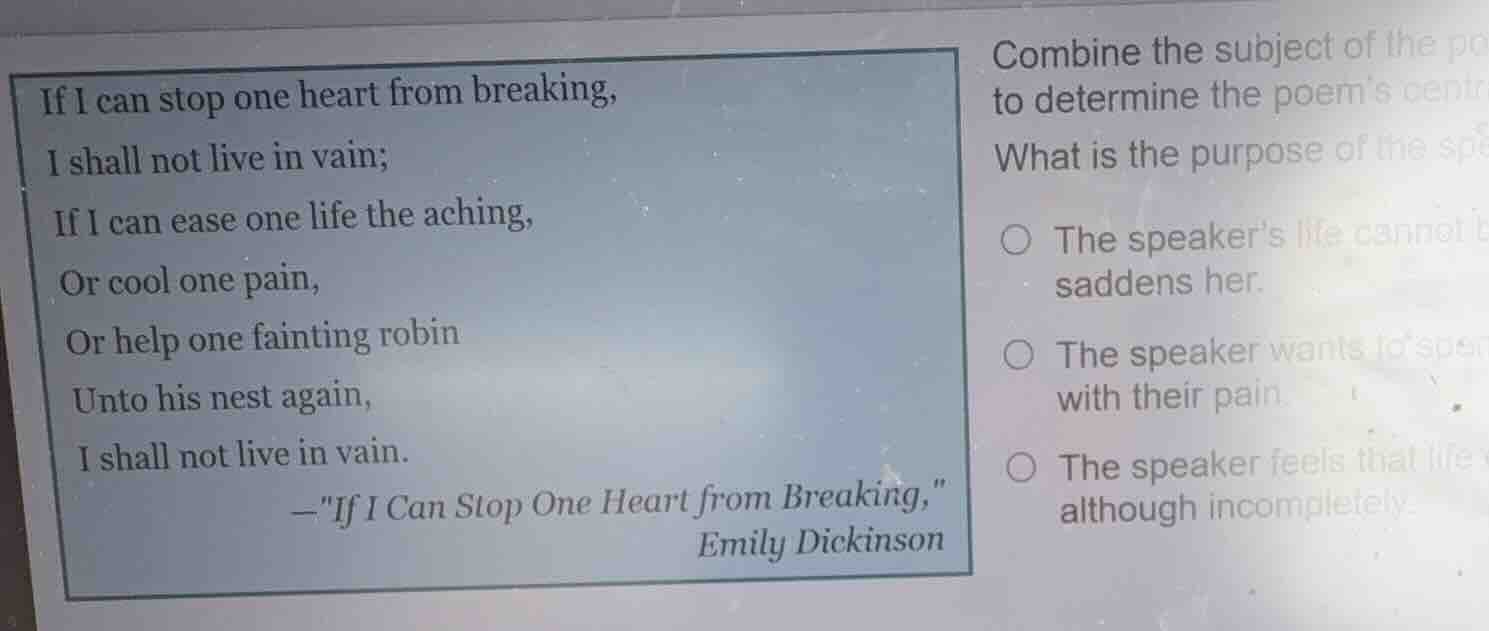
Analyze the poem's theme
The poem by Emily Dickinson expresses that helping others—whether by stopping a heart from breaking, easing an aching life, cooling a pain, or helping a fainting robin back to its nest—gives the speaker's life meaning and purpose ("I shall not live in vain").
Evaluate the visible options
The question asks: "What is the purpose of the speaker?" or "What is the purpose of the speaker's life?" based on the central idea.
- Option 1: "The speaker's life cannot be..." (cut off, likely incorrect context).
- Option 2: "The speaker wants to spend..." (cut off, likely incorrect context).
- Option 3: "The speaker feels that life..." (cut off, but aligns with the theme of finding value/purpose in helping others).
Let's reconstruct the complete standard question and options for this well-known curriculum item:
Question: "What is the purpose of the speaker?" or "What is the central idea?"
Standard options for this question typically include:
- "The speaker wants to help others to make her life meaningful." / "The speaker feels that life is worth living if she can help others."
Looking at the third visible option: "The speaker feels that life [has value/is meaningful if she can help others, even] although incompletely [or in small ways]." This matches the core message of helping even "one" heart, "one" life, or "one" robin.

Snap & solve any problem in the app
Get step-by-step solutions on Sovi AI
Photo-based solutions with guided steps
Explore more problems and detailed explanations
- (A) The speaker's life cannot be happy because the suffering of others saddens her.
- (B) The speaker wants to spend her life helping others cope with their pain.
- (C) The speaker feels that life is worth living if she can help others, even in small ways. (Correct answer)