QUESTION IMAGE
Question
Question was provided via image upload.
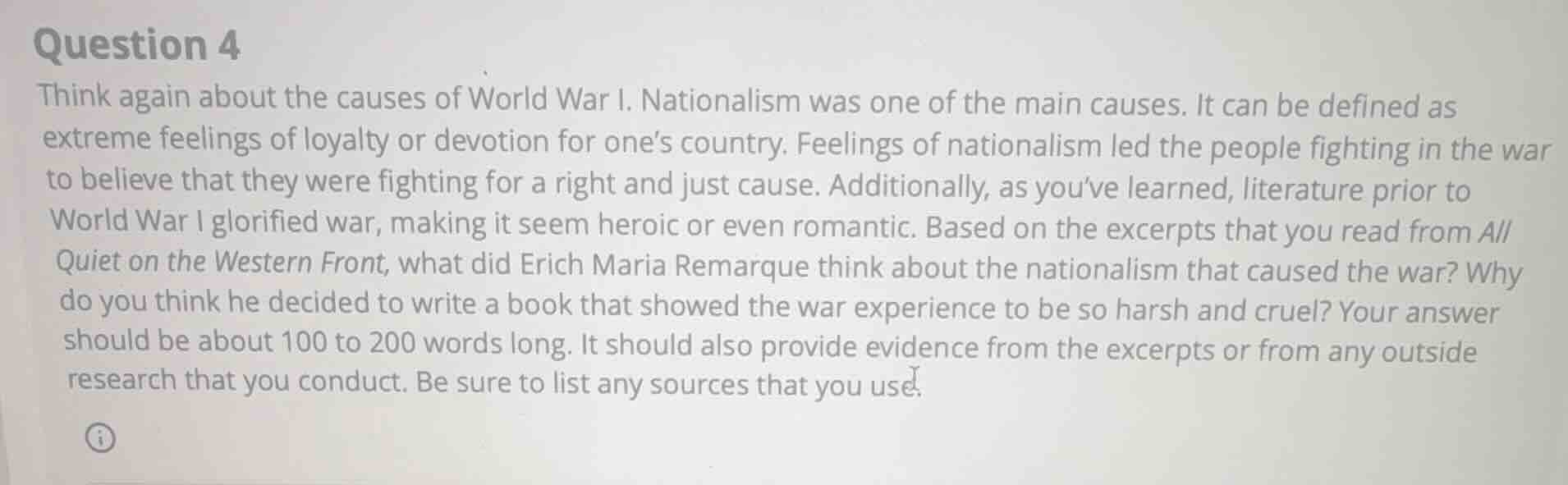
Analyze Remarque's view on nationalism
Erich Maria Remarque viewed the nationalism that fueled the Outbreak of World War I as a destructive, manipulative force. He believed that older generations, such as teachers and authority figures, used romanticized nationalistic rhetoric to pressure young men into volunteering for a brutal conflict they did not understand.
Determine the purpose of the novel
Remarque wrote All Quiet on the Western Front to strip away the heroic myths of war. By depicting the harsh, cruel, and mundane realities of the trenches, he aimed to expose the devastating physical and psychological toll of modern warfare on an entire generation.
Synthesize evidence and draft response
To meet the 100-to-200-word requirement, we combine these points with specific literary context. Remarque's characters, like Paul Bäumer, realize that the nationalistic ideals taught by Kantorek do not survive the reality of artillery fire, showing how nationalism betrayed their youth.

Snap & solve any problem in the app
Get step-by-step solutions on Sovi AI
Photo-based solutions with guided steps
Explore more problems and detailed explanations
In All Quiet on the Western Front, Erich Maria Remarque portrays nationalism as a dangerous illusion used by authority figures to manipulate young men into fighting. He believed that the romanticized patriotism taught in schools was a betrayal, sending an entire generation to be slaughtered under the guise of duty.
Remarque decided to write a book depicting the war as harsh and cruel to shatter the heroic myths surrounding combat. By focusing on the grim realities of trench warfare—such as constant fear, starvation, and the agonizing deaths of his comrades—he sought to expose the true human cost of the conflict. For example, the character of Kantorek, the schoolmaster who pressured Paul and his classmates to enlist, represents the empty nationalistic rhetoric that crumbled under the reality of artillery fire. Remarque wrote this raw account to give a voice to a "destroyed" generation and to serve as a warning against future militarism.
Sources:
- Remarque, Erich Maria. All Quiet on the Western Front. Translated by A.W. Wheen, Little, Brown and Company, 1929.