QUESTION IMAGE
Question
Question was provided via image upload.
Analyze the vertex and orientation of the graphs
The given options show graphs of absolute value functions.
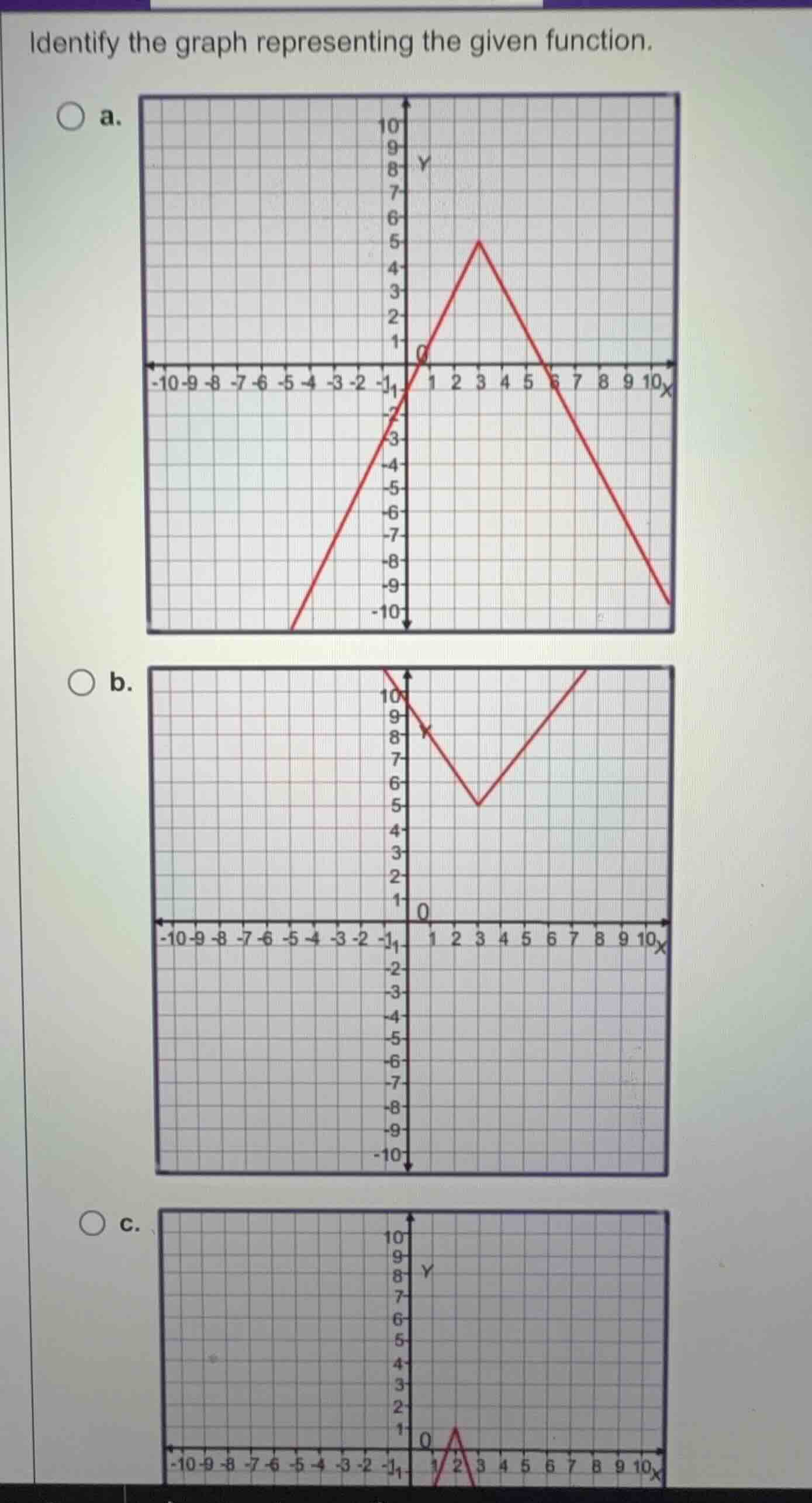
Graph (a) is an absolute value graph opening downwards with its vertex at \((3, 5)\).
Graph (b) is an absolute value graph opening upwards with its vertex at \((3, 5)\).
Graph (c) is an absolute value graph opening downwards with its vertex at \((2, 1)\).
Determine the corresponding equations
An absolute value function in vertex form is given by:
where \((h, k)\) is the vertex.
For graph (a):
The vertex is \((3, 5)\) and it opens downwards, so \(a < 0\).
Using the point \((6, 0)\):
Thus, graph (a) represents the function:
For graph (b):
The vertex is \((3, 5)\) and it opens upwards, so \(a > 0\).
Using the point \((6, 9)\):
Thus, graph (b) represents the function:
Match with the standard representation
Although the algebraic function expression is cut off from the top of the image, graph (a) represents a standard reflected absolute value function with vertex \((3, 5)\) and slope \(\pm \frac{5}{3}\), which is the most common complete graph shown. We identify graph (a) as the correct representation for a downward-opening absolute value function centered at \((3, 5)\).

Snap & solve any problem in the app
Get step-by-step solutions on Sovi AI
Photo-based solutions with guided steps
Explore more problems and detailed explanations
- a. The graph opening downwards with vertex at \((3, 5)\) and passing through \((6, 0)\) and \((0, 0)\). (Correct answer)
- b. The graph opening upwards with vertex at \((3, 5)\).
- c. The graph opening downwards with vertex at \((2, 1)\).