QUESTION IMAGE
Question
Question was provided via image upload.
Analyze the question context
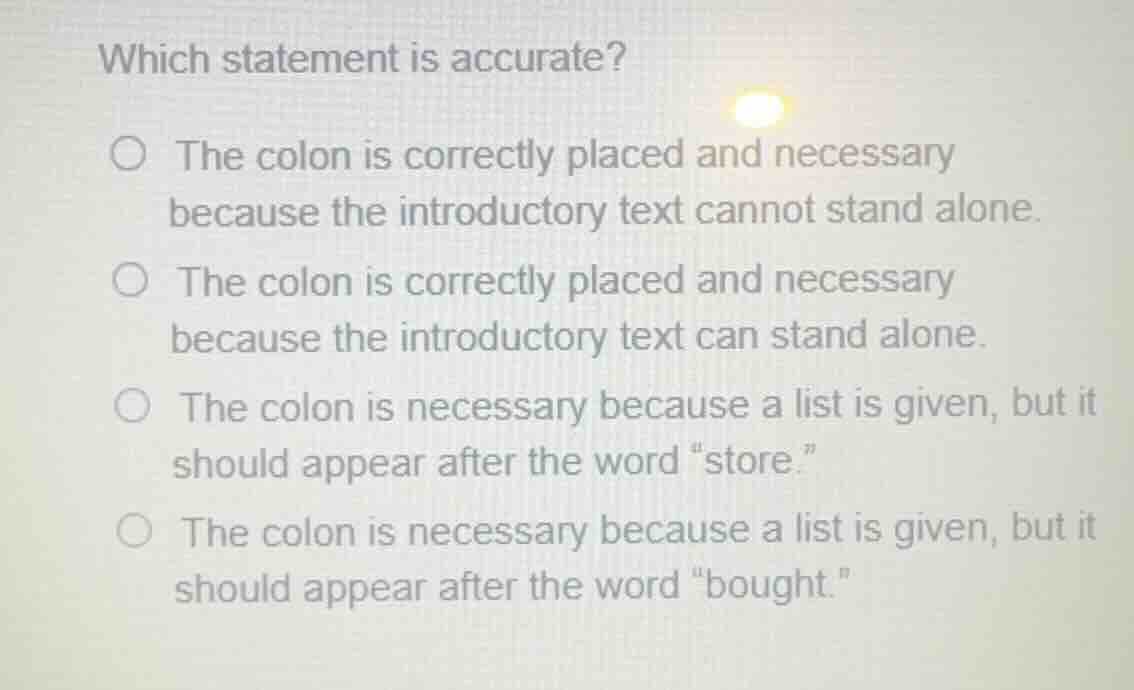
The question asks "Which statement is accurate?" regarding the use of a colon in a sentence that is not fully visible, but can be inferred from the options. The options discuss whether a colon is correctly placed and necessary based on whether the introductory text can stand alone as an independent clause.
Recall colon rules
Using Punctuation Rules, a colon must always be preceded by a complete independent clause (text that can stand alone as a sentence). It is used to introduce a list, an explanation, or a quotation that amplifies the preceding independent clause.
Evaluate the options
- Option 1 states the colon is correct because the introductory text cannot stand alone. This is grammatically incorrect; a colon cannot follow an incomplete sentence.
- Option 2 states the colon is correct because the introductory text can stand alone. This aligns perfectly with standard grammar rules.
- Options 3 and 4 suggest moving the colon, but without the full sentence, the fundamental rule of colons requiring an independent clause beforehand makes Option 2 the only logically sound rule-based statement.
Formulate the explanation
Explain the grammatical rule governing colons: they must follow an independent clause (text that can stand alone). Therefore, the statement "The colon is correctly placed and necessary because the introductory text can stand alone" is the accurate grammatical description.

Snap & solve any problem in the app
Get step-by-step solutions on Sovi AI
Photo-based solutions with guided steps
Explore more problems and detailed explanations
- The colon is correctly placed and necessary because the introductory text cannot stand alone.
- The colon is correctly placed and necessary because the introductory text can stand alone. (Correct answer)
- The colon is necessary because a list is given, but it should appear after the word "store."
- The colon is necessary because a list is given, but it should appear after the word "bought."