QUESTION IMAGE
Question
Question was provided via image upload.
Define restrictive and nonrestrictive clauses
A restrictive (or essential) clause provides necessary information about the noun it modifies. It limits or identifies the noun and is not set off by commas. A nonrestrictive (or nonessential) clause adds extra, parenthetical information that can be removed without changing the core meaning of the sentence. Nonrestrictive clauses are set off by commas.
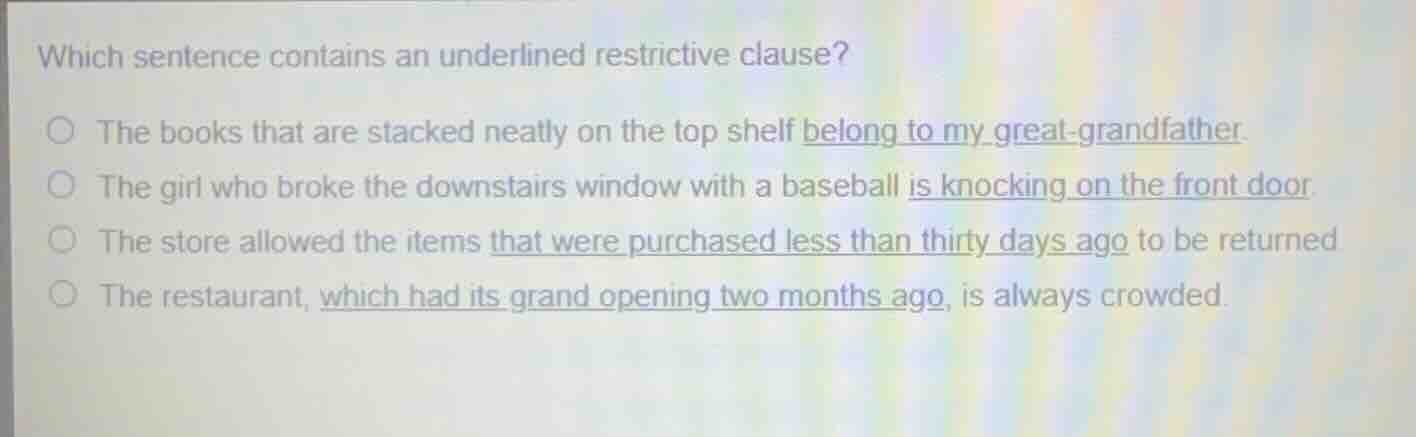
Analyze the first option
In the sentence "The books that are stacked neatly on the top shelf belong to my great-grandfather," the underlined portion is "belong to my great-grandfather." This is the main verb phrase of the sentence, not a relative clause.
Analyze the second option
In the sentence "The girl who broke the downstairs window with a baseball is knocking on the front door," the underlined portion is "is knocking on the front door." This is the main verb phrase of the sentence, not a relative clause.
Analyze the third option
In the sentence "The store allowed the items that were purchased less than thirty days ago to be returned," the underlined portion is "that were purchased less than thirty days ago." This clause identifies which specific items are allowed to be returned. It is essential to the meaning of the sentence and is not set off by commas, making it a restrictive clause.
Analyze the fourth option
In the sentence "The restaurant, which had its grand opening two months ago, is always crowded," the underlined portion is "which had its grand opening two months ago." This clause is set off by commas and adds extra information about the restaurant. This is a nonrestrictive clause.

Snap & solve any problem in the app
Get step-by-step solutions on Sovi AI
Photo-based solutions with guided steps
Explore more problems and detailed explanations
- (A) The books that are stacked neatly on the top shelf _belong to my great-grandfather_.
- (B) The girl who broke the downstairs window with a baseball _is knocking on the front door_.
- (C) The store allowed the items _that were purchased less than thirty days ago_ to be returned. (Correct answer)
- (D) The restaurant, _which had its grand opening two months ago_, is always crowded.