QUESTION IMAGE
Question
Question was provided via image upload.
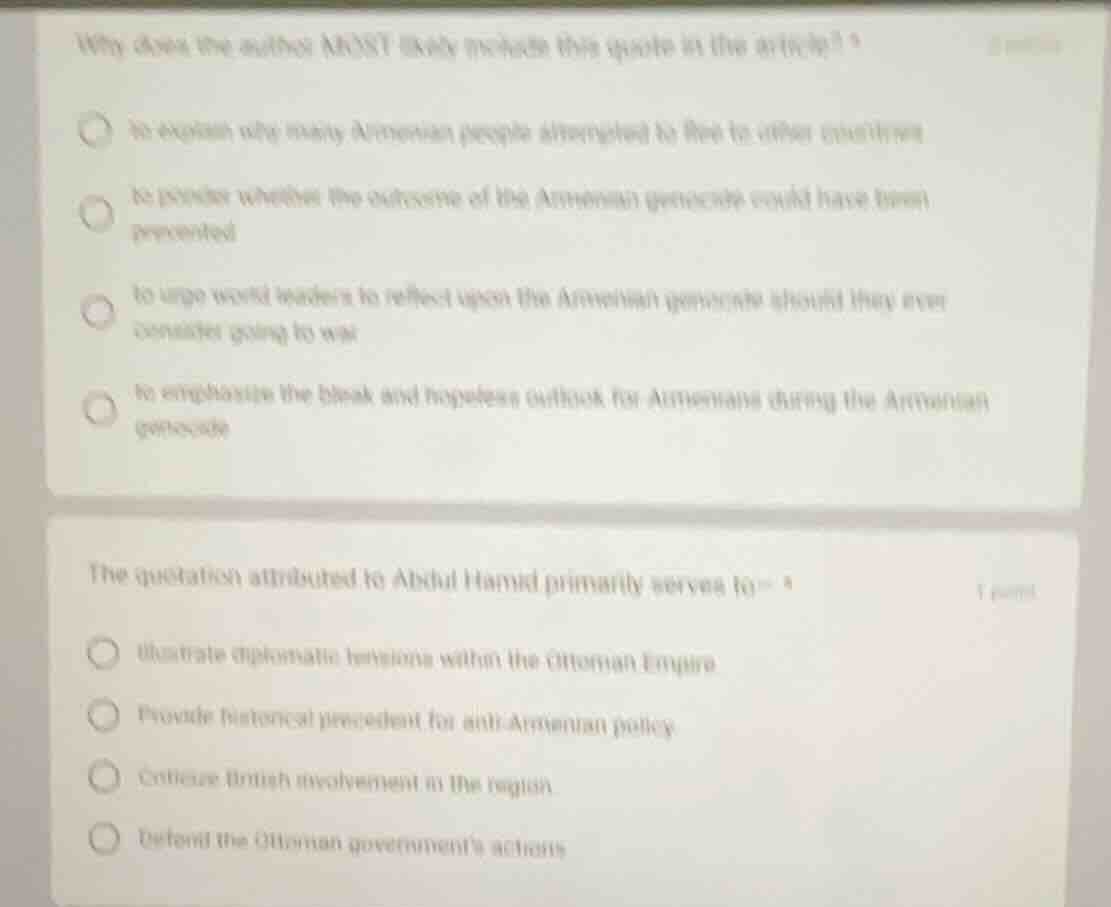
Analyze the first question's intent
The first question asks: "Why does the author MOST likely include this quote in the article?" This requires analyzing authorial intent and rhetorical purpose. The options focus on the Armenian genocide, specifically:
- explaining why Armenian people attempted to flee,
- pondering whether the outcome could have been prevented,
- urging world leaders to reflect upon the genocide before going to war,
- emphasizing the bleak and hopeless outlook for Armenians during the genocide.
Without the full text, we analyze the standard rhetorical function of such historical quotes in articles about the Armenian genocide. The quote is typically used to highlight the severe, tragic, and desperate conditions faced by the victims, which aligns with emphasizing their bleak and hopeless outlook.
Analyze the second question's intent
The second question asks: "The quotation attributed to Abdul Hamid primarily serves to..." Abdul Hamid II was the Ottoman Sultan associated with the Hamidian massacres (1894–1896), which preceded the 1915 genocide.
Using Historical Analysis, a quote from Abdul Hamid II regarding Armenians typically serves to establish the state-sanctioned hostility and systematic prejudice that existed prior to 1915. This provides a historical precedent for the later anti-Armenian policies and genocide.
Evaluate the options for Question 1
- Option 1: Focuses on flight/migration, which is usually a secondary detail rather than the primary rhetorical purpose of a central quote.
- Option 2: Pondering prevention is speculative and less common for direct historical quotes.
- Option 3: Urging leaders not to go to war is a modern lesson, but usually too broad for a specific historical quote's primary function in-text.
- Option 4: Emphasizing the bleak and hopeless outlook directly connects to the emotional and historical weight of the testimony, which is a primary reason authors include such quotes. We select Option 4.
Evaluate the options for Question 2
- Option 1: "Illustrate diplomatic tensions" is too narrow and diplomatic-focused for Abdul Hamid's internal policies.
- Option 2: "Provide historical precedent for anti-Armenian policy" directly connects Abdul Hamid's earlier actions/quotes to the subsequent genocide, showing a pattern of state policy. This is a core concept in Historical Analysis.
- Option 3: "Criticize British involvement" is historically peripheral to his primary statements on internal Armenian affairs.
- Option 4: "Defend the Ottoman government's actions" is incorrect as articles on this topic use his quotes to expose state policy rather than defend it. We select Option 2.

Snap & solve any problem in the app
Get step-by-step solutions on Sovi AI
Photo-based solutions with guided steps
Explore more problems and detailed explanations
Question 1
- (A) to explain why many Armenian people attempted to flee to other countries
- (B) to ponder whether the outcome of the Armenian genocide could have been prevented
- (C) to urge world leaders to reflect upon the Armenian genocide should they ever consider going to war
- (D) to emphasize the bleak and hopeless outlook for Armenians during the Armenian genocide (Correct answer)
Question 2
- (A) illustrate diplomatic tensions within the Ottoman Empire
- (B) Provide historical precedent for anti-Armenian policy (Correct answer)
- (C) Criticize British involvement in the region
- (D) Defend the Ottoman government's actions