QUESTION IMAGE
Question
Question was provided via image upload.
This analysis covers the five multiple-choice questions visible in the passage.
Analyze Question 6
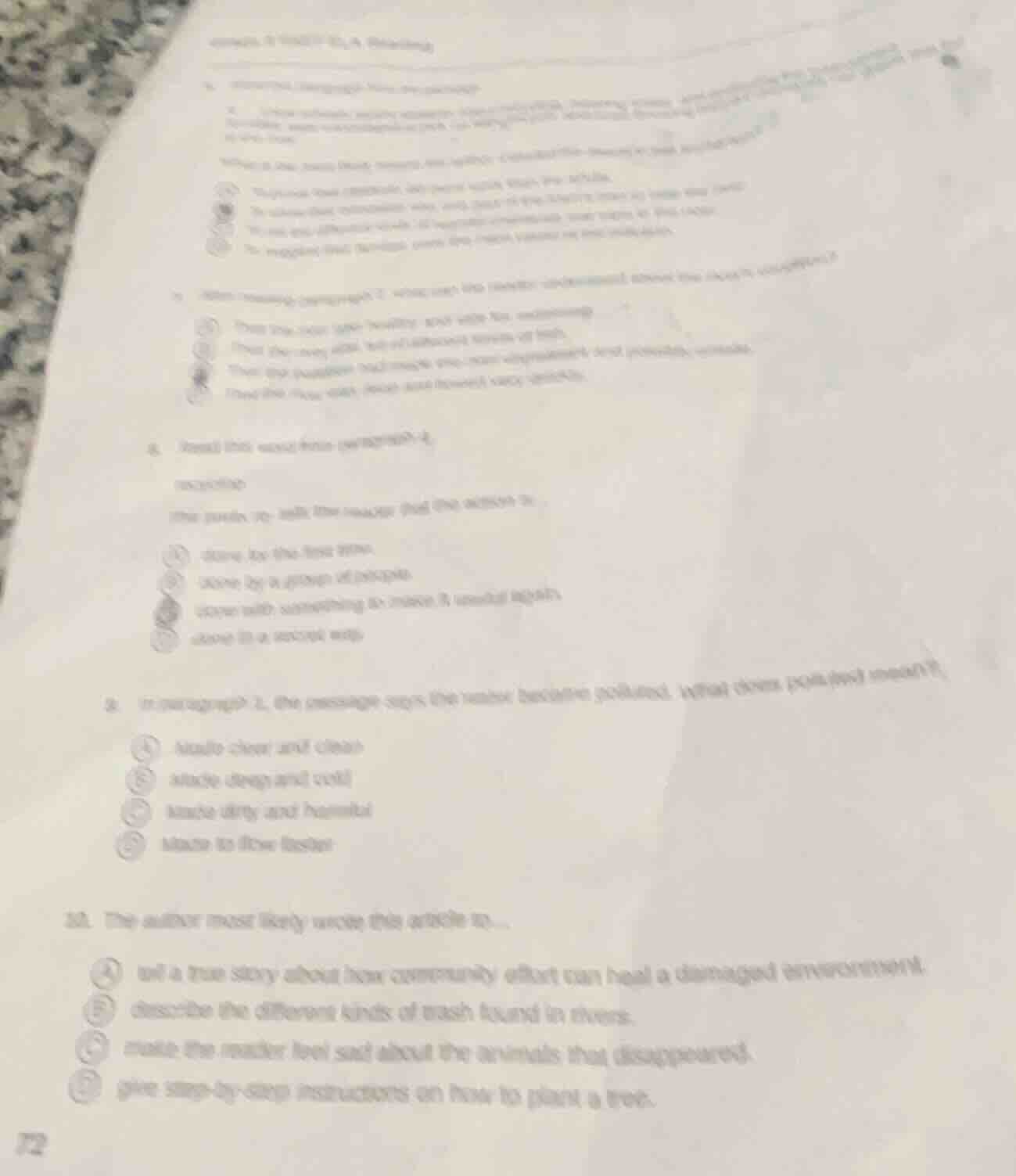
The question asks about figurative language or word choice in a sentence: "Other schools quickly joined in. Soon, individual citizens, scouting groups, and community organizations did too. Families even participated, with children working alongside their parents to help clean up the river."
The prompt asks: "What is the most likely reason the author included the details in this sentence?"
Looking at the options:
- (A) To show how children did more work than the adults.
- (B) To show that individuals who were part of the community came to help the river.
- (C) To list the different kinds of harmful chemicals that were in the river.
- (D) To suggest that families were the most important of the groups.
The sentence lists various community members (schools, citizens, scouting groups, organizations, families) joining the effort. This supports option (B), showing community-wide involvement.
Analyze Question 7
The question asks: "After reading paragraph 2, what can the reader understand about the river's condition?"
Looking at the options:
- (A) That the river was healthy and safe for swimming.
- (B) That the river was full of different kinds of fish.
- (C) That the pollution had made the river unpleasant and possibly unsafe.
- (D) That the river was deep and flowed very quickly.
Paragraph 2 describes the river becoming polluted. This aligns with option (C), indicating that the pollution made the river unpleasant and possibly unsafe.
Analyze Question 8
The question asks about the word "recycle" from paragraph 4:
"The prefix re- tells the reader that the action is..."
- (A) done by the first time.
- (B) done by a group of people.
- (C) done with something to make it useful again.
- (D) done in a secret way.
Using the Vocabulary in Context concept, the prefix "re-" means "again." Recycling involves processing materials to make them useful again. Thus, option (C) is correct.
Analyze Question 9
The question asks: "In paragraph 2, the passage says the water became polluted. What does polluted mean?"
- (A) Made clear and clean
- (B) Made deep and cold
- (C) Made dirty and harmful
- (D) Made to flow faster
Using the Vocabulary in Context concept, "polluted" means contaminated with harmful or dirty substances. This matches option (C).
Analyze Question 10
The question asks about the author's primary intent: "The author most likely wrote this article to..."
- (A) tell a true story about how community effort can heal a damaged environment.
- (B) describe the different kinds of trash found in rivers.
- (C) make the reader feel sad about the animals that disappeared.
- (D) give step-by-step instructions on how to plant a tree.
Using the Authors Purpose concept, the text describes a community coming together to clean up a polluted river. This matches option (A).

Snap & solve any problem in the app
Get step-by-step solutions on Sovi AI
Photo-based solutions with guided steps
Explore more problems and detailed explanations
Question 6
- (A) To show how children did more work than the adults.
- (B) To show that individuals who were part of the community came to help the river. (Correct answer)
- (C) To list the different kinds of harmful chemicals that were in the river.
- (D) To suggest that families were the most important of the groups.
Question 7
- (A) That the river was healthy and safe for swimming.
- (B) That the river was full of different kinds of fish.
- (C) That the pollution had made the river unpleasant and possibly unsafe. (Correct answer)
- (D) That the river was deep and flowed very quickly.
Question 8
- (A) done by the first time.
- (B) done by a group of people.
- (C) done with something to make it useful again. (Correct answer)
- (D) done in a secret way.
Question 9
- (A) Made clear and clean
- (B) Made deep and cold
- (C) Made dirty and harmful (Correct answer)
- (D) Made to flow faster
Question 10
- (A) tell a true story about how community effort can heal a damaged environment. (Correct answer)
- (B) describe the different kinds of trash found in rivers.
- (C) make the reader feel sad about the animals that disappeared.
- (D) give step-by-step instructions on how to plant a tree.