QUESTION IMAGE
Question
Question was provided via image upload.
Analyze the context
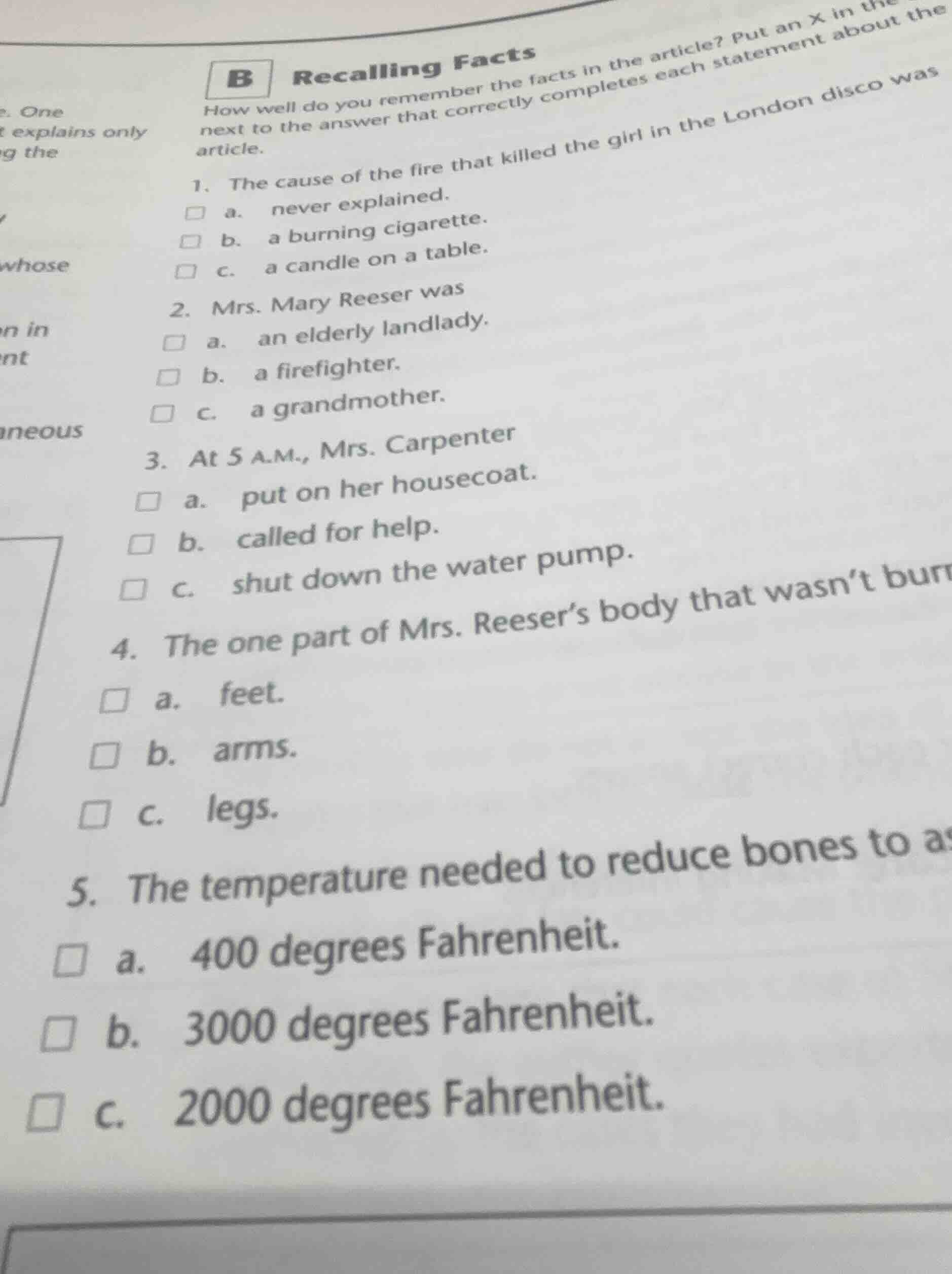
The questions are based on an article about spontaneous human combustion, specifically focusing on the famous case of Mary Reeser (which occurred in St. Petersburg, Florida, in 1951) and another referenced incident in a London disco. We will use Reading Comprehension to identify the correct factual answers based on the standard historical details of these well-known cases.
Evaluate Question 1
The first question asks about the cause of the fire that killed the girl in the London disco. In documented accounts of this case (often associated with the spontaneous combustion discussion of Susan Motteshead or similar London cases), the cause of the fire was never explained.
- Option a: never explained.
- Option b: a burning cigarette.
- Option c: a candle on a table.
The correct choice is a.
Evaluate Question 2
The second question asks about Mrs. Mary Reeser's identity. Mary Reeser was a 67-year-old widow, which makes her a grandmother.
- Option a: an elderly landlady. (Mrs. Carpenter was her landlady).
- Option b: a firefighter.
- Option c: a grandmother.
The correct choice is c.
Evaluate Question 3
The third question asks what Mrs. Carpenter (Mary Reeser's landlady) did at 5 A.M. According to the official reports, Mrs. Carpenter woke up at about 5 A.M., smelled smoke, and thought it was a water pump that had overheated, so she got up and shut down the water pump.
- Option a: put on her housecoat.
- Option b: called for help.
- Option c: shut down the water pump.
The correct choice is c.
Evaluate Question 4
The fourth question asks about the one part of Mrs. Reeser's body that was not burned. In this famous case, her left foot (wearing a black satin slipper) was left completely unburned and intact.
- Option a: feet.
- Option b: arms.
- Option c: legs.
The correct choice is a.
Evaluate Question 5
The fifth question asks about the temperature needed to reduce bones to ash. To cremate a human body completely, including destroying the bones, temperatures of about 2000 to 3000 degrees Fahrenheit are typically cited, with 3000 degrees Fahrenheit often highlighted in these specific articles to emphasize how intense the heat must have been. Let's verify the standard text: "A temperature of 3,000 degrees Fahrenheit is needed to reduce bones to ash."
- Option a: 400 degrees Fahrenheit.
- Option b: 3000 degrees Fahrenheit.
- Option c: 2000 degrees Fahrenheit.
The correct choice is b.

Snap & solve any problem in the app
Get step-by-step solutions on Sovi AI
Photo-based solutions with guided steps
Explore more problems and detailed explanations
Question 1
- a. never explained. (Correct answer)
- b. a burning cigarette.
- c. a candle on a table.
Question 2
- a. an elderly landlady.
- b. a firefighter.
- c. a grandmother. (Correct answer)
Question 3
- a. put on her housecoat.
- b. called for help.
- c. shut down the water pump. (Correct answer)
Question 4
- a. feet. (Correct answer)
- b. arms.
- c. legs.
Question 5
- a. 400 degrees Fahrenheit.
- b. 3000 degrees Fahrenheit. (Correct answer)
- c. 2000 degrees Fahrenheit.