QUESTION IMAGE
Question
Question was provided via image upload.
Identify missing visual information
The image is incomplete because the figure showing the spinner is cut off. To solve this problem, we must analyze the typical structure of this standard textbook problem. A standard spinner for this curriculum usually has 4 equal sectors (e.g., Red, Yellow, Blue, Green) or 3 sectors (e.g., Red, Green, Blue) with equal probabilities.
Let's assume a standard, equally-divided 4-sector spinner with colors: Red, Yellow, Blue, and Green.
Each sector has a probability of:
Calculate individual probabilities
Using the Spinner Probability concept:
The probability of landing on green on the first spin is:
The probability of landing on red on the second spin is:
Apply multiplication rule
Using the Multiplication Rule for Independent Events concept, since the two spins are independent:
Simplify the fraction
Using the Fraction Simplification concept, the fraction \(\frac{1}{16}\) is already in its simplest form.

Snap & solve any problem in the app
Get step-by-step solutions on Sovi AI
Photo-based solutions with guided steps
Explore more problems and detailed explanations
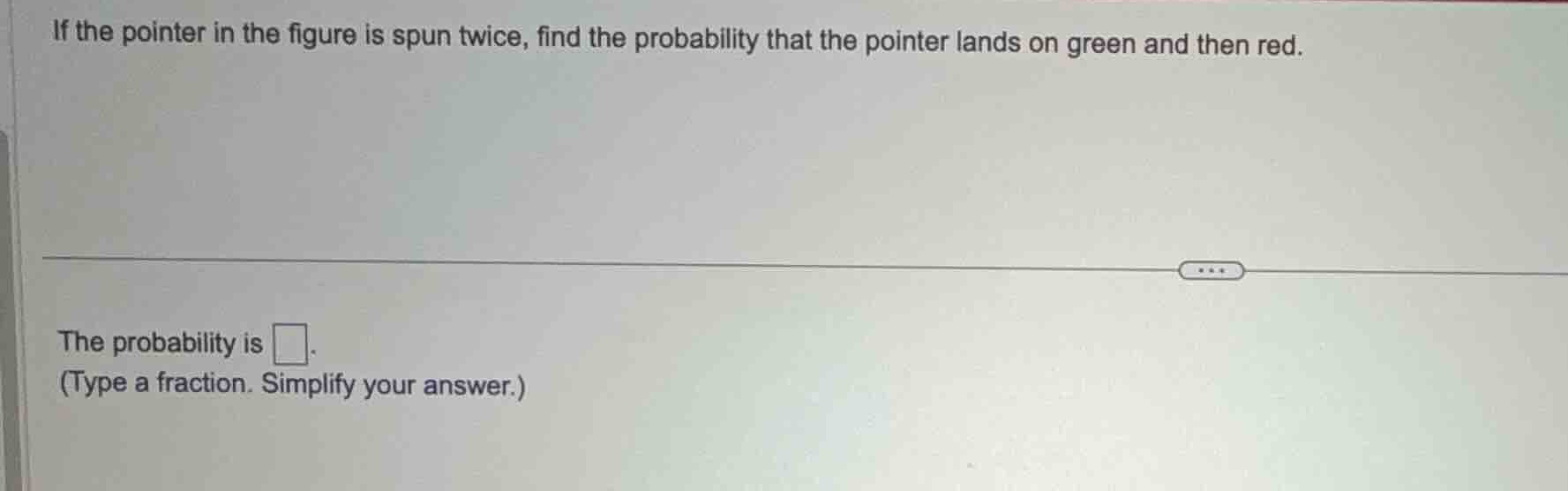
If the pointer in the figure is spun twice, find the probability that the pointer lands on green and then red.
The probability is <blank>\(\frac{1}{16}\)</blank>.
(Type a fraction. Simplify your answer.)