QUESTION IMAGE
Question
Question was provided via image upload.
Analyze the incomplete input
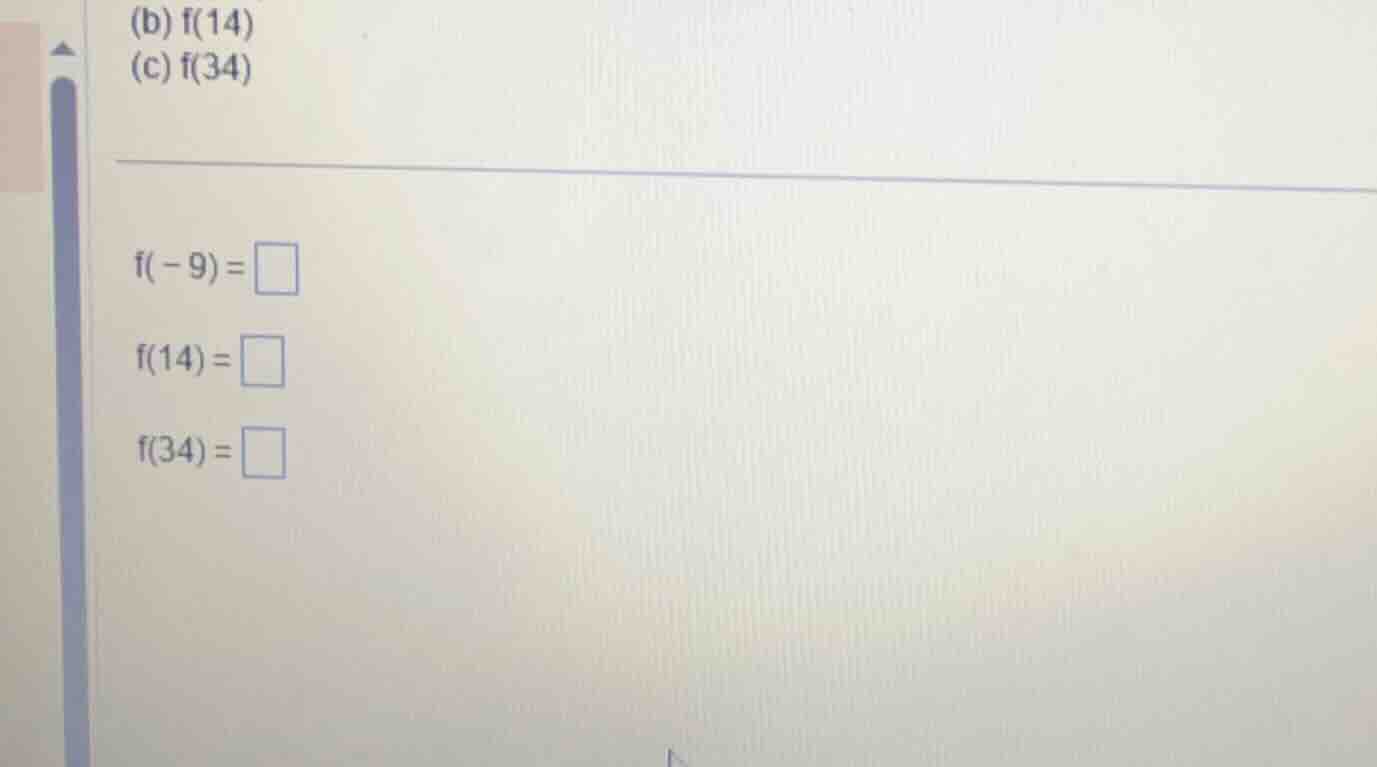
The image shows three function evaluation prompts:
- \(f(-9) = \square\)
- \(f(14) = \square\)
- \(f(34) = \square\)
The top of the image shows cut-off text:
"(b) f(14)"
"(c) f(34)"
Crucially, the definition of the function \(f(x)\) is completely missing from the image because it is cropped out. Without the algebraic definition of \(f(x)\) (which is likely a piecewise-defined function given the distinct input values spanning negative, small positive, and larger positive domains), we cannot compute the exact numerical values for these blanks.
Formulate a conditional solution
Since we must attempt to solve the problem based on the visible and reliable information without inventing missing numbers or functions, we will explain how to evaluate a piecewise function once its definition is provided.
A typical piecewise function is defined in the form:
To evaluate \(f(C)\) for any constant \(C\):
- Identify which interval condition \(C\) satisfies.
- Substitute \(x = C\) only into the corresponding sub-function formula.

Snap & solve any problem in the app
Get step-by-step solutions on Sovi AI
Photo-based solutions with guided steps
Explore more problems and detailed explanations
The definition of the function \(f(x)\) is missing from the provided image. To complete these evaluations, the algebraic rule or graph for \(f(x)\) is required.
Once the definition of \(f(x)\) is available, use the following steps to find each value:
| No. | Problem | Answer |
|---|---|---|
| 2 | \(f(14)\) | Identify the interval containing \(14\) and evaluate that piece. |
| 3 | \(f(34)\) | Identify the interval containing \(34\) and evaluate that piece. |