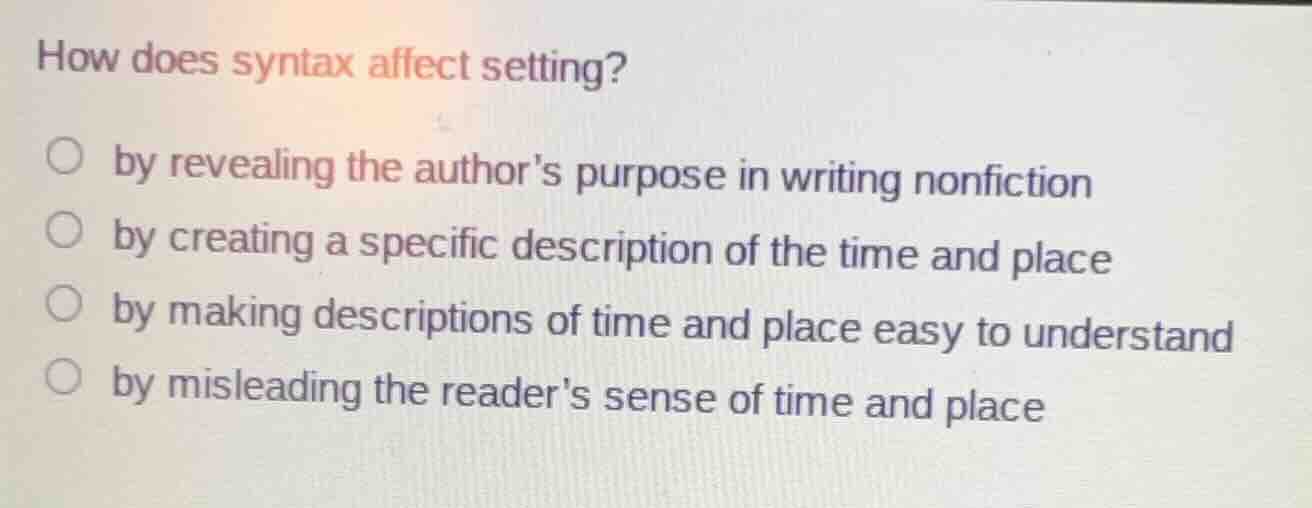
QUESTION IMAGE
Question
how does syntax affect setting?
by revealing the authors purpose in writing nonfiction
by creating a specific description of the time and place
by making descriptions of time and place easy to understand
by misleading the readers sense of time and place
<pre_analysis>
{
"quality": "clear",
"question_count": 1,
"skills_matched": [
"direct_cot",
"multiple_choice_formatter",
"explain_then_answer",
"tutor",
"mastery_adaptive_brevity"
],
"needs_drawing": false,
"concepts_used": [
"Authors Purpose",
"Setting Analysis"
],
"new_concepts": [
"Syntax Analysis",
"Literary Devices"
],
"current_concepts": [
"Authors Purpose",
"Setting Analysis",
"Syntax Analysis",
"Literary Devices"
]
}
</pre_analysis>
<reasoning>
Define syntax and setting
Using the Setting Analysis knowledge point
Syntax refers to the arrangement of words and phrases to create well-formed sentences in a language. Setting refers to the time and place in which a story occurs.
Analyze the relationship between syntax and setting
Using the Setting Analysis and Authors Purpose knowledge points
An author uses specific sentence structures (syntax)—such as long, complex sentences to evoke a slow, historical era, or short, fragmented sentences to convey a fast-paced, modern environment—to construct a vivid, specific description of the time and place.
Evaluate the given options
- Option 1: Incorrect. Syntax is not limited to nonfiction, nor is its primary role here to reveal purpose in nonfiction.
- Option 2: Correct. Syntax shapes the rhythm, mood, and texture of the language, directly building a specific description of the time and place.
- Option 3: Incorrect. Syntax can sometimes make descriptions complex or poetic rather than simply "easy to understand."
- Option 4: Incorrect. The primary purpose of syntax in establishing setting is to construct it, not to mislead the reader.
</reasoning>
<answer>
<mcq-option>by revealing the author's purpose in writing nonfiction</mcq-option>
<mcq-correct>by creating a specific description of the time and place</mcq-correct>
<mcq-option>by making descriptions of time and place easy to understand</mcq-option>
<mcq-option>by misleading the reader's sense of time and place</mcq-option>
</answer>
<post_analysis>
{
"subject": "Arts",
"question_type": "Multiple Choice",
"knowledge_point": [
"Arts",
"Literary Analysis",
"Setting Analysis"
]
}
</post_analysis>
Snap & solve any problem in the app
Get step-by-step solutions on Sovi AI
Photo-based solutions with guided steps
Explore more problems and detailed explanations
<pre_analysis>
{
"quality": "clear",
"question_count": 1,
"skills_matched": [
"direct_cot",
"multiple_choice_formatter",
"explain_then_answer",
"tutor",
"mastery_adaptive_brevity"
],
"needs_drawing": false,
"concepts_used": [
"Authors Purpose",
"Setting Analysis"
],
"new_concepts": [
"Syntax Analysis",
"Literary Devices"
],
"current_concepts": [
"Authors Purpose",
"Setting Analysis",
"Syntax Analysis",
"Literary Devices"
]
}
</pre_analysis>
<reasoning>
Define syntax and setting
Using the Setting Analysis knowledge point
Syntax refers to the arrangement of words and phrases to create well-formed sentences in a language. Setting refers to the time and place in which a story occurs.
Analyze the relationship between syntax and setting
Using the Setting Analysis and Authors Purpose knowledge points
An author uses specific sentence structures (syntax)—such as long, complex sentences to evoke a slow, historical era, or short, fragmented sentences to convey a fast-paced, modern environment—to construct a vivid, specific description of the time and place.
Evaluate the given options
- Option 1: Incorrect. Syntax is not limited to nonfiction, nor is its primary role here to reveal purpose in nonfiction.
- Option 2: Correct. Syntax shapes the rhythm, mood, and texture of the language, directly building a specific description of the time and place.
- Option 3: Incorrect. Syntax can sometimes make descriptions complex or poetic rather than simply "easy to understand."
- Option 4: Incorrect. The primary purpose of syntax in establishing setting is to construct it, not to mislead the reader.
</reasoning>
<answer>
<mcq-option>by revealing the author's purpose in writing nonfiction</mcq-option>
<mcq-correct>by creating a specific description of the time and place</mcq-correct>
<mcq-option>by making descriptions of time and place easy to understand</mcq-option>
<mcq-option>by misleading the reader's sense of time and place</mcq-option>
</answer>
<post_analysis>
{
"subject": "Arts",
"question_type": "Multiple Choice",
"knowledge_point": [
"Arts",
"Literary Analysis",
"Setting Analysis"
]
}
</post_analysis>