QUESTION IMAGE
Question
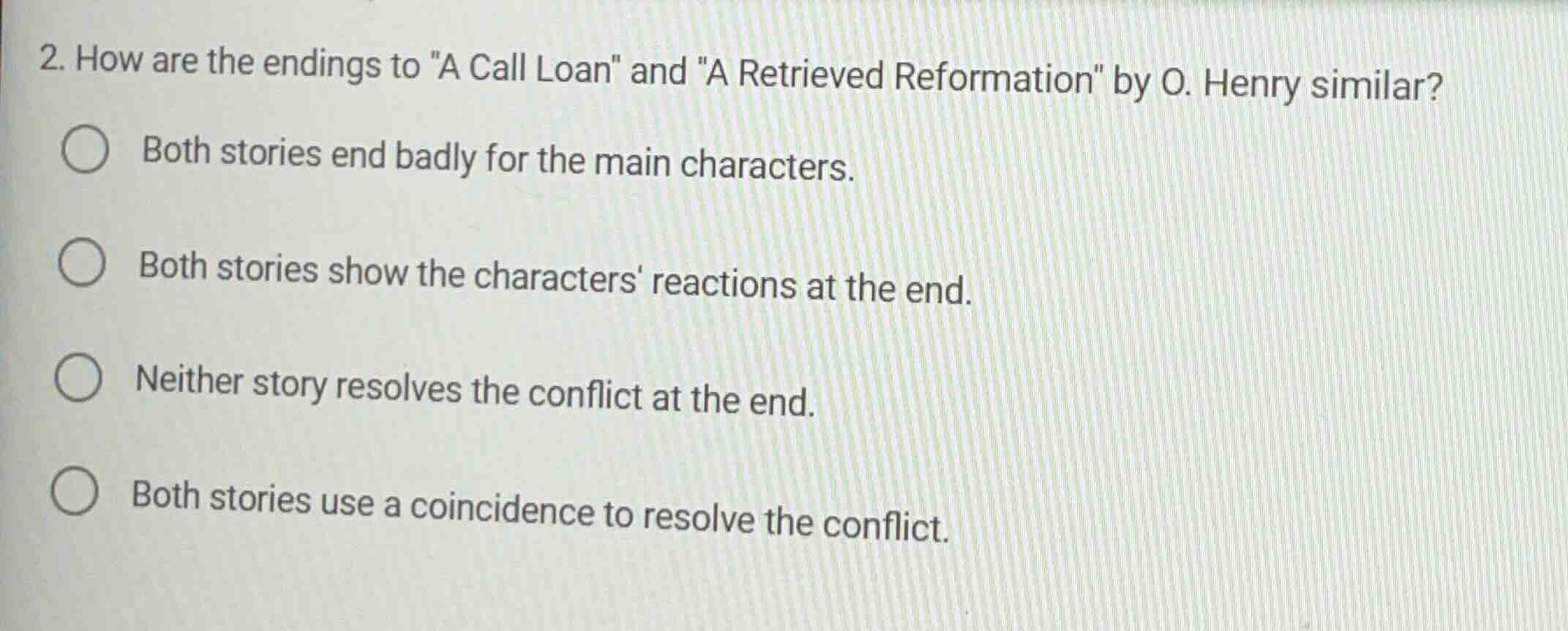
- how are the endings to \a call loan\ and \a retrieved reformation\ by o. henry similar?
both stories end badly for the main characters.
both stories show the characters reactions at the end.
neither story resolves the conflict at the end.
both stories use a coincidence to resolve the conflict.
Analyze the ending of "A Call Loan"
In O. Henry's "A Call Loan," the plot centers on a bank examiner, Long Selim, and a cattleman, Jerry Long. The conflict is resolved through a sudden, unexpected coincidence when the examiner finds that the missing funds are accounted for just in time due to a series of rapid financial transactions and coincidental timings, saving the characters from ruin.
Analyze the ending of "A Retrieved Reformation"
In "A Retrieved Reformation," the safe-cracker Jimmy Valentine (living as Ralph Spencer) must expose his past to save a child locked in a bank vault. Just as he prepares to surrender to detective Ben Price, a major coincidence occurs: Ben Price pretends not to recognize him, allowing Jimmy to walk away free and continue his reformed life.
Compare the resolutions
Using Theme Analysis to compare both stories, we observe that O. Henry relies heavily on his signature plot device: a sudden twist of fate or coincidence that resolves the central conflict happily for the protagonists.
Evaluate the given options
Using Textual Evidence from both narratives:
- Option 1 is incorrect because both stories actually end happily/positively for the main characters.
- Option 2 is incorrect because showing reactions is a general narrative feature, not the primary structural similarity of these specific endings.
- Option 3 is incorrect because both stories fully resolve their main conflicts.
- Option 4 is correct because both plots rely on a timely coincidence to resolve the conflict.

Snap & solve any problem in the app
Get step-by-step solutions on Sovi AI
Photo-based solutions with guided steps
Explore more problems and detailed explanations
- Both stories end badly for the main characters.
- Both stories show the characters' reactions at the end.
- Neither story resolves the conflict at the end.
- Both stories use a coincidence to resolve the conflict. (Correct answer)