QUESTION IMAGE
Question
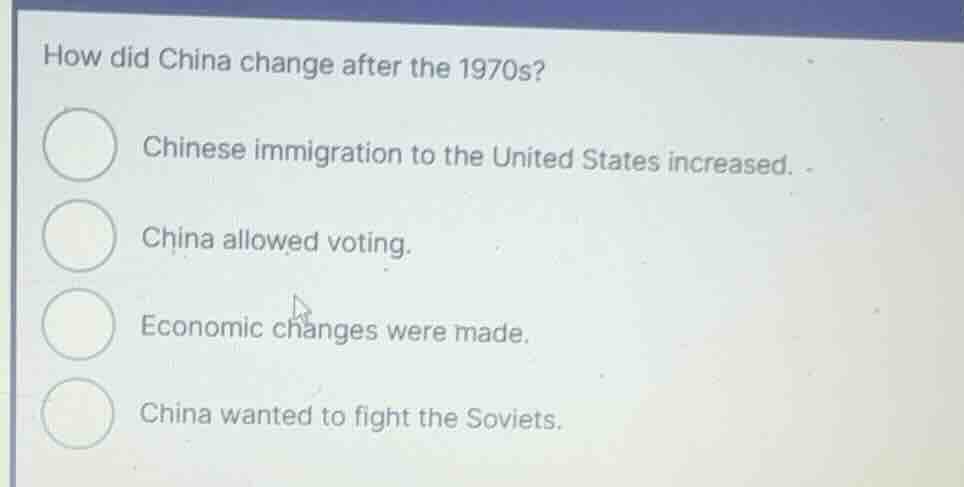
how did china change after the 1970s?
chinese immigration to the united states increased.
china allowed voting.
economic changes were made.
china wanted to fight the soviets.
Analyze post-1970s Chinese historical developments
Following the death of Mao Zedong in 1976, Deng Xiaoping assumed leadership and initiated the "Four Modernizations" in December 1978. These reforms introduced market-oriented elements, de-collectivized agriculture, opened the country to foreign investment, and permitted private entrepreneurship, representing a major shift in economic policy.
Evaluate the given options
- "Chinese immigration to the United States increased": While immigration did rise over subsequent decades, this was a secondary demographic effect rather than the primary structural change defining China's post-1970s transformation.
- "China allowed voting": China remained a single-party state led by the Chinese Communist Party without introducing democratic national voting.
- "Economic changes were made": This directly describes the historic transition from a planned command economy to a socialist market economy.
- "China wanted to fight the Soviets": Sino-Soviet tensions actually began to ease gradually in the 1980s, culminating in normalization of relations in 1989.

Snap & solve any problem in the app
Get step-by-step solutions on Sovi AI
Photo-based solutions with guided steps
Explore more problems and detailed explanations
- Chinese immigration to the United States increased.
- China allowed voting.
- Economic changes were made. (Correct answer)
- China wanted to fight the Soviets.