QUESTION IMAGE
Question
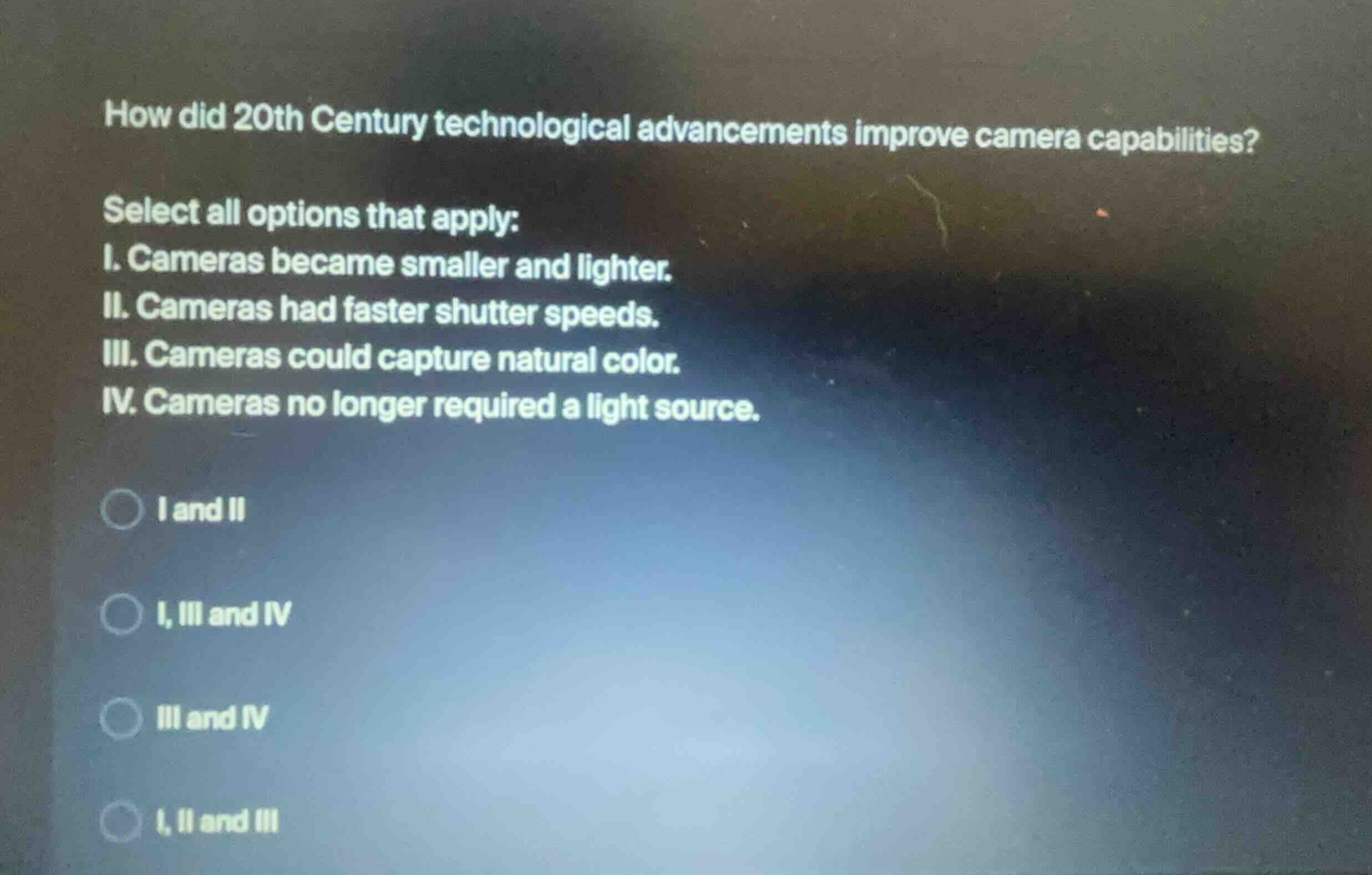
how did 20th century technological advancements improve camera capabilities?
select all options that apply:
i. cameras became smaller and lighter.
ii. cameras had faster shutter speeds.
iii. cameras could capture natural color.
iv. cameras no longer required a light source.
- i and ii
- i, iii and iv
- iii and iv
- i, ii and iii
🆕 New Concept Discovered: History of Photography
How technology changed how we capture images over time.
Step 1: Analyze Statement I (Size and Weight)
During the 20th century, cameras transitioned from bulky, heavy wooden boxes and large-format plate systems to highly portable formats. The introduction of the \(35\text{ mm}\) film format by Leica in the 1920s and the subsequent development of compact point-and-shoot cameras made cameras significantly smaller and lighter.
- Statement I is correct.
Step 2: Analyze Statement II (Shutter Speed)
Technological improvements in mechanical and electronic shutters throughout the 1900s allowed cameras to capture images at fractions of a second (such as \(\frac{1}{1000}\) of a second or faster). This was a massive improvement over early photography, which required exposures lasting several seconds or minutes.
- Statement II is correct.
Step 3: Analyze Statement III (Color Capture)
While early photography was strictly monochrome (black and white), the 20th century saw the commercialization of practical color films, most notably Kodak's Kodachrome in 1935. This allowed cameras to capture natural, lifelike colors.
- Statement III is correct.
Step 4: Analyze Statement IV (Light Source Requirement)
All photography, by definition, relies on light (the word "photography" literally means "drawing with light"). Cameras must gather light reflected from a subject to expose film or a digital sensor. While 20th-century cameras became much better at shooting in low-light conditions due to more sensitive films and wider apertures, they still fundamentally require a light source to capture an image.
- Statement IV is incorrect.
Step 5: Combine the Correct Statements
Since statements I, II, and III are correct, and statement IV is incorrect, the correct combination is I, II and III.

Snap & solve any problem in the app
Get step-by-step solutions on Sovi AI
Photo-based solutions with guided steps
Explore more problems and detailed explanations
I, II and III