QUESTION IMAGE
Question
from house of stone
1
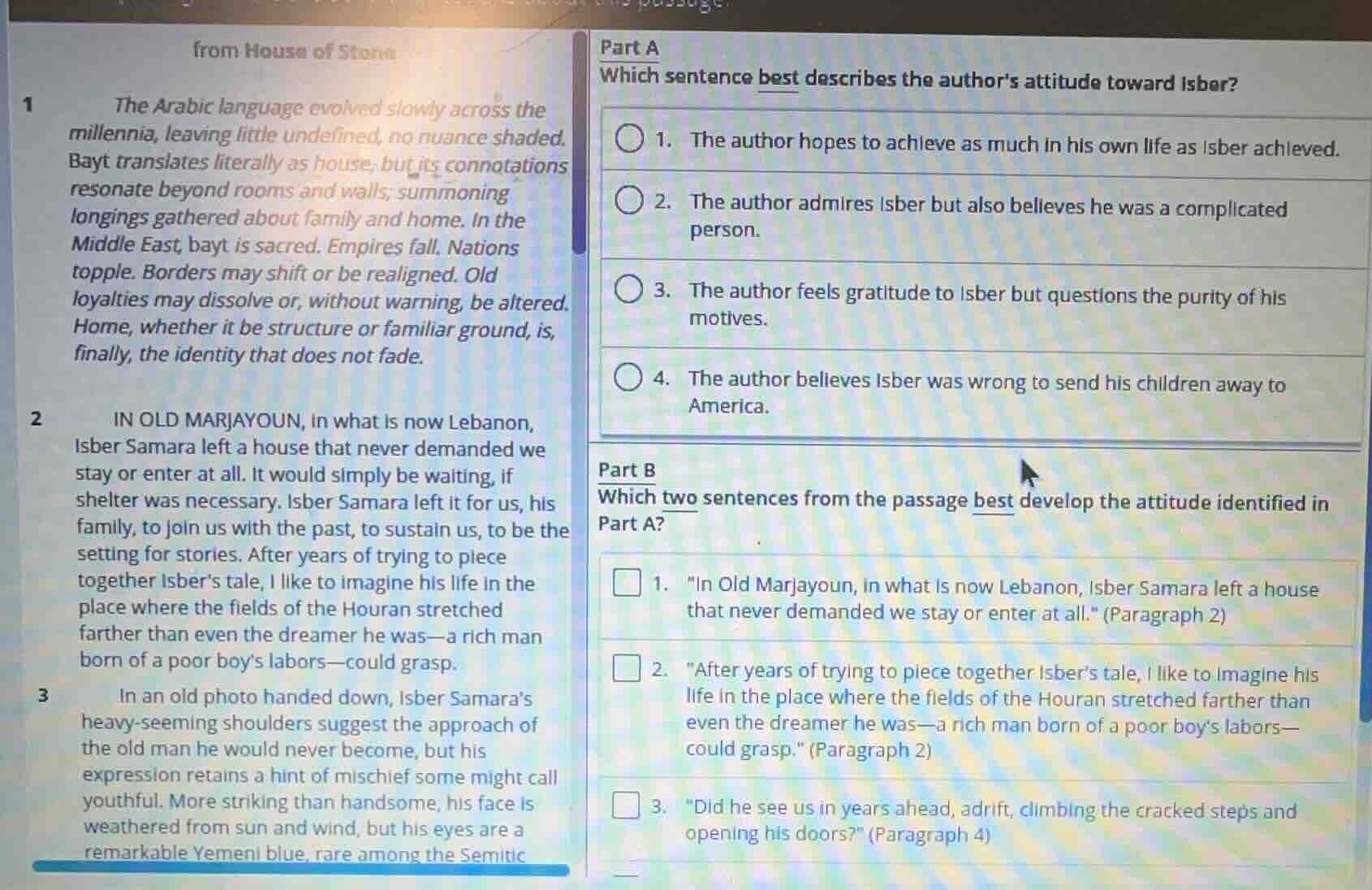
the arabic language evolved slowly across the millennia, leaving little undefined, no nuance shaded. bayt translates literally as house, but its connotations resonate beyond rooms and walls; summoning longings gathered about family and home. in the middle east, bayt is sacred. empires fall. nations topple. borders may shift or be realigned. old loyalties may dissolve or, without warning, be altered. home, whether it be structure or familiar ground, is, finally, the identity that does not fade.
2
in old marjayoun, in what is now lebanon, isber samara left a house that never demanded we stay or enter at all. it would simply be waiting, if shelter was necessary. isber samara left it for us, his family, to join us with the past, to sustain us, to be the setting for stories. after years of trying to piece together isber’s tale, i like to imagine his life in the place where the fields of the houran stretched farther than even the dreamer he was—a rich man born of a poor boy’s labors—could grasp.
3
in an old photo handed down, isber samara’s heavy - seeming shoulders suggest the approach of the old man he would never become, but his expression retains a hint of mischief some might call youthful. more striking than handsome, his face is weathered from sun and wind, but his eyes are a remarkable yemeni blue, rare among the semitic
part a
which sentence best describes the author’s attitude toward isber?
- the author hopes to achieve as much in his own life as isber achieved.
- the author admires isber but also believes he was a complicated person.
- the author feels gratitude to isber but questions the purity of his motives.
- the author believes isber was wrong to send his children away to america.
part b
which two sentences from the passage best develop the attitude identified in part a?
- “in old marjayoun, in what is now lebanon, isber samara left a house that never demanded we stay or enter at all.” (paragraph 2)
- “after years of trying to piece together isber’s tale, i like to imagine his life in the place where the fields of the houran stretched farther than even the dreamer he was—a rich man born of a poor boy’s labors—could grasp.” (paragraph 2)
- “did he see us in years ahead, adrift, climbing the cracked steps and opening his doors?” (paragraph 4)
For Part A: The text shows the author values Isber's legacy (the house connecting the family to the past) and notes he was a self-made rich man with a mix of seriousness and mischief, pointing to admiration paired with recognition of his complexity.
For Part B: Sentence 1 highlights the generous, unburdening legacy of Isber's house, showing admiration. Sentence 2 reveals Isber's complicated journey from poor boy to wealthy man, showing his complexity, which aligns with the Part A attitude.

Snap & solve any problem in the app
Get step-by-step solutions on Sovi AI
Photo-based solutions with guided steps
Explore more problems and detailed explanations
Part A:
- The author admires Isber but also believes he was a complicated person.
Part B:
- "In Old Marjayoun, in what is now Lebanon, Isber Samara left a house that never demanded we stay or enter at all." (Paragraph 2)
- "After years of trying to piece together Isber's tale, I like to imagine his life in the place where the fields of the Houran stretched farther than even the dreamer he was—a rich man born of a poor boy's labors—could grasp." (Paragraph 2)