QUESTION IMAGE
Question
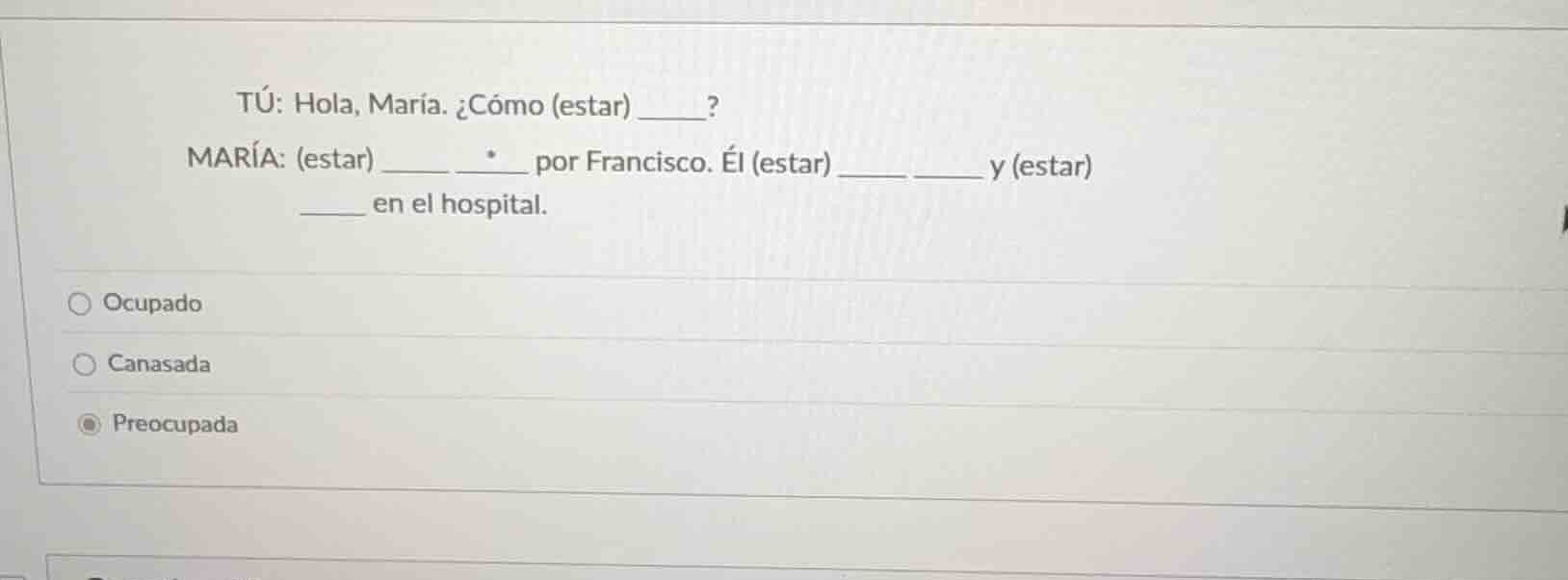
tú: hola, maría. ¿cómo (estar) ______?
maría: (estar) ____ * __ por francisco. él (estar) __ __ y (estar) ____ en el hospital.
ocupado
canasada
preocupada
Analyze the first blank
The dialogue starts with "TÚ: Hola, María. ¿Cómo (estar) \_\_\_\_\_?". Since the speaker is addressing María directly and informally (using her first name), the verb estar must be conjugated in the second-person singular informal form (tú), which is estás.
Analyze the second blank and options
María responds: "MARÍA: (estar) \_\_\_\_\_ \* \_\_\_\_\_ por Francisco."
- The first part is the conjugation of estar for yo (I), which is estoy.
- The asterisk \* indicates the blank to be filled by one of the multiple-choice options: "Ocupado", "Canasada" (typo for Cansada), or "Preocupada".
- Since María is female, the adjective must be feminine singular. "Ocupado" is masculine. "Preocupada" means "worried" and fits the context of someone being in the hospital. Thus, the correct option is "Preocupada".
Analyze the remaining blanks
The sentence continues: "Él (estar) \_\_\_\_\_ \_\_\_\_\_ y (estar) \_\_\_\_\_ en el hospital."
- "Él" (He, referring to Francisco) requires the third-person singular conjugation of estar, which is está.
- The double blank after "Él (estar)" represents an adjective/state, and the final part "y (estar) \_\_\_\_\_ en el hospital" represents his location, which also uses está (third-person singular).
- The selected option "Preocupada" correctly completes the marked blank (\*).

Snap & solve any problem in the app
Get step-by-step solutions on Sovi AI
Photo-based solutions with guided steps
Explore more problems and detailed explanations
- Ocupado
- Canasada
- Preocupada (Correct answer)