QUESTION IMAGE
Question
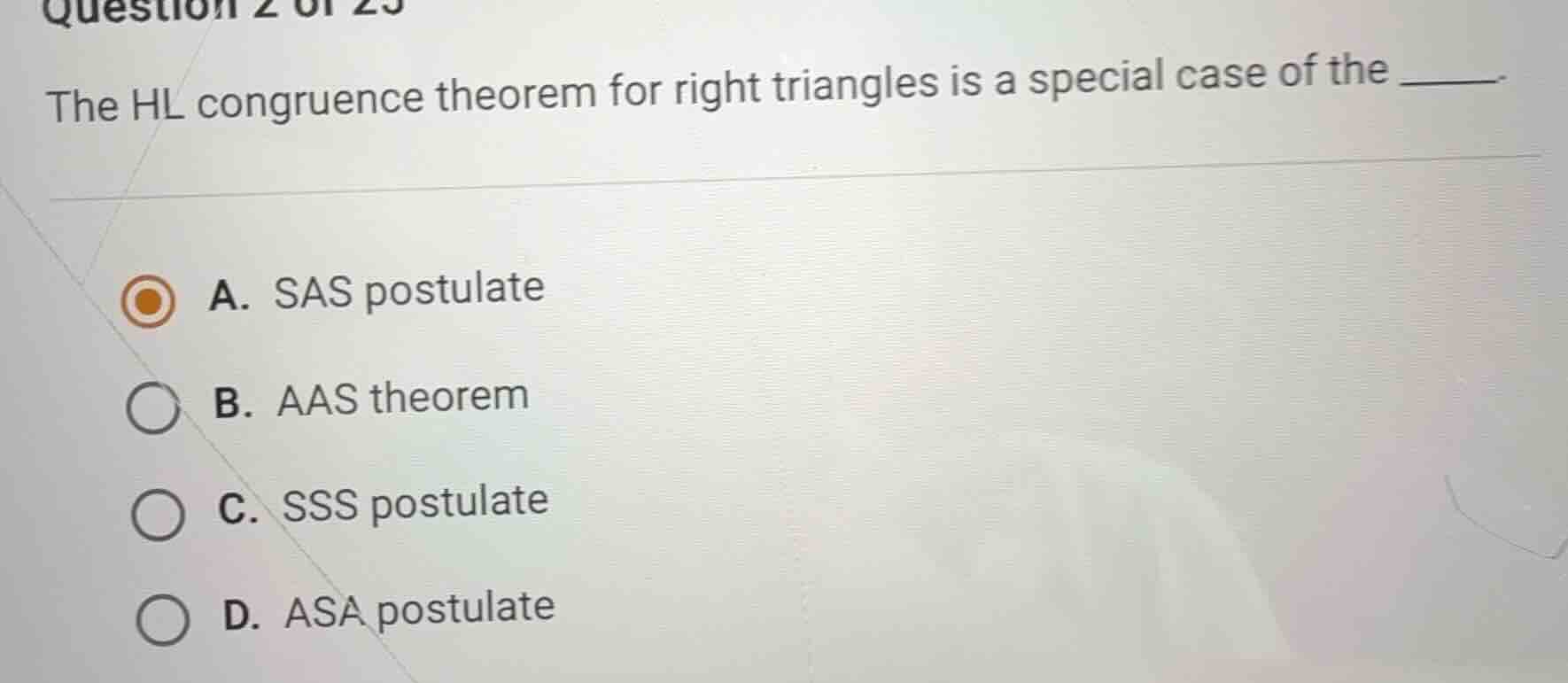
the hl congruence theorem for right triangles is a special case of the ______.
a. sas postulate
b. aas theorem
c. sss postulate
d. asa postulate
Analyze the HL Congruence Theorem
Using the HL Congruence Theorem knowledge point
- The Hypotenuse-Leg (HL) theorem states that if the hypotenuse and one leg of a right triangle are congruent to the hypotenuse and one leg of another right triangle, then the triangles are congruent.
- In any right triangle, the right angle is located opposite the hypotenuse.
- This means we have two congruent sides (Hypotenuse and Leg) and a non-included congruent angle (the right angle, which is not between the hypotenuse and the leg).
Connect to general congruence postulates
Using the Triangle Congruence Postulates knowledge point
- A congruence pattern with two sides and a non-included angle is generally referred to as Side-Side-Angle (SSA).
- In general geometry, SSA is not a valid postulate because it can lead to two different possible triangles (the ambiguous case).
- However, when the non-included angle is a right angle (\(90^\circ\)), the SSA case is restricted to exactly one unique triangle.
- Therefore, HL is a special, valid case of the SSA pattern.
Evaluate the given options
- A. SAS postulate: Requires the congruent angle to be included between the two congruent sides.
- B. AAS theorem: Requires two angles and a non-included side.
- C. SSS postulate: Requires three congruent sides.
- D. ASA postulate: Requires two angles and an included side.
- Since SSA is not listed, we look at the closest geometric relationship. By using the Pythagorean Theorem, knowing two sides of a right triangle (Hypotenuse and Leg) uniquely determines the third side (Leg).
- Once the third side is determined to be congruent (\(a^2 + b^2 = c^2\)), we have three pairs of congruent sides.
- Thus, the HL congruence theorem is proven and justified as a special case of the SSS postulate.

Snap & solve any problem in the app
Get step-by-step solutions on Sovi AI
Photo-based solutions with guided steps
Explore more problems and detailed explanations
- (A) SAS postulate
- (B) AAS theorem
- (C) SSS postulate (Correct answer)
- (D) ASA postulate