QUESTION IMAGE
Question
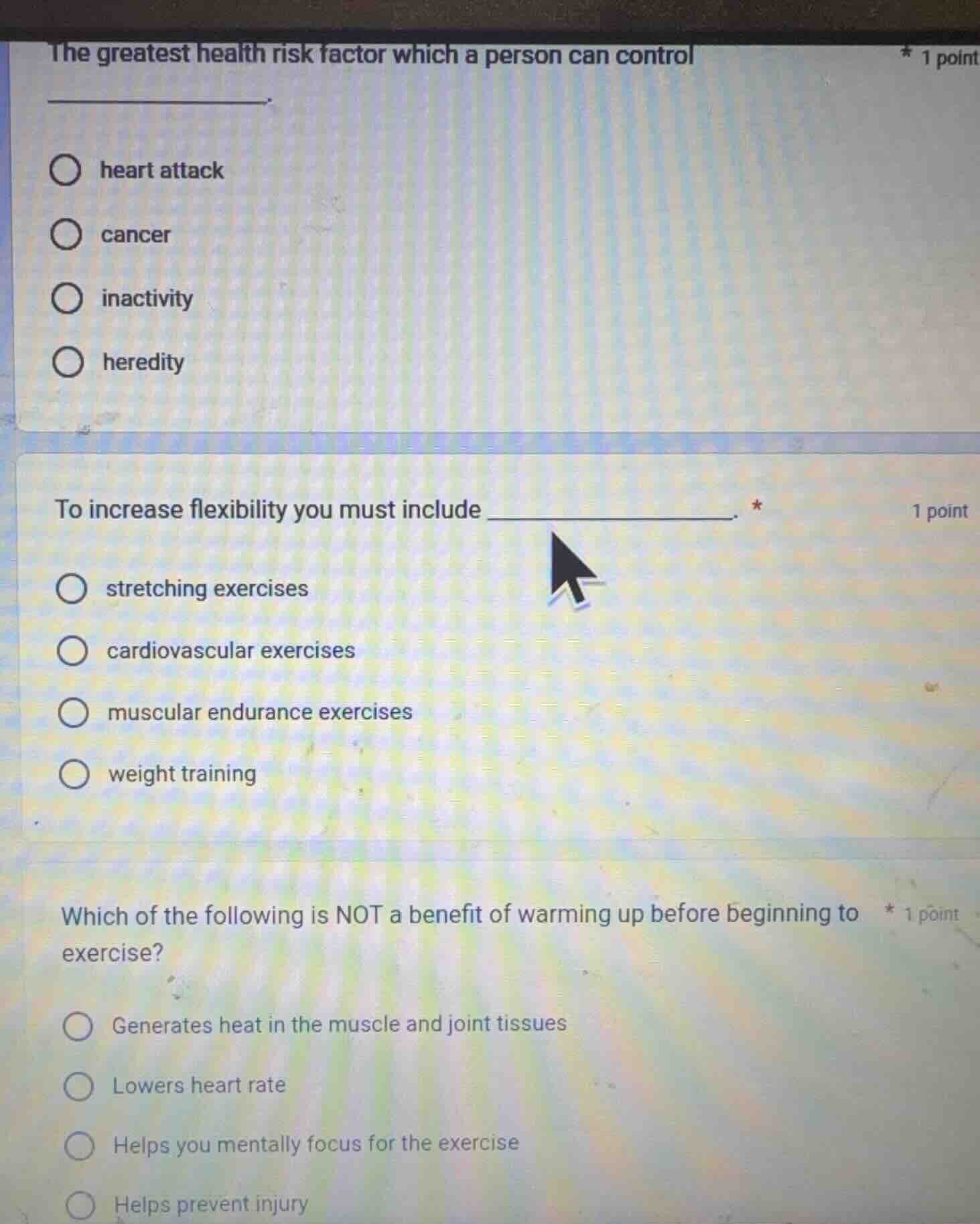
the greatest health risk factor which a person can control ______.
- 1 point
- heart attack
- cancer
- inactivity
- heredity
to increase flexibility you must include ______.*
1 point
- stretching exercises
- cardiovascular exercises
- muscular endurance exercises
- weight training
which of the following is not a benefit of warming up before beginning to exercise?*
1 point
- generates heat in the muscle and joint tissues
- lowers heart rate
- helps you mentally focus for the exercise
- helps prevent injury
<pre_analysis>
{
"quality": "clear",
"question_count": 3,
"skills_matched": [
"direct_cot",
"multiple_choice_formatter",
"explain_then_answer",
"tutor"
],
"needs_drawing": false,
"concepts_used": [
"Cardiovascular Disease Risk Factors"
],
"new_concepts": [
"Flexibility Training",
"Warm-up Physiology"
],
"current_concepts": [
"Cardiovascular Disease Risk Factors",
"Flexibility Training",
"Warm-up Physiology"
]
}
</pre_analysis>
<reasoning>
Analyze risk factors
We evaluate controllable health risks.
Using the Cardiovascular Disease Risk Factors knowledge point:
- Heredity is genetic and cannot be controlled.
- Heart attack and cancer are medical conditions, not direct behavioral risk factors themselves.
- Inactivity is a major behavioral risk factor that a person can directly control.
Analyze flexibility requirements
We identify how to increase joint range of motion.
- Cardiovascular, muscular endurance, and weight training focus on aerobic capacity and strength.
- Stretching exercises specifically target muscle-tendon units to increase flexibility.
Analyze benefits of warming up
We evaluate physiological responses to a warm-up.
- Warming up generates heat in tissues, increases mental focus, and helps prevent injury.
- Warming up increases heart rate to prepare the cardiovascular system; it does not lower it.
</reasoning>
<answer>
Question 1
<mcq-option>heart attack</mcq-option>
<mcq-option>cancer</mcq-option>
<mcq-correct>inactivity</mcq-correct>
<mcq-option>heredity</mcq-option>
Question 2
<mcq-correct>stretching exercises</mcq-correct>
<mcq-option>cardiovascular exercises</mcq-option>
<mcq-option>muscular endurance exercises</mcq-option>
<mcq-option>weight training</mcq-option>
Question 3
<mcq-option>Generates heat in the muscle and joint tissues</mcq-option>
<mcq-correct>Lowers heart rate</mcq-correct>
<mcq-option>Helps you mentally focus for the exercise</mcq-option>
<mcq-option>Helps prevent injury</mcq-option>
</answer>
<post_analysis>
{
"subject": "Natural Science",
"question_type": "Multiple Choice",
"knowledge_point": [
"Natural Science",
"Others",
"Health and Physical Education"
]
}
</post_analysis>
Snap & solve any problem in the app
Get step-by-step solutions on Sovi AI
Photo-based solutions with guided steps
Explore more problems and detailed explanations
<pre_analysis>
{
"quality": "clear",
"question_count": 3,
"skills_matched": [
"direct_cot",
"multiple_choice_formatter",
"explain_then_answer",
"tutor"
],
"needs_drawing": false,
"concepts_used": [
"Cardiovascular Disease Risk Factors"
],
"new_concepts": [
"Flexibility Training",
"Warm-up Physiology"
],
"current_concepts": [
"Cardiovascular Disease Risk Factors",
"Flexibility Training",
"Warm-up Physiology"
]
}
</pre_analysis>
<reasoning>
Analyze risk factors
We evaluate controllable health risks.
Using the Cardiovascular Disease Risk Factors knowledge point:
- Heredity is genetic and cannot be controlled.
- Heart attack and cancer are medical conditions, not direct behavioral risk factors themselves.
- Inactivity is a major behavioral risk factor that a person can directly control.
Analyze flexibility requirements
We identify how to increase joint range of motion.
- Cardiovascular, muscular endurance, and weight training focus on aerobic capacity and strength.
- Stretching exercises specifically target muscle-tendon units to increase flexibility.
Analyze benefits of warming up
We evaluate physiological responses to a warm-up.
- Warming up generates heat in tissues, increases mental focus, and helps prevent injury.
- Warming up increases heart rate to prepare the cardiovascular system; it does not lower it.
</reasoning>
<answer>
Question 1
<mcq-option>heart attack</mcq-option>
<mcq-option>cancer</mcq-option>
<mcq-correct>inactivity</mcq-correct>
<mcq-option>heredity</mcq-option>
Question 2
<mcq-correct>stretching exercises</mcq-correct>
<mcq-option>cardiovascular exercises</mcq-option>
<mcq-option>muscular endurance exercises</mcq-option>
<mcq-option>weight training</mcq-option>
Question 3
<mcq-option>Generates heat in the muscle and joint tissues</mcq-option>
<mcq-correct>Lowers heart rate</mcq-correct>
<mcq-option>Helps you mentally focus for the exercise</mcq-option>
<mcq-option>Helps prevent injury</mcq-option>
</answer>
<post_analysis>
{
"subject": "Natural Science",
"question_type": "Multiple Choice",
"knowledge_point": [
"Natural Science",
"Others",
"Health and Physical Education"
]
}
</post_analysis>