Sovi.AI - AI Math Tutor

Scan to solve math questions

QUESTION IMAGE

the graph shows that \\(f(x) = 3^x\\) is translated horizontally and ve…

Question

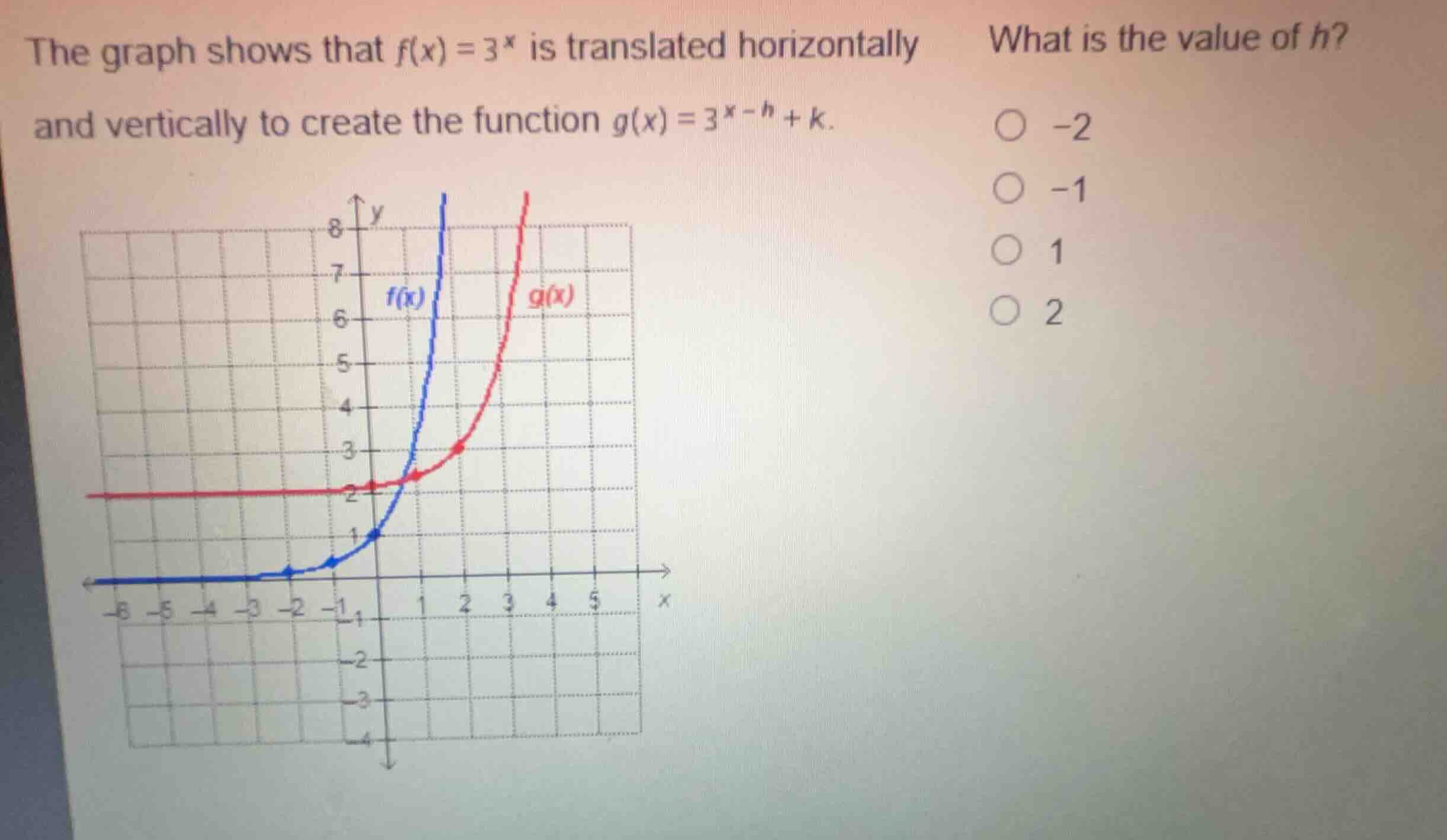
the graph shows that \\(f(x) = 3^x\\) is translated horizontally and vertically to create the function \\(g(x) = 3^{x-h} + k\\).

what is the value of \\(h\\)?

-2
-1
1
2

Explanation:

Response

<pre_analysis>
{
"quality": "clear",
"question_count": 1,
"skills_matched": [
"step_cot",
"multiple_choice_formatter",
"explain_then_answer",
"quick"
],
"needs_drawing": false,
"concepts_used": [
"Exponential Functions",
"Function Transformations",
"Horizontal Asymptote"
],
"new_concepts": [],
"current_concepts": [
"Exponential Functions",
"Function Transformations",
"Horizontal Asymptote"
]
}
</pre_analysis>

<reasoning>

Identify the horizontal asymptote of the translated function

The horizontal asymptote of \(f(x) = 3^x\) is \(y = 0\).
The graph of \(g(x) = 3^{x-h} + k\) has a horizontal asymptote at \(y = 2\).
Thus, the vertical shift is:
\[
k = 2
\]

Use a reference point to find the horizontal shift

The reference point on \(f(x) = 3^x\) at \(x = 0\) is \((0, 1)\).
Under the transformation \(g(x) = 3^{x-h} + 2\), this point shifts to \((h, 1 + 2) = (h, 3)\).
Looking at the graph of \(g(x)\), the point with a \(y\)-value of \(3\) is located at \(x = 2\).
Therefore, the horizontal shift is:
\[
h = 2
\]

Verify with another point on the graph

For \(h = 2\) and \(k = 2\), the function is \(g(x) = 3^{x-2} + 2\).
Let's test \(x = 3\):
\[
g(3) = 3^{3-2} + 2 = 3^1 + 2 = 5
\]
The graph of \(g(x)\) passes through \((3, 5)\), which matches the visual representation.
</reasoning>

<answer>
<mcq-option>-2</mcq-option>
<mcq-option>-1</mcq-option>
<mcq-option>1</mcq-option>
<mcq-correct>2</mcq-correct>
</answer>

<post_analysis>
{
"subject": "Mathematics",
"question_type": "Multiple Choice",
"knowledge_point": [
"Mathematics",
"Algebra",
"Function Transformations"
]
}
</post_analysis>

Answer:

<pre_analysis>
{
"quality": "clear",
"question_count": 1,
"skills_matched": [
"step_cot",
"multiple_choice_formatter",
"explain_then_answer",
"quick"
],
"needs_drawing": false,
"concepts_used": [
"Exponential Functions",
"Function Transformations",
"Horizontal Asymptote"
],
"new_concepts": [],
"current_concepts": [
"Exponential Functions",
"Function Transformations",
"Horizontal Asymptote"
]
}
</pre_analysis>

<reasoning>

Identify the horizontal asymptote of the translated function

The horizontal asymptote of \(f(x) = 3^x\) is \(y = 0\).
The graph of \(g(x) = 3^{x-h} + k\) has a horizontal asymptote at \(y = 2\).
Thus, the vertical shift is:
\[
k = 2
\]

Use a reference point to find the horizontal shift

The reference point on \(f(x) = 3^x\) at \(x = 0\) is \((0, 1)\).
Under the transformation \(g(x) = 3^{x-h} + 2\), this point shifts to \((h, 1 + 2) = (h, 3)\).
Looking at the graph of \(g(x)\), the point with a \(y\)-value of \(3\) is located at \(x = 2\).
Therefore, the horizontal shift is:
\[
h = 2
\]

Verify with another point on the graph

For \(h = 2\) and \(k = 2\), the function is \(g(x) = 3^{x-2} + 2\).
Let's test \(x = 3\):
\[
g(3) = 3^{3-2} + 2 = 3^1 + 2 = 5
\]
The graph of \(g(x)\) passes through \((3, 5)\), which matches the visual representation.
</reasoning>

<answer>
<mcq-option>-2</mcq-option>
<mcq-option>-1</mcq-option>
<mcq-option>1</mcq-option>
<mcq-correct>2</mcq-correct>
</answer>

<post_analysis>
{
"subject": "Mathematics",
"question_type": "Multiple Choice",
"knowledge_point": [
"Mathematics",
"Algebra",
"Function Transformations"
]
}
</post_analysis>