QUESTION IMAGE
Question
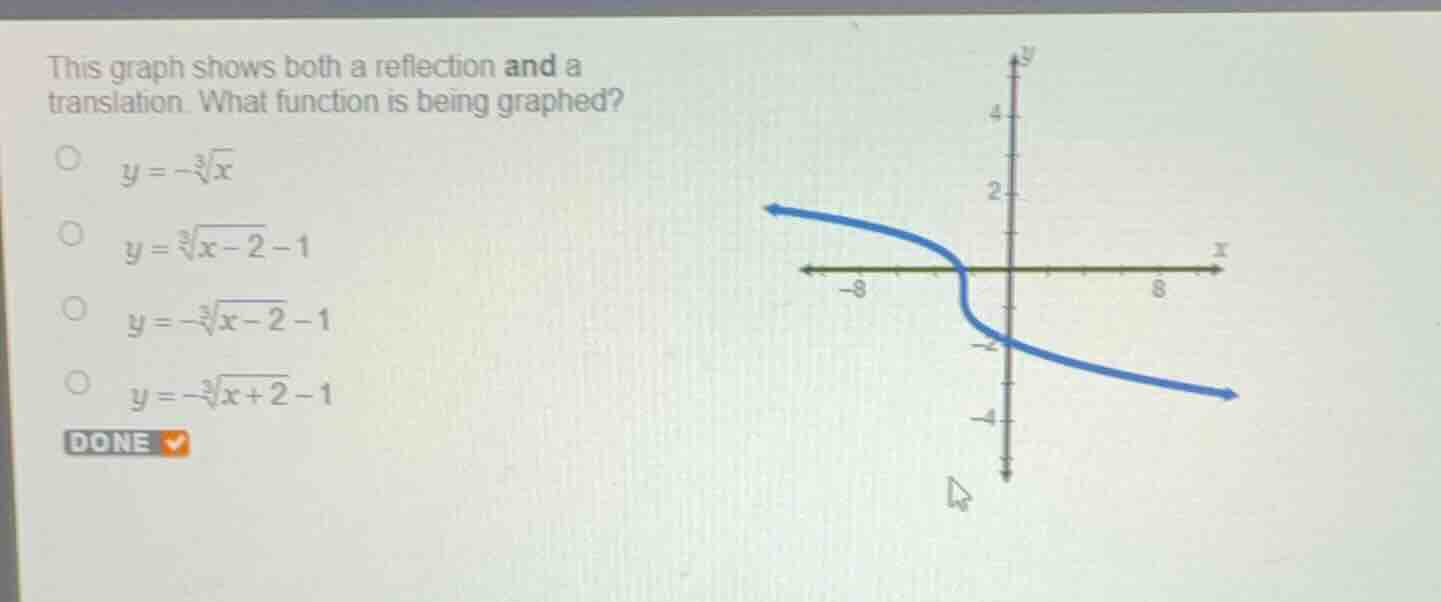
this graph shows both a reflection and a translation. what function is being graphed?
\\(y = -\sqrt3{x}\\)
\\(y = \sqrt3{x - 2} - 1\\)
\\(y = -\sqrt3{x - 2} - 1\\)
\\(y = -\sqrt3{x + 2} - 1\\)
Identify the parent function and inflection point
Using the Cube Root Function knowledge point
The parent function is \(y = \sqrt[3]{x}\), which has its inflection point (center of symmetry) at \((0,0)\). Looking at the given graph, the inflection point has been shifted to \((-2, -1)\).
Determine the translations
Using the Horizontal Translation and Vertical Translation knowledge points
A shift of the inflection point from \((0,0)\) to \((h, k) = (-2, -1)\) corresponds to:
- A horizontal translation left by 2 units: \(x \to x + 2\)
- A vertical translation down by 1 unit: \(y \to y - 1\)
This gives the form:
Determine the reflection
The standard cube root function \(y = \sqrt[3]{x}\) increases from left to right. The graphed function decreases from left to right, which indicates a vertical reflection across the \(x\)-axis. This means the leading coefficient \(a\) must be negative:
Verify with a point on the graph
Using the Function Evaluation knowledge point
Let's test the point \((-2, -1)\):
This matches the inflection point on the graph.
Let's test another clear point from the graph, such as \((-3, 0)\):
The graph clearly passes through \((-3, 0)\), confirming the equation is:

Snap & solve any problem in the app
Get step-by-step solutions on Sovi AI
Photo-based solutions with guided steps
Explore more problems and detailed explanations
- \(y = -\sqrt[3]{x}\)
- \(y = \sqrt[3]{x - 2} - 1\)
- \(y = -\sqrt[3]{x - 2} - 1\)
- \(y = -\sqrt[3]{x + 2} - 1\) (Correct answer)